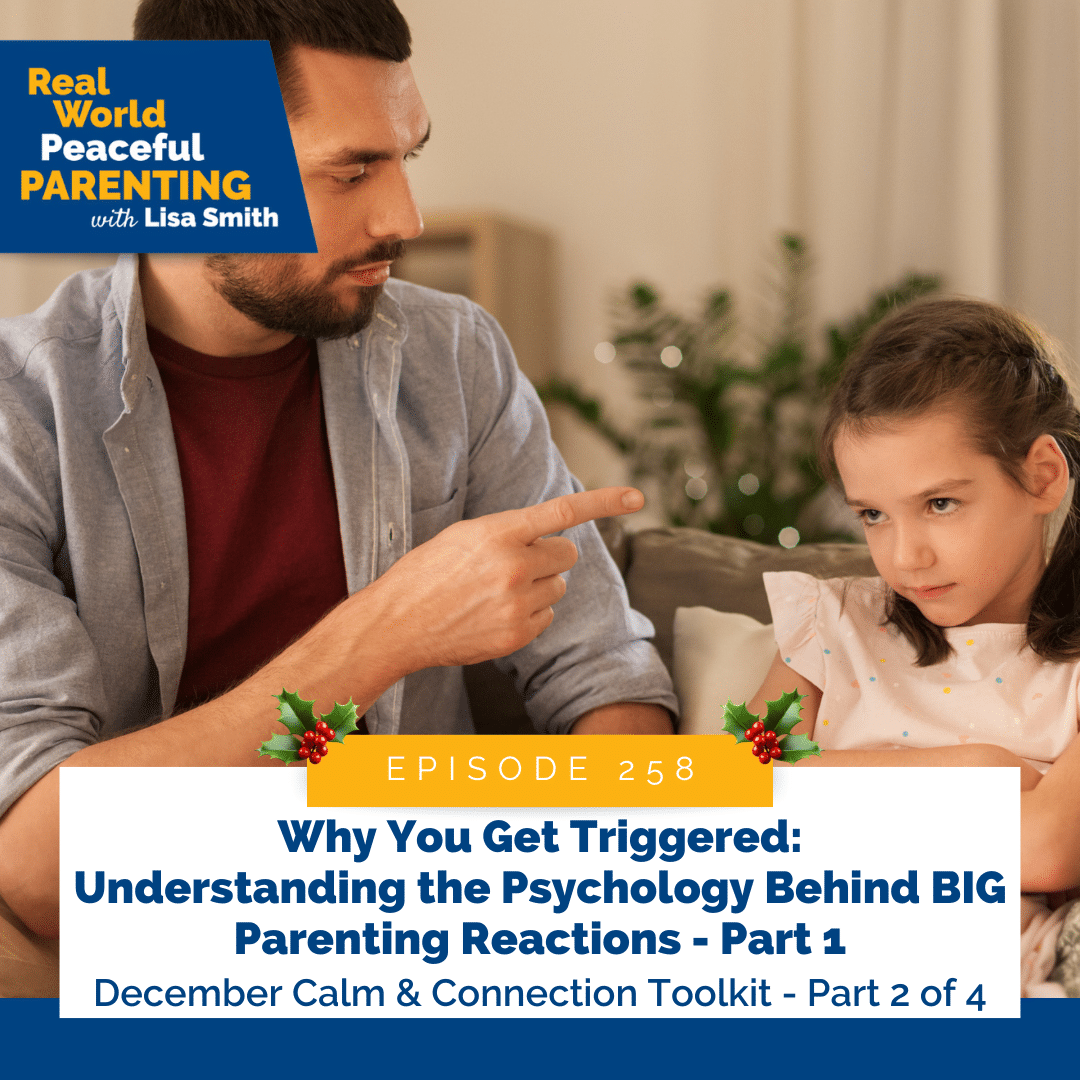
This episode is part of our December Calm & Connection Toolkit – four of our most downloaded episodes designed to help you find peace through the holiday chaos. Whether you’re brand new to this podcast or revisiting these essential tools, this series will help you understand your nervous system, your triggers, and your child’s developing brain during one of the most stressful times of the year.
Ever lost it with your kid and wondered, what just happened? You’re not alone—and you’re not broken. In this episode, Lisa Smith dives deep into the three psychological triggers that hijack every parent: identity, social standing, and fear of loss. She breaks down why our reactions are often more about our own wounds than our child’s behavior—and how awareness can help us respond with calm, connection, and confidence. Whether you have a toddler, a strong-willed 8-year-old, or a moody teenager, this episode will give you actionable tools to pause, recognize your triggers, and parent from your higher brain instead of your fight-or-flight instincts.
Sign up for my free Peaceful Parenting mini-course! You’ll find everything you need to get started on the path to peaceful parenting just waiting for you right here!
What You’ll Learn from this Episode:
- Why “bad behavior” isn’t the real problem—it’s what it triggers in your nervous system.
- How the identity trigger makes us feel like failures when our child’s actions contradict the parent we want to be.
- How the social standing trigger hijacks us with shame, comparison, and fear of judgment from others.
- How the loss trigger creates grief and fear about your child, your relationship, and your family vision.
- How to pause and recognize which trigger is activated in the moment, instead of reacting automatically.
- Practical next steps to start responding from your higher brain, not your reactive one, so your child hears your guidance instead of your frustration.
Listen to the Full Episode:
Featured on the Show:
-
- Click here to sign up for my free Peaceful Parenting mini-course! You’ll find everything you need to continue on the path to peaceful parenting over there just waiting for you.
- Send us an email!
- Message me on Instagram and tell me how you felt after 10 minutes of undivided attention with your child.
- Click here to join The Hive!
- Peace & Quiet: The Crash Course For Peacefully Parenting Your Strong-Willed Kids
Full Episode Transcript:

Welcome to Real World Peaceful Parenting, a podcast for parents that are tired of yelling, threatening, and punishing their kids. Join mom and master certified parent coach Lisa Smith as she gives you actionable step-by-step strategies that’ll help you transform your household from chaos to cooperation.
Let’s dive in.
Welcome, welcome, welcome, welcome to today’s episode. I am so excited to be with you here today. And I’m sure you would agree with this statement and agree with me that December can be a lot, right? The month of December. I know everyone talks about the magic of the holidays. I get it. I love them too. I mean, there’s, the school plays, the caroling, the family parties.
In my case, the kickoff of the college basketball season, the cookie decorating, the matching pajamas on Christmas morning. And yes, those moments can be magical, but you and I both know what else December is. It’s overstimulated. Kids who can’t regulate, sometimes pack schedules that leave zero downtime, sugar fueled meltdowns in target fights over who gets to put the star on the tree.
Kids who won’t put their fancy clothes on for the family photo bedtimes that go completely out the window and you, you’re standing in the middle of all of it. Trying so hard to create those magical moments while managing the chaos. I know I see you. You spend December trying to keep everyone fed, trying to get that one Christmas card photo where everyone’s smiling and looking at the camera at the same time.
I know you’re making sure presents are purchased, wrapped, and mailed on time. You’re addressing Christmas cards maybe at 11:00 PM ’cause that’s the only quiet moment you get. You’re also trying to keep the tree looking perfect, even though your toddler keeps rearranging the ornaments or the cat keeps knocking the class ornaments on the ground.
And it’s also your job to remember teacher gifts for three different teachers, and you’re probably coordinating travel plans or hosting family or navigating complicated family dynamics with in-laws who have opinions about everything. And you’re trying to make memories while also making sure homework still gets done and everyone has clean socks.
Am I right? And somehow, somehow in the midst of all this, it’s your job to stay calm when your child has an absolute meltdown because they broke their candy cane again. I see you and I get it. And if you’re feeling stretched thin right now, and honestly, I dunno how you couldn’t be. If you’ve already yelled way more than you wanted to this month, and if you’re wondering how you’re gonna make it through the next few weeks without completely losing it, well, I’m here for you and I’ve got the solution.
Here’s what I want you to know. You’re not failing. December’s genuinely hard on the nervous system on yours and your kids. So this month I wanted to give you a gift. This month I’ve curated four. Episodes that really hit home on helping you and your kids’ nervous systems stay regulated. And I’m calling it your December Calm and Connection Toolkit, and it’s my gift to you all month long now.
These are the specific tools that will help you find peace through the chaos and stay connected to your kids all month long. I’ve curated four episodes that cover how to stay calm when your kid is melting down. And so are you. Why you get triggered, and the psychology behind your big parenting reactions.
That’s a two part series. And then finally, why your kids can’t listen even when they desperately want to. I pick these episodes to help you understand your nervous system, your triggers, and your kids’ developing brain, and they’re gonna roll nicely into January. I’m going to give you a brand new five week series on setting and holding two limits with a strong spine and soft heart.
But right now let’s focus through December on finding the calm and the connection. Yeah. Awesome. My gift to you. So wherever you are right now, whether you’re driving to another holiday event. Folding laundry while your kids argue in the other room, or hiding in your car in the target parking lot after a particularly hard moment.
I got you. I’m here for you. I’m going to be with you every step of the way in December, and I know you can do this. You can find the calm and connection through these four episodes. So let’s dive in. I wanna start today’s episode with a moment of radical honesty. Have you ever had one of those parenting moments where you completely lost it with your kid and afterwards you think, what just happened to me?
That’s not the parent I want to be. Maybe it was your 4-year-old refusing to put on shoes for the third time this morning, and suddenly you’re yelling at a 4-year-old about responsibility and respect, or your teenager rolled their eyes at you. You found yourself launching into a lecture about gratitude that went on for 20 minutes, or your 8-year-old quote, forgot their homework again, and you’re spiraling into fears about their future success.
If you’re nodding right now, I want you to know something. You’re not broken. You’re not a bad parent. What happened in those moments wasn’t a parenting failure. It was your psychology doing what it’s designed to do. Let me explain. Today we’re gonna dive deep into three psychological triggers that hijack every single parent from time to time, and why understanding them changes everything about how we show up for our kids.
Because here’s what I’ve learned after coaching families for the last 17 years. It’s not really. About our kids’ behavior, it’s about what their behavior triggers in us. So let me explain and paint a picture for you of what’s really happening when our kids quote, push our buttons. Let’s say your 10-year-old just called you stupid during homework time, and in that instance literally faster than you can think.
Your brain registers this as a threat. This is what happens. It’s not a physical threat, but a psychological threat. And your nervous system responds exactly the same way it would if a bear walked into your living room. Your amygdala, that alarm system in your brain sends emergency signals throughout your body, stress hormone floods your system.
Your heart rate spikes and your breathing gets shallow. And here’s the kicker. Your thinking brain. The part that holds your peaceful parenting values literally goes offline to conserve energy for the rest of your body. This isn’t your fault. This is human biology, but here’s what most parenting advice misses.
We’re not just reacting to the behavior itself, the fact that your kid called you stupid. We’re reacting to what the behavior means about us. Our family and our future, and that’s where the three psychological triggers come in based on research in biology, psychology, sociology, and neuroscience. We know there are three main categories of threats that send us into what’s called the ignition phase.
Those moments where we’re parenting from our wounds instead of wisdom. Let me break them down. The first trigger is threats to our identity, and this one cuts deep because it’s about your self-concept as a parent. So we often get triggered when our child’s behavior contradicts the kind of parent you believe yourself to be or desperately want to be.
It feels like a personal attack, especially if you’ve worked hard to break generational cycles or to be different from your own upbringing. Let me give you some examples of what this looks like. With toddlers. It might look like your three-year-old hits their sibling, and your brain immediately goes to, oh my gosh, I’m raising a violent kid.
What kind of parent lets this happen? It’s not really about the hitting, it’s about what you fear. Your three-year-old hitting your sibling is saying about your parenting with school age kids. Your 8-year-old talks back to you in front of your mother-in-law. Suddenly you hear your own mother’s voice in your head.
You let them walk all over you. Your identity is someone who commands respect, feels shattered or threatened. Your 11-year-old shuts you out when you try to connect and it stabs that old wound of, I’m not lovable, even my own child doesn’t want me. And your identity is the parent who has a close relationship with their kids feels threatened.
Your team gets caught cheating on something. A test and you spiral. Where did I go wrong? I thought I was raising a kid with integrity. What does this say about our family values? Here’s what I want you to understand and hear underneath the anger is fear. Fear that you’re failing. Fear that your child will turn out wrong, but even more painfully, fear that your efforts to be better aren’t working, that you’re not enough.
I remember when Malcolm is about eight. He had this phase where he would argue with absolutely everything I said, and I found myself getting so triggered. And when I really took a look at it, what I realized is it wasn’t about the arguing itself, but because I was thinking I’m supposed to be raising a respectful child, what does this constant pushback say about me as a parent?
But here’s the deeper truth, I discovered my trigger wasn’t really about Malcolm’s behavior. It was about my own childhood wound. The fear that I wasn’t worthy of respect and that I didn’t matter enough to be listened to because as a child, no one listened to me. When you can recognize identity triggers, you can pause and ask yourself, is this really about my child’s behavior or is this about my own fear that I’m not good enough?
When I did the work in this area, what I realized is that Malcolm was pushing back respectfully. That I wanted to raise a kid that could find his own voice and that I needed to reframe the pushback, the back and forth that we were doing as him actually listening to me, and that I was worthy of respect and that it was a form of respect.
And once I was able to identify the trigger and reframe what was happening, I wasn’t triggered by the pushback anymore. Yeah. The second trigger is threats to our social standing. And this one hits hard because it’s not just about image, it’s about belonging. This trigger gets activated when your kid has a meltdown in public acts, roots to adults, or seems to be behind compared to peers.
And often it triggers shame and social comparison because many of us were taught that being accepted and loved. When conditioned upon being good or getting it right, people pleasing or looking good in public. So this social standing trigger might show up when your child throws a fit in target and you think people must think I’m a terrible mom, but underneath that is a deeper fear.
If I can’t control my kid, do I belong in the community of good mothers, which you identify with, or you’re attempting to be a good parent? It also shows up when your friend’s child is reading chapter books, while yours still struggles with simple sentences, and you feel that hot flush of inadequacy, not just about your child’s progress, but about your worth as a parent who should be doing more, or maybe this social standing identity shows up at a family gathering when your child refuses to hug grandma and hides behind you.
While your nephew politely shakes hands and asks adults about their jobs, you’re mortified and you’re triggered by the thinking that you must be raising a rude, antisocial kid. Or maybe it shows up when your teenager gets suspended from school, while other parents are posting about their kids honor roll achievements on social media, and you realize that your trigger isn’t just about the suspension, which is no fun and definitely needs some help.
It’s also about whether you still belong in your community of successful families. Here’s what I want you to see. This isn’t just about what people think of our parenting in this social standing trigger. It’s also about belonging, which is core to who we are as humans, as a species, were meant to belong and fit in and be in circles and tribes and communities.
So when our kid acts in a way. It might create judgment for us, it threatens our sense of social safety and our belief that we’re worthy of love and acceptance. I remember we were at a family gathering once, and I think Malcolm is about 11 or 12, and he was being his typical introverted self hiding behind me giving one word answers when relatives tried to talk to him.
Meanwhile, our nephew was confidently gauging with adults. Making eye contact and being that perfect social child, and I felt this wave of shame washed over me, not because there was anything wrong with Malcolm. He just often needs some time to warm up, to feel out the landscape and to get his bearings.
But I remember I was triggered by what I thought my family was thinking. What’s wrong with Malcolm? Why can’t Lisa get him to be more social? Look how much more mature and confident his cousin is. That’s what I thought they were thinking. The social standing trigger makes us parent for the audience instead of parenting for our child.
It makes us prioritize how things look over what our child actually needs. Yeah, I think we’ve all been there. We’ve all been there. And the third trigger is fear of loss. And this one is deeply existential. It’s not about the moment itself, it’s about. What you fear the moment means for the future, yours, your kids, your relationship.
And often this trigger activates grief and not always the full blown kind, but micro griefs, the slow unraveling of the fantasy about how things are supposed to go. And our grief unprocessed often comes out as anger. There are three types of loss that trigger us. The first one is loss of control. Let’s say your child refuses to do homework and you think they’re going to fail in life.
I’m losing any influence I have over their success. Or your toddler won’t stay in bed at night and you’re ready to relax and unwind, and you feel completely powerless to get them to stay in bed and go to sleep, and you get really triggered. They’re getting up and down because you feel a loss of control over being able to make what you want to happen happen.
Your teenager starts making choices you disagree with and you realize you’re losing the control you once had over their world when they were little and you’re really grieving that loss of control. The second category is loss of connection. Your once affectionate nine-year-old pulls away. When you try to hug them and you ache, I’m losing them.
They don’t need me anymore. It’s always gonna be like this. They’re never gonna come back. Or your teenager barely talks to you and every conversation is an argument or an eye roll. You feel like strangers living in the same house and you grieve the closeness you used to have, and it scares you that you’re never gonna have it back.
The third category is loss of family vision. You have an identity or a dream or a vision for what you want your family to be. And in this category it might look like one of your kids struggle in school while the other excels, and you grieve the successful student identity you had for all of your kids.
Maybe your family deals with. Something like anxiety or depression or A DHD, which makes homework a struggle while other families seem carefree and you mourn the easy childhood you wanted your kid to have, or maybe you’ve tried everything and nothing’s working and you grieve the vision of being an amazing parent, and it feels like everything’s hard and nothing’s gonna get better.
That’s a trigger of loss of family vision. There’s a difference between expectation and reality, and it comes out in getting triggered in the reality that’s in front of you that does not match the expectation you had for your family. Let me share another personal story. When Malcolm is about 15, he went through this phase where he barely wanted to spend time with me.
He’d come home, grab a snack, and disappear in his room. Our conversations became the surface level exchanges about homework and chores, and I found myself getting triggered a lot. Not because he was doing anything wrong, he was being a completely normal teenager, but I was grieving the loss of our connection, our close connection.
I missed the little boy who couldn’t wait to tell me everything. Who wanted to cuddle on the couch and who thought I was the most interesting person in the world, and the number one play date? This lost trigger made me try to force connection in ways that actually pushed him further away. I pepper him with questions.
I try to extend conversations. He wanted to end and get hurt when he chose time with friends over me. And here’s the deeper truth about lost triggers. They activate grief, the slow unraveling of fantasies about how parenting was going to go. And when we don’t recognize that grief, it comes out as anger control and desperation.
And we get really triggered and we try to over parent and we try to control things and we project. It wasn’t until I recognized this as a loss trigger that I could step back and see that Malcolm wasn’t rejecting me, and that this is me grieving the natural evolution of our relationship and instead of fighting the change I needed to trust that connection would look different at different stages.
Yeah. If you’ve got a teenager, you know what I’m talking about, most likely. So why am I telling you all this? Well, because awareness is the first step to choice. When you understand these three categories, identity, social, standing, and loss, you can start to recognize what’s really happening in these heated moments with your kids.
On your end, you can begin to become the watcher of your thoughts. While you’re interacting with your kids, you can begin to rewire your brain. Instead of thinking, my child is being disrespectful, you might think, oh, this is triggering my identity fears. I’m seeing this as unnecessary proof of the kind of parent I am that I can’t get my kid to respect me instead of my child is so difficult.
You might recognize. This is hitting my social standing trigger. I’m worrying about what other people think instead of my child doesn’t care about our family. You might see this as this is a loss trigger and I’m grieving this change in our relationship. And that awareness, it changes everything because when you know what you’re really reacting to, you can pause and ask yourself, how do I wanna respond?
From my higher brain, my CEO brain, instead of my triggers. Let me give you a concrete example. Last week, a parent in our hive community shared her 16-year-old came home past curfew, and her first reaction was to wanna ground him for a month, take away his phone and launch into a lecture about responsibility.
Then she paused and recognized her triggers. This is hitting my identity trigger. I’m worried about being a pushover parent. I’m worried about being permissive, and it’s hitting my lost trigger. I’m scared of losing control of him. With that awareness, she was able to respond differently. I was worried about you and I need to understand what happened, and we need to figure out how you’re gonna rebuild trust around curfew, same situation, completely different outcome.
The difference. She was responding from her peaceful parenting values and her CEO brain instead of reacting from her psychological triggers. There was a consequence for being late for curfew, but she was able to present it in a completely different way to her son and in a way that he could hear and understand.
Yeah, okay. Your homework this week is simple but transformational for the next three days. Just notice. When you feel that familiar heat rising because of your child’s behavior, pause and ask yourself, which trigger is this identity, social standing, or loss? Don’t try to change anything yet. Just notice awareness is the first step.
And then homework number two, think back to your last big parenting moment. You know, one of those times you reacted in a way that you later regretted. Can you identify which trigger was activated? What were you really afraid of in that moment? If you go back and do an after action review, this isn’t about shame or judgment, it’s about understanding the psychology beneath our parenting so we can choose differently next time.
And if you’re thinking, Lisa, this makes so much sense. I’m so glad you brought this episode today, but I need help actually applying this. Sorting it all out, figuring it out, and applying this in the moment I hear you, and that is exactly why I created the hive. In the hive, I will teach you how to recognize and regulate your psychological triggers with personal strategies just for you and your family.
We will practice identifying triggers in real time. You will learn tools for staying connected and in your higher brain, even when you’re activated. You will get support from a community of parents who understand exactly what you’re going through, because here’s what I know, every parent, every parent, every parent gets triggered.
But the parents who create the peaceful, connected homes they dream of, they’re the ones who understand their psychology triggers and have tools for working with it instead of against it. So if this feels like you, I want you to run right now. Not walk, but run to the hive coaching.com and come join us. I can’t wait to see you inside and work with you.
Now, next week I’m bringing you part two of this series, A round table conversation with Hive parents sharing their real stories about these triggers and how understanding them transform their parenting, and you’re not gonna wanna miss it. Remember, you’re not broken when you get triggered by your kid’s behavior, you’re human.
And when you understand the psychology behind those big reactions, you can choose to respond from love instead of fear, from wisdom instead of wounds. I want that for you and I want that for your kids. Until next time, I’m wishing you Peaceful parenting.
Thanks for listening to Real World Peaceful Parenting. If you want more info on how you can transform your parenting, visit the peaceful parent.com. See you soon.
Enjoy the Show?
-
-
- Don’t miss an episode, follow the podcast on Spotify, Apple Podcasts, or RSS.
- Leave me a review in Apple Podcasts.
-