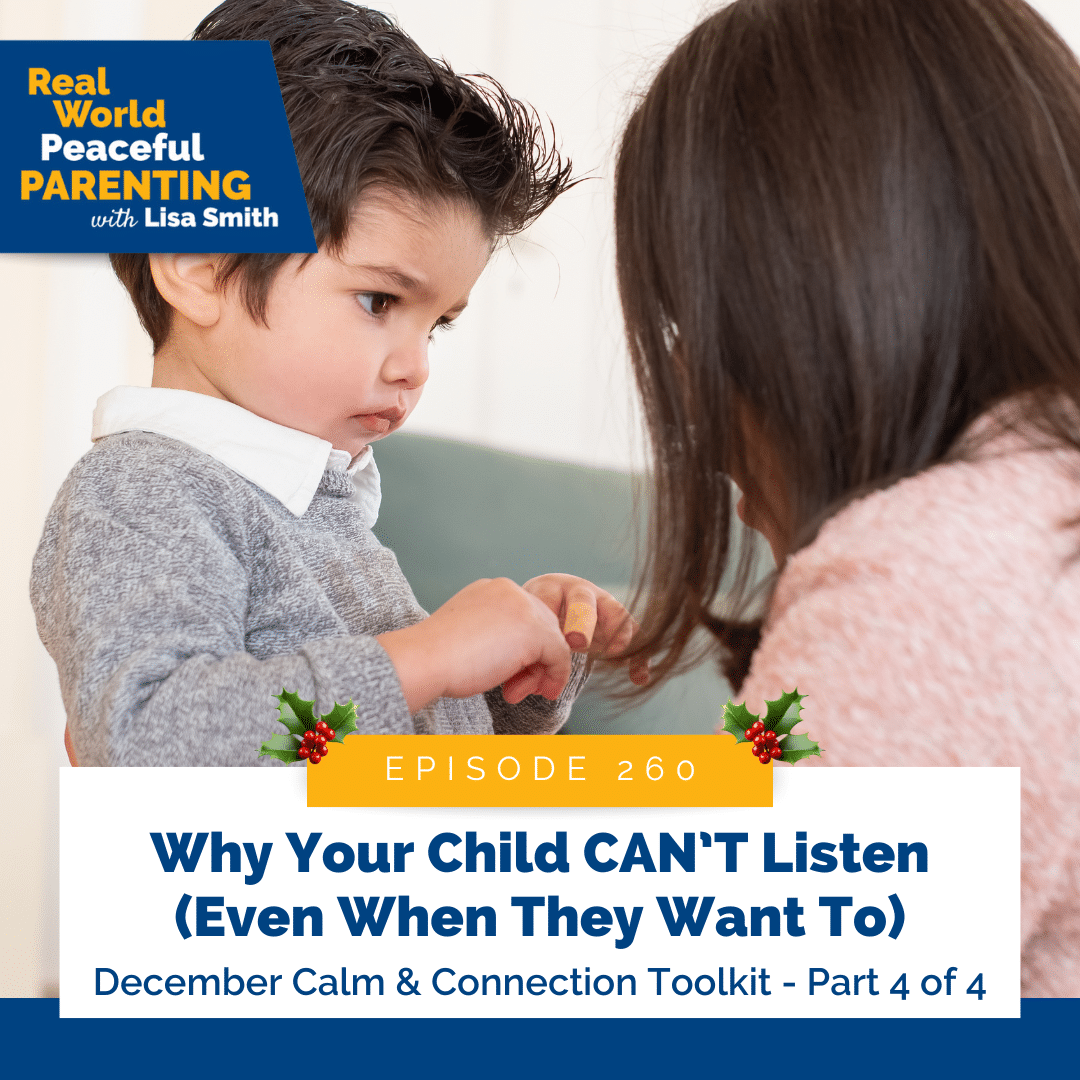
This episode is part of our December Calm & Connection Toolkit – four of our most downloaded episodes designed to help you find peace through the holiday chaos. Whether you’re brand new to this podcast or revisiting these essential tools, this series will help you understand your nervous system, your triggers, and your child’s developing brain during one of the most stressful times of the year.
In this eye-opening episode, Lisa Smith shares a powerful story from her own parenting journey that transformed how she understood children’s behavior. Discover why your child’s dysregulation isn’t defiance but a result of their brain being overwhelmed. Lisa breaks down the science of dysregulation across different ages, explains the key signs to watch for, and provides actionable steps to move from chaos to connection. Whether your toddler is melting down or your teenager is slamming doors, this episode will give you the tools to handle these moments with compassion and confidence.
Sign up for my free Peaceful Parenting mini-course! You’ll find everything you need to get started on the path to peaceful parenting just waiting for you right here!
What You’ll Learn from this Episode:
- Why dysregulation isn’t about defiance but your child’s brain being overwhelmed.
- How to recognize the early signs of dysregulation in toddlers, school-aged kids, and teenagers.
- The critical difference between correcting behavior and connecting with your child.
- Why traditional discipline methods often fail in moments of dysregulation.
- Two key steps to transform your reactions: noticing patterns and tracking your responses.
- How to begin helping your child regulate their emotions for better cooperation and trust.
Listen to the Full Episode:
Featured on the Show:
-
- Click here to sign up for my free Peaceful Parenting mini-course! You’ll find everything you need to continue on the path to peaceful parenting over there just waiting for you.
- Send us an email!
- Message me on Instagram and tell me how you felt after 10 minutes of undivided attention with your child.
- Click here to join The Hive!
- Peace & Quiet: The Crash Course For Peacefully Parenting Your Strong-Willed Kids
Full Episode Transcript:

Welcome to Real World Peaceful Parenting, a podcast for parents that are tired of yelling, threatening, and punishing their kids. Join mom and master certified parent coach Lisa Smith as she gives you actionable step-by-step strategies that’ll help you transform your household from chaos to cooperation.
Let’s dive in.
Welcome, welcome, welcome, welcome to today’s episode. I am so excited to be with you here today. And I’m sure you would agree with this statement and agree with me that December can be a lot, right? The month of December. I know everyone talks about the magic of the holidays. I get it. I love them too. I mean, there’s, the school plays, the caroling, the family parties.
In my case, the kickoff of the college basketball season, the cookie decorating, the matching pajamas on Christmas morning. And yes, those moments can be magical, but you and I both know what else December is. It’s overstimulated. Kids who can’t regulate, sometimes pack schedules that leave zero downtime, sugar fueled meltdowns in target fights over who gets to put the star on the tree.
Kids who won’t put their fancy clothes on for the family photo bedtimes that go completely out the window and you, you’re standing in the middle of all of it. Trying so hard to create those magical moments while managing the chaos. I know I see you. You spend December trying to keep everyone fed, trying to get that one Christmas card photo where everyone’s smiling and looking at the camera at the same time.
I know you’re making sure presents are purchased, wrapped, and mailed on time. You’re addressing Christmas cards maybe at 11:00 PM ’cause that’s the only quiet moment you get. You’re also trying to keep the tree looking perfect, even though your toddler keeps rearranging the ornaments or the cat keeps knocking the class ornaments on the ground.
And it’s also your job to remember teacher gifts for three different teachers, and you’re probably coordinating travel plans or hosting family or navigating complicated family dynamics with in-laws who have opinions about everything. And you’re trying to make memories while also making sure homework still gets done and everyone has clean socks.
Am I right? And somehow, somehow in the midst of all this, it’s your job to stay calm when your child has an absolute meltdown because they broke their candy again. I see you and I get it. And if you’re feeling stretched thin right now, and honestly I don’t know how you couldn’t be. If you’ve already yelled way more than you wanted to this month, and if you’re wondering how you’re gonna make it through the next few weeks without completely losing it, well, I’m here for you and I’ve got the solution.
Here’s what I want you to know. You’re not failing. December’s genuinely hard on the nervous system on yours and your kids. So this month I wanted to give you a gift. This month I’ve curated four. Episodes that really hit home on helping you and your kids’ nervous systems stay regulated. And I’m calling it your December Calm and Connection Toolkit, and it’s my gift to you all month long now.
These are the specific tools that will help you find peace through the chaos and stay connected to your kids all month long. I’ve curated four episodes that cover how to stay calm when your kid is melting down. And so are you. Why you get triggered, and the psychology behind your big parenting reactions.
That’s a two part series. And then finally, why your kids can’t listen even when they desperately want to. I pick these episodes to help you understand your nervous system, your triggers, and your kids’ developing brain, and they’re gonna roll nicely into January. I’m going to give you a brand new five week series on setting and holding two limits with a strong spine and soft heart.
But right now let’s focus through December on finding the calm and the connection. Yeah. Awesome. My gift to you. So wherever you are right now, whether you’re driving to another holiday event. Folding laundry while your kids argue in the other room or hiding in your car in the target parking lot after a particularly hard moment.
I got you. I’m here for you. I’m going to be with you every step of the way in December, and I know you can do this. You can find the calm and connection through these four episodes, so let’s dive in. You know, I love to share stories with you about Malcolm and my transformation from a dominant to a peaceful parent.
I wanna let you know that I have had my own massive transformation. And so it really allows me to relate to the transformation you’re in the process of going through. And also I want you to know that I know you’re doing the best you can, that you’re not alone and that I see you and I’m here for you week in and week out.
And I wanna share with you today one of those moments with Malcolm years ago, ’cause he’s 20 now. That completely changed how I understood. Children’s behavior. He was about seven and we were running late for school, which was pretty regular occurrence in our house back then. Uh, and I kept asking him to put his shoes on and explain why he wasn’t ready.
And I was, you know, hurrying him along. Hurry up, hurry up, hurry. Come on, we gotta go. We gotta go. We’re gonna be late. We can’t be late, we gotta go. And at the same time, I was grilling him with questions and with each question, he seemed to get more and more frozen, and his eyes got wider, his movements got slower, and he finally just had a category five meltdown in the entryway to the garage where he just burst into tears.
Can you relate? Been there hand raised, and in that moment I was frustrated and I was demanding answers and I was demanding compliance and hurry up and get with the program. I wanted him to have an answer to all of my questions as to why he wasn’t moving fast enough while I wanted him to move faster.
And it makes me laugh to even tell you this story today because he was seven. What I didn’t understand then, and I know now, is that his brain literally couldn’t give me what I was asking for. Why you ask? Yeah, Lisa, I’ve been there too. Why can’t my kid do this? Well, have you ever noticed how your child seems to lose all ability to function when they’re upset?
It. Maybe your teenager slams their door and can’t form complete sentences, or your toddler throws themselves on the floor and can’t even tell you what kind of juice they want, or your nine yearold makes that one frustrated sound, you know, the one and suddenly can’t remember how to put their socks on something they’ve done a thousand times.
Here’s what I really want you to understand today. When your child or your kids are dysregulated, when their emotions are overwhelming them, their brain literally cannot perform certain tasks. It’s not that it won’t, it’s that it can’t. Let me say that again, because this is so important for you to hear and absorb and understand and integrate into your parenting.
If you change nothing else, but understand this, it would be a total game changer in your parenting and your relationship with your kids. So let me say that again. When your kid is dysregulated, they cannot perform certain tasks. It’s not defiance, it’s not manipulation, it’s neuroscience. Think about it like this.
Imagine you’re trying to have a conversation while someone is blasting an air horn next to your ear. Imagine that, right? Could you focus? Could you give thoughtful answers? Could you regulate your tone of voice? Of course not. Of course not. That’s what it feels like inside your child’s brain when they’re dysregulated.
Let’s really explore what dysregulation looks like at different ages, because understanding these signs is your first step in transforming these challenging moments. It’s up to you to transform these challenging moments because your dysregulated kid with an underdeveloped brain is not capable in the moment of overcoming the dysregulation.
So for your toddler or preschooler dysregulation might show up as. Throwing themselves on the floor, being unable to choose between two simple options, like which cup they want, becoming completely rigid or floppy when you try to help them, making those big, heartbreaking sobs when they can barely catch their breath, hitting, biting, or throwing things running away when you’re trying to help or being unable to use any of their usual words.
For your school age child, you might see stomping or storming away, being unable to explain what happened in a simple situation, especially with something like sibling fighting saying, I don’t know, to every question getting stuck on one phrase or word, they repeat over and over again, becoming clumsier, uncoordinated with familiar tasks, speaking too loud or too soft, maybe with their fingers in their mouth, having exaggerated reactions to small sensations.
Like the tag in their shirt and being unable to follow simple, familiar routines. Now for your teenager, dysregulation typically appears as slamming doors, being unable to make eye contact, responding with grunts or one word answers, having extreme reactions to seemingly small triggers, being overly dramatic about situations.
Being unable to engage in logical discussion, making impulsive decisions, and or shutting down completely or becoming hyperactive. I want you to pause right now where you are. I want you to pause. Maybe you’re doing dishes or finally getting that moment of peace after bedtime. And I want you to think about your child’s behavior in the last few days.
Ask yourself, when did I see signs of dysregulation? Early on that I might’ve mistaken for defiance or I might’ve just glossed over and what was happening right before those moments of dysregulation. How did I respond? Looking back, what was their brain actually capable of in those moments and what could I do differently?
Next time? Lemme share another story that really brings this home. Last week I was working with a parent inside the hive. Let’s call her Jodi. She was telling me about her six year old’s, massive meltdown over a broken crayon. And Jodi kept asking him, why are you so upset? It’s just a crayon. Can you calm down and explain what’s wrong?
And he was just getting more and more upset. And here’s the thing, in that moment that 6-year-old little boy, Jodi’s son’s brain couldn’t answer questions about his feelings, couldn’t explain his reaction, couldn’t calm down on command. Couldn’t think logically about the situation. Couldn’t apologize for yelling, couldn’t follow directions to grab another crayon.
Couldn’t listen to logic or reason, couldn’t process consequences. Couldn’t remember past solutions because his brain was in survival mode. When our kids’ brains are in survival mode, they need something very different than what we usually offer when they’re not in survival mode. Now, here’s where it gets really interesting, real world, peaceful parent and hopeful.
Let’s talk about what a regulated brain can do, because this is where the magic happens. When your kid is regulated, when they feel safe and calm, their brain can listen and process information, problem solve creatively, show empathy towards others, control their impulses, express their needs clearly. Learn from their mistakes.
Repair relationships. Consider different perspectives. Remember past solutions. Follow multi-step directions. Engage in meaningful conversation. Make thoughtful choices, and connect actions with consequences. Yeah, but here’s the key. Their brains can only access these abilities. When they’re regulated, and this is why so many of our kids get stuck, and when we’re talking to them while they’re dysregulated, it actually only triggers a bigger storm.
And to them it sounds like
it’s too much. It’s like that air horn is going off in their ear. Only were the air horn when they’re dysregulated. Then to make it worse when we try to teach reason or discipline, when our child is dysregulated and it doesn’t work, then we get frustrated. Let me share what this looked like with Malcolm.
Once I understood this concept, I day with the shoes looked very different. Instead of demanding explanations in compliance, I learned to notice the signs of dysregulation Instead of reacting, I learned to pause. And respond. I learned to pause and be present to prioritize, helping them feel safe and calm before trying to solve the practical problem of getting to school.
And you know what? The more I focused on regulation first, the easier everything else became. The battles got shorter. Over time, the connection got stronger, the learning got deeper. Most importantly, Malcolm learned that it was safe to have big feelings in our home. And that he wouldn’t be punished or shamed for losing control sometimes.
And ironically, we got to school on time without me feeling guilt and like a bad parent as I drove away. Yeah, I want that for you too, and I know it’s possible. So I have two simple powerful homework assignments for you this week. Number one, I want you to notice and name the dysregulation. Start observing when your child moves from regulated to dysregulated.
What are their unique signs? What are their tells? What does it look like in their body? How does their voice change? What behaviors signal that they’re moving from regulated to dysregulated? What situations tend to trigger dysregulation? And number two, I want you to track your own responses. What are you doing when your child is dysregulated?
Are you being the air horn? Are you being the safe, comforting place? What questions do you automatically ask? That’s a good one. What expectations do you hold onto? How does your body respond to their dysregulation? What triggers your own dysregulation? So the job this week is just notice these patterns.
Don’t try to change anything yet. Awareness is the first step towards transformation. Just notice the patterns coming up. This will help you transition from reacting when they’re storming or dysregulated to pause and respond. Now, as I share this information with you today and get the light bulb to turn on, I can almost hear some of you thinking, okay, Lisa, I get it.
I get it. Regulation before correction. I get it, but how? How do I actually help my child regulate? What do I do in these heated moments when my toddler is throwing everything in sight? How do I stay calm when my teenager is slamming doors? What are the actual steps to move from chaos to calm? Well, I’m so glad you’re wondering about this and wanting help because these are the exact questions I’m going to answer in my upcoming free challenge from yelling to connection, the January reset.
This is a three day journey specifically designed for busy parents who want real solutions that work in the real world. Here’s exactly what you’re gonna learn on day one. Tuesday, January 27th, we’re gonna dive deep into when your child storms, what’s really happening. You’ll discover the hidden reasons behind those big reactions, why your strong-willed kid pushes back, and why traditional parenting approaches might be making things worse on day two.
Thursday, January 29th, I’m gonna give you your new parenting toolbox. Where you’ll learn simple strategies that work even with the most stubborn or strong-willed kid, how to get cooperation without threats or punishments. Yes, it’s possible. And building connection with your kids while maintaining your rules, boundaries, or consequences, which is also possible, I promise.
And then on day three, Saturday, February 1st, I’ll share staying cool when they’re hot. I’m gonna give you your step-by-step guide to staying calm. I’m gonna help you break through the yelling cycle, even when you’re triggered, and I’m gonna help you create your personal reset button. Each of these three days is gonna include 90 minutes of live teaching and coaching with me.
Yes, you heard that right? Live because I know that understanding the concept is one thing, but applying it in real life is where the magic happens. Think about it, three months from now, you could still be stuck in the same cycles of dysregulation. Still feeling frustrated and helpless when your child storms, or you could have a clear understanding of what’s happening in those moments and exactly what to do about it.
The choice is yours, but you need to act now. So I want you to head over to the peaceful parent.com/challenge to save your seat. And remember, this challenge is completely free, but you must register to join us. I can’t wait to see you there. As we wrap up today, I want you to remember that your child’s dysregulation isn’t about defiance.
It’s about their brain’s capability. In that moment, when we understand this deeply, we can shift from frustration to compassion, from demanding to supporting. And from correcting to connecting. Yeah. Awesome. Alright, until next time, I’m wishing you Peaceful Parenting. Thanks for listening to Real World Peaceful Parenting.
If you want more info on how you can transform your parenting, visit the peaceful parent.com. See you soon.
Enjoy the Show?
-
-
- Don’t miss an episode, follow the podcast on Spotify, Apple Podcasts, or RSS.
- Leave me a review in Apple Podcasts.
-