Last week, Lisa introduced co-regulation. This week, she goes deeper.
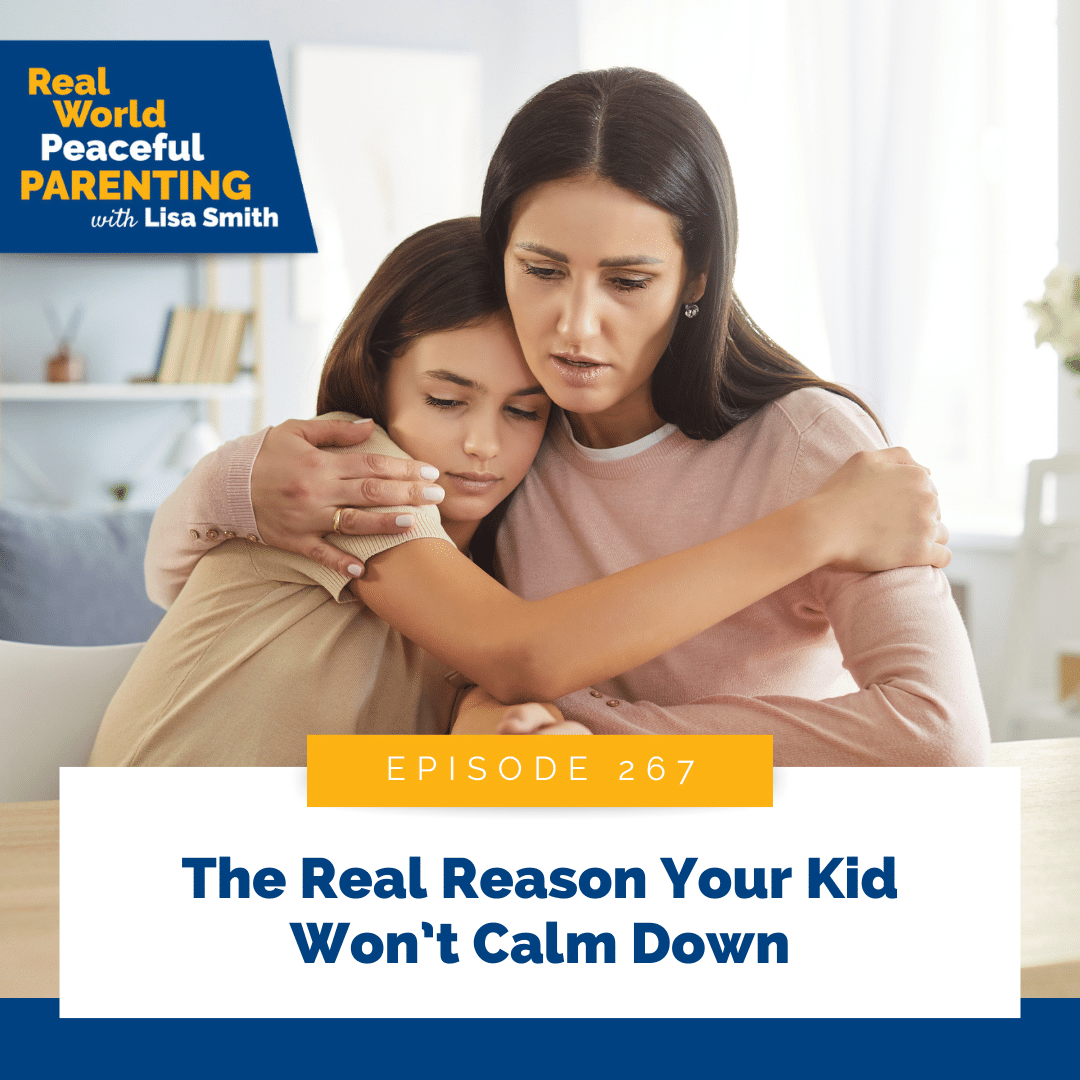
In this episode, Lisa explains the neuroscience behind why co-regulation works and what is actually happening inside your kid’s nervous system when you stay calm during their meltdown. From “borrowed calm” to repair to attunement, you’ll learn how your regulated presence literally builds your kid’s brain.
If you’ve ever wondered why your kid’s meltdowns seem to spiral no matter what you say or do, this episode will change how you see regulation forever.
Sign up for my free Peaceful Parenting mini-course! You’ll find everything you need to get started on the path to peaceful parenting just waiting for you right here!
What You’ll Learn from this Episode:
- What “borrowed calm” is and how your kid’s nervous system syncs with yours during emotional storms
- Why regulation is social before it becomes internal, and how kids learn self-regulation through safe relationships
- How repair after you lose your cool actually strengthens emotional development, not weakens it
- What attunement means and how it builds emotional intelligence without lectures or long conversations
- Why safety increases better behavior, and how regulation creates the conditions for growth
- How to reframe meltdowns as brain-building opportunities instead of parenting failures
Listen to the Full Episode:
Featured on the Show:
-
- Click here to sign up for my free Peaceful Parenting mini-course! You’ll find everything you need to continue on the path to peaceful parenting over there just waiting for you.
- Send us an email!
- Message me on Instagram and tell me how you felt after 10 minutes of undivided attention with your child.
- Click here to join The Hive!
- Peace & Quiet: The Crash Course For Peacefully Parenting Your Strong-Willed Kids
Full Episode Transcript:

Welcome to Real World Peaceful Parenting, a podcast for parents that are tired of yelling, threatening, and punishing their kids. Join mom and master certified parent coach Lisa Smith as she gives you actionable step-by-step strategies that’ll help you transform your household from chaos to cooperation.
Let’s dive in.
Welcome, welcome, welcome, welcome to today’s episode. I am so grateful to be with you here today. We just crossed the five year anniversary of Real World Peaceful Parenting. I hope you’re enjoying these episodes as much as I am, and I’m so grateful to be able to bring you this content week to week. So thank you so much for listening and learning and growing in your Peaceful Parenting with me.
I’m honored to be on this journey with you. Last week we talked about co-regulation. We talked about what it is, why it matters, and I gave you a really simple practice to try with your kids, and I have a feeling some of you tried it, I’m guessing maybe it felt a little awkward if you’ve never done it before.
Maybe it felt too simple. Maybe you’re sitting there thinking, okay, Lisa, I need to understand why this actually works well. Today’s episode is going to answer that question because here’s the thing. Co-regulation, and I alluded to this a little bit last week, isn’t just something we do for our kids. It’s something that literally builds their brain and ours for that matter.
It’s the mechanism, the actual biological process through which your kid learns to eventually regulate themselves. And this might sound really big, but stay with me because I promise by the end of this episode, you’re going to understand exactly what’s happening inside your kid’s nervous system when you show up, calm in the middle of their storm, and you’re going to have real stories from real parents.
Parents just like you that show you what this looks like. Messy real life moments. Not perfect moments. Real moments. Yeah. All right. Let’s dive in. Let me start with something that’s going to change the way you think about every single meltdown from here on out. When your kid is falling apart at any age, I’m talking two to 22, when they’re falling apart, when they’re screaming, crying.
Yelling, eye rolling, running away from you, fighting with their sibling when they’re completely out of control. Your instinct might be to jump in and fix it or even to panic a little yourself. But what if I told you the most powerful thing you can do in that moment is to simply stay calm and regulated, not fix, not lecture, not even say the perfect thing.
Just stay calm and regulated because here’s what’s happening inside your child’s body. When you do that, and this is the part that blew my mind when I first learned it. Your kids’ body and actually nervous system actually starts to follow yours. This is proven scientifically. It’s not something I made up.
When you show up, calm and regulated, even a little bit, even mpa, just a little bit, and your heart rate slows down or is slow, their heart rate begins to slow down. Their breathing starts to sink up with yours. Their brain, which is in full alarm mode, begins to use your calm as a bridge back to safety.
Neuroscientists call this Borrowed calm. Borrowed calm, and it’s one of the most beautiful things about how our nervous systems are designed to work together. I really want you to hear this. Their heart rate starts to slow down. Their breathing starts to sync with yours and their brain, which could be in full alarm mode, begins to use your regulation.
As a scaffold to find its way back to calm. This isn’t even something you have to make happen. It happens automatically because it’s biology. It’s how nervous systems are designed to work together. And here’s what this means for you as a parent. Every single time you stay calm during your kids’ storms, you are literally building their calm muscles in their brain.
You’re not just getting ’em through the moment you’re teaching their nervous system. What safety feels like, you’re creating the neural pathways that will eventually allow them to do this on their own. Lemme tell you about a mom in the hive named Jessica. Jessica’s daughter Lily was having one of those meltdowns that just stops you in your tracks, breaks your heart.
Lily, who’s 13 was screaming, throwing things, slamming her fists on the floor. Her body was completely outta control. Jessica told me, I heard her doing this in her bedroom. I was in the kitchen. As I was walking to the bedroom, Jessica said my heart started racing and I was terrified. And then she said, I heard your voice, Lisa, and you told me.
I’m trained for this. I didn’t even have to think. I moved into her bedroom, calm and regulated. Jessica stayed close to her daughter. She made sure her breathing was slow. She didn’t fix, she didn’t lecture, she didn’t threaten. She just worked on staying calm, her body and her mind, and offering that calm to Lily.
Slowly, Lily’s body began to mimic Jessica’s, and it began to regulate. Now, here’s where it gets really important. Most parents would look at that moment and think, I stayed calm, and eventually she calmed down. That’s not what actually happened. Biologically. What happened is that Lily’s nervous system borrowed Jessica’s calm, their heart rate started matching.
Their breathing synchronized. Lily’s brain used Jessica’s regulation as a scaffold. This isn’t permissive parenting. This isn’t letting her get away with anything. This is biology borrowed calm, builds the brain. Every time Jessica shows up like that. Frankly, anytime any of us show up like that with our kids, we are literally laying bricks.
In our child’s ability to eventually do this themselves. I see this all the time in my 21-year-old and his ability to self-regulate when things get tough. Okay, so we just talked about what happens when a parent stays calm in that moment. But what about when the parent can’t or doesn’t? What about the times when we lose it and we yell and we get angry and say something we regret?
Does that mean bricks come down from the wall? Does that mean the kid unlearn? Does that mean the whole thing falls apart? No, it absolutely does not. And this is really important that you hear this because this might surprise you. But again, science shows us the kids don’t learn emotional regulation because we’re perfect and calm all the time.
First of all, no human is perfect and calm all the time. They learn it because they experience what it looks like when someone fights their way back. Let me say that again, because it’s important. They learn it. Our kids learn emotional regulation because they see regulation and they see what repair looks like when there’s dysregulation.
I have a story from the Hive that really shows this. A mom named Emma shared this with me one morning, Emma woke up. She was sick. She was already dysregulated. Before her feet even hit the floor, her throat hurt. She probably had a fever. She got a sleepless night. She was already on edge and already running on empty.
Her daughter Maya pushed a limit hard and Emma got angry in the car, and afterwards Emma cried the entire drive home. She felt terrible. She realized that instead of the calm streaks she had going. With her daughter in the car because her daughter was often dysregulated on the way to school, and Emma had been doing a great job of offering her daughter regulation in the car and allowing her to borrow it on the drive to school.
But this morning, Emma got angry and she lost it. And again, she cried the entire drive home. She felt terrible. She walked in the house. And she stopped. She reflected, she remembered what we talk about inside the hive repair after dysregulation. So she sent a text to her daughter, knowing her daughter would see it at lunchtime, and she said, I’m sorry for how I showed up.
That’s it, a simple, honest repair, and here’s why that moment mattered so much. Maya didn’t just learn, the mom made a mistake. She learned that big emotions don’t break connection. She learned that hard moments don’t mean abandonment. She learned that adults can lose it and repair, and the relationship survives.
That’s what regulation looks like in real time. It’s not perfect, calm 24 7. It’s the willingness to come back, and here’s the thing, every time your kid watches you do that, every time they experience that repair, their nervous system is learning. This relationship is safe. Even when things get hard. This is safe.
Regulation is social before it’s internal. Your kid doesn’t learn it alone in a vacuum. They learn it inside A safe relationship inside the messy, imperfect, beautiful back and forth of being in a safe family together. So we’ve talked about borrowed calm, we’ve talked about repair today, and now I wanna talk about something that many of us have never even considered.
Because here’s what I know. When you co-regulate over and over and over again with your kids at any age, you’re not just calming them down. You’re allowing them to learn and understand what’s happening inside themselves. And this is called attunement. And it’s one of the most powerful things or byproducts about co-regulation that I don’t think gets talked about enough.
Here’s what I mean. A mom in the hive, let’s call her, Jen, told me about a moment with her son Oliver. Oliver was in the middle of one of those argumentative spirals. And if you know, you know, they were the kind that just kept going on and on and on. Instead of engaging in the argument, instead of trying to reason with Oliver or lecture him or win or be dominant and shut it down, Jen Choses in this one moment to just stay calm and quiet.
Now we’re not talking about cold and distant, just calm and present, but making the decision to not feed the fire or engage in the power struggle and. Oliver changed, not instantly, but noticeably. He started reflecting. He apologized. He said, what can I do now? And here’s the part that really gets me in those quiet moments.
Oliver wasn’t just regulating, his brain was doing something incredible. It was mapping what we call mapping. It was noticing. He was able to notice that the feeling I’m feeling is frustration and the urge I’m having is impulse. And this emotion can rise and fall. It can come and go without everything blowing up.
And what’s happening here is Oliver wasn’t just learning to calm and regulate. He was learning to understand what was happening inside of him, which. Was building his emotional intelligence, not through a lecture about his feelings, but through the experience of being with a regulated person during his big moments.
And that’s attunement. It doesn’t happen when we’re yelling. It doesn’t happen when we’re trying to fix or control or reason while our kid is dysregulated, because the truth is if we’re lecturing or fixing or trying to control. Or help our kids see our point while they’re dysregulated, they can’t hear it anyway.
Attunement happens through presence. It’s every time you stay regulated with your kid during a hard emotional moment. You’re not just helping them calm by borrowing your regulation, you’re teaching them what their feelings mean. You’re showing them that these big emotions are survivable. You’re showing them that they can be comfortable being uncomfortable.
You’re building the foundation of emotional intelligence that they will carry with them for the rest of their life. And that my real world, peaceful parent, that’s everything. Now, let’s address something directly that some of you might be thinking, Lisa, this sounds great, but aren’t we just letting them get away with it?
Aren’t we just basically. Telling them there are no consequences. No, absolutely not. And I wanna be really clear about this. Safety is not the absence of limits. Safety is the presence of regulation. You can have limits in place and co-regulate at the same time. We literally talked about this last week, right?
I told you that. I said no to the candy bar. Malcolm stuck his tongue out at me. I was embarrassed. And angry and I offered him and myself regulation and we talked about it later. Limits and co-regulation are not opposites, and in fact, they work together. Jessica, the mom I told you about earlier with Lily, she shared something with me after one of those really intense meltdowns.
She said, I didn’t even have to think I knew what to do. She wasn’t controlling Lily’s behavior. She was stabilizing Lily’s nervous system and once safety came online, behavior follows every single time. Here’s what I really need you to hear. Kids who struggle with regulation or kids who are dysregulated are not failing.
They’re not being defiant just to drive you crazy. What they are doing is they’re signaling that they need support. Not pressure, not demands, not dominance support. And here’s the light bulb moment I want you to have. When safety increases, behavior changes, I’d love for every one of us to write this on a post-it note and put it in our car and on our fridge and our bathroom mirror.
When safety increases, behavior changes, not because we force it. Not because we threaten it, but because the nervous system finally feels safe enough to learn. That is what co-regulation is doing. Every single time you show up regulated in your child’s storm, even imperfectly, you are increasing their sense of safety.
You are giving their brain the environment it needs to build the very skills. You’re hoping they’ll develop. You are not letting them get away with anything. You’re giving them the one thing they need most in order to grow regulation and safety. Okay, with that in mind, here’s your homework this week, and this one builds on what I gave you last week.
So if you did that noticing practice, you’re already ahead of the game this week. Next time your kid has a big emotional moment. You managed to even stay a little bit calm. I want you to say to yourself in that moment, I’m building their brain right now. That’s it. Just that one sentence because it’s true and it’s going to change how you see what they’re doing in those next moments.
You’re not just surviving the meltdown, you’re not just dealing with it. You’re actively, biologically. Building your kids’ capacity to regulate. Yeah. Awesome. Okay, let’s bring it all home. This week we went deep into why co-regulation works, and here’s what I want you to walk away with first, borrowed calm builds the brain.
When you stay regulated during your kid storm, their nervous system literally sinks with yours. Their heart rate slows, their breathing matches your own. You are giving their brain the scaffold It needs to eventually learn to do this on its own. Second regulation is social. Before it’s internal. Your child doesn’t learn to regulate in isolation.
They learn it inside a safe relationship through repeated experiences of being soothed, of watching repair and of feeling safe, even when things are hard. Third attunement teaches meaning when you are calm and present with your kids during a big emotional moment, you’re not just helping them calm down.
You’re teaching them to understand what’s happening inside themselves. You’re building emotional intelligence. And fourth, safety is not the absence of limits, it’s the presence of regulation. Kids who are struggling aren’t failing. They’re signaling that they need support. And when that safety increases, behavior changes, every time, my friend, I know this work can feel invisible sometimes you’re not seeing a trophy.
At the end of the day, you’re not getting a gold star for staying calm during the meltdown, and no one’s giving you a standing ovation, but I promise you, something profound is happening. Every time you show up for your kid in their hard moments, even when it’s messy, even when you have to repair afterwards, you are building something inside them that will last their entire life.
You are teaching them that emotions are survivable. You are teaching them that they are safe. You are teaching them that they matter. It’s the legacy you’re building one regulated moment at a time. I know you can do this, and I’ll be with you every step of the way. Until next time, I’m wishing you Peaceful parenting.
Thanks for listening to Real World Peaceful Parenting. If you want more info on how you can transform your parenting, visit the peaceful parent.com. See you soon.
Enjoy the Show?
-
-
- Don’t miss an episode, follow the podcast on Spotify, Apple Podcasts, or RSS.
- Leave me a review in Apple Podcasts.
-