Last week we talked about the gap and the gain. This week we go deeper.
There is one emotion that keeps parents stuck in the gap, and that emotion is shame.
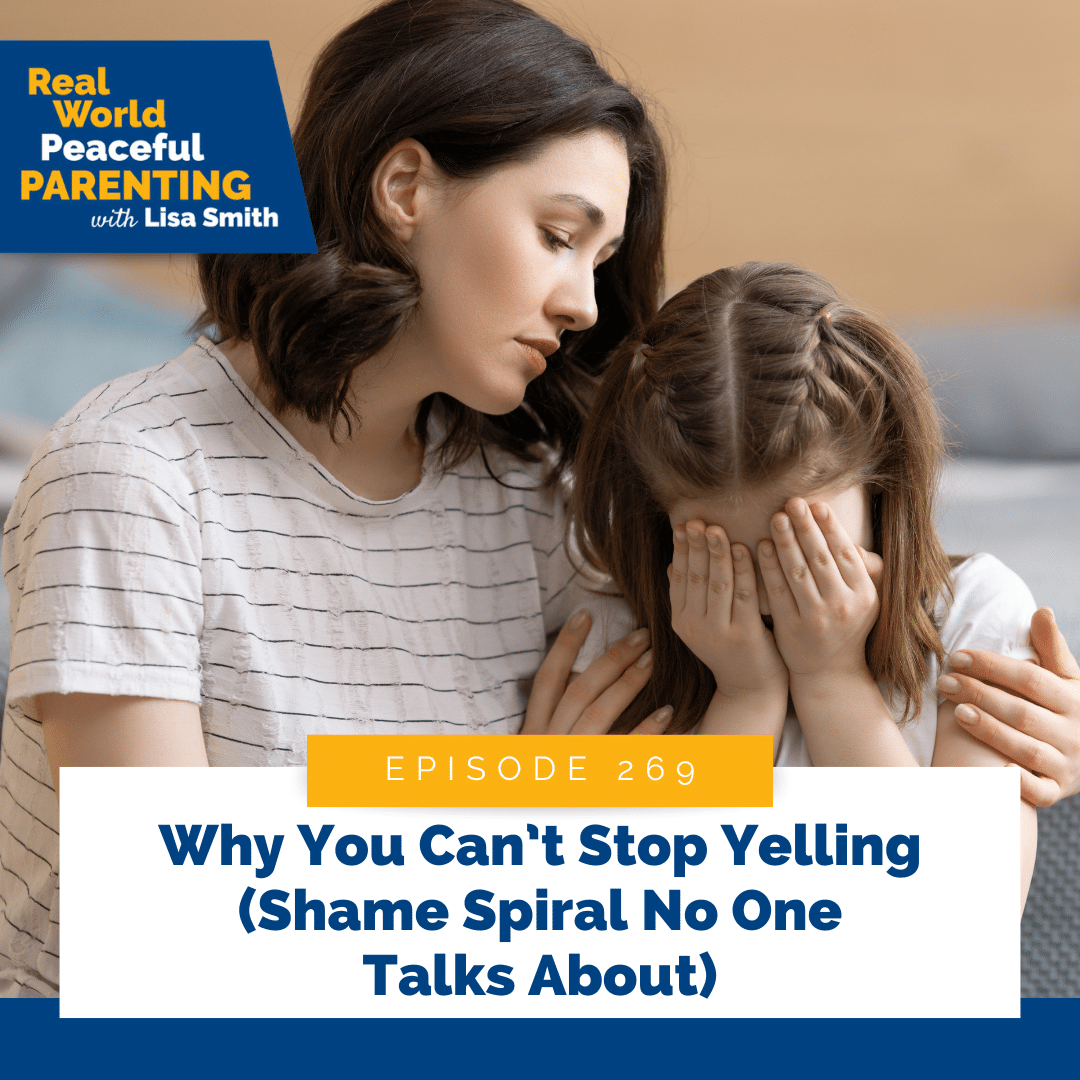
In this episode, Lisa breaks down the difference between guilt and shame, explains what shame does to your brain, and shows how it quietly gets passed down to your kids. Most importantly, she gives you practical tools to interrupt shame so you can repair faster, grow stronger, and stop handing this pattern to the next generation.
This is a powerful, honest conversation that will change the way you see yourself and your kids’ mistakes.
Sign up for my free Peaceful Parenting mini-course! You’ll find everything you need to get started on the path to peaceful parenting just waiting for you right here!
What You’ll Learn from this Episode:
- The critical difference between guilt and shame and why confusing the two keeps you stuck
- What happens in your brain when shame takes over and why it shuts down growth
- How the shame spiral fuels more yelling, shutdown, defensiveness, and regret
- The sneaky ways parental shame gets passed down to kids at every age
- Why kids internalize shame as “I am bad” instead of “I made a mistake”
- Simple, practical steps to interrupt shame and build resilience in yourself and your kid
Listen to the Full Episode:
Featured on the Show:
-
- Click here to sign up for my free Peaceful Parenting mini-course! You’ll find everything you need to continue on the path to peaceful parenting over there just waiting for you.
- Send us an email!
- Message me on Instagram and tell me how you felt after 10 minutes of undivided attention with your child.
- Click here to join The Hive!
- Peace & Quiet: The Crash Course For Peacefully Parenting Your Strong-Willed Kids
Full Episode Transcript:

Welcome to Real World Peaceful Parenting, a podcast for parents that are tired of yelling, threatening, and punishing their kids. Join mom and master certified parent coach Lisa Smith as she gives you actionable step-by-step strategies that’ll help you transform your household from chaos to cooperation.
Let’s dive in.
Welcome, welcome, welcome, welcome to today’s episode. I am so pleased. To be with you here today. Last week you and I talked about the gap and the gain. We talked about how most parents are measuring themselves against an impossible, ideal target or goal and how that keeps you stuck and always feeling like you’re failing.
And I got messages from so many of you saying, Lisa, I feel that I’m living in the gap and I see it now. Yeah. So today I wanna take us the layer deeper because there’s an emotion that lives in the gap and I wanna call it out. It’s an emotion that keeps you stuck there. It’s an emotion that’s probably running more of your parenting than you realize, and that emotion is shame.
Now, I know that’s a heavy word and some of you might be thinking, I don’t have shame. That’s not me. Stay with me because shame doesn’t always show up the way we think it does. Okay, so here’s my question. Have you ever snapped at your kid? Maybe you yelled, maybe you said something harsh, and then that voice in your head kicks in afterwards.
You know the one that says, what kind of parents am I? I’m ruining my kids. Other parents don’t do this. What’s wrong with me? Well, if some or all of that dialogue has gone through your head at one time in your parenting career that my friend is shame, or maybe your kid has a meltdown in public and you feel your face get really hot.
It feels like everyone’s watching you and you feel this crushing sense of, I’m failing. Everyone can see that I’m failing. Okay. That’s shame too. And today we’re going to talk about what shame is, why it shows up in our parenting, and most importantly, how to interrupt it before it gets passed on to our kids.
Because here’s the thing, shame doesn’t just hurt you. When we feel a lot of shame, it teaches our kids to feel shame about themselves, not about you, but themselves. And once you see that how this happens. You can’t unsee it. So let’s dive in. So first things first, we need to talk about what shame actually is because many people confuse shame with guilt, and they’re not the same thing at all.
Guilt says, I did something bad. Shame says I am bad. Guilt is about your behavior. Shame is about your identity. Okay, so let me give you an example. Let’s say you yell at your kid, you lose your temper, and you say something you wish you could take back. Guilt. Sounds like I yelled and that wasn’t okay, and I take responsibility for my behavior and I need to repair and do better next time.
Okay, that’s guilt. Now here’s what shame sounds like. I am a terrible parent. I am damaging my kids. Kid and there is something wrong with me. Do you hear the difference? Guilt motivates you to change. It says you made a mistake. You can learn from this and you can do better. Shame on the other hand, paralyzes you.
Shame says you are the mistake. You’re broken and you can’t be fixed. And here’s why shame is so powerful. Shame thrives in secrecy. It thrives in the dark. As long as you keep shame hidden, as long as you don’t name it and don’t acknowledge it. Shame has complete control over you. But research shows us, including the work from Brene Brown, that the moment you bring shame into light, the moment you say out loud, oh, that’s shame talking.
It begins to lose its power. Shame can’t survive scrutiny. It can only survive in the dark while hiding. And here’s where this connects back to last week’s episode. On the gap in the game, when you’re stuck in the gap, when you’re measuring yourself against that impossible, ideal parent who never yells, who always has the right words, who handles every situation with perfect calm, shame is the feeling that keeps you there.
Because every time you fall short of that ideal of that target, of that goal, shame whispers. See, you’re not good enough and you never will be. Now, here’s what’s really happening in your brain when shame shows up, and this is really important. When you feel shame, your nervous system interprets it as a threat.
As though it is the equivalent of someone holding a gun to your head or a lion chasing you through the Serengeti and your emotional brain, your middle brain, the part that processes threat and protection kicks into high gear. And when that happens, your higher brain, your prefrontal cortex, where you’re calm and logical and can connect dots and stay regulated, that higher brain goes offline.
Your middle brain and your higher brain cannot be working at the same time. It’s an either or. Sound familiar? That’s the exact same thing that happens when you’re stuck in the gap that we talked about last week. Shame shuts down the part of your brain that can actually reflect, learn, and make good choices, so you’re not just feeling bad when you’re in your middle brain.
You’re literally stuck. Shame prevents your brain from accessing the tools it needs to change. And that my real world, peaceful parent is why shame is so dangerous. It doesn’t just make you feel terrible. It actually prevents you from growing. So lemme tell you about a moment I have with Malcolm that really showed me this.
He was about eight and we were having one of those mornings, you know, the kind where everything is going wrong. We got up late. He’s dragging his feet, getting ready for school. I’m running late. He didn’t like breakfast. My coffee’s cold. So on this particular moment, I lose it. I yell. I said things I didn’t mean.
And the look on his face, it broke me. And in that moment, shame hit me like a wave. My shame said to me, my God, Lisa, you’re a parent coach. You teach us stuff and look at you. You’re yelling at your kid. You’re a fraud and you’re failing him. That was the conversation. That was the voice. Shame was screaming at the top of his lungs in my head, and here’s what shame did to me in that moment.
It made me shut down. I couldn’t repair, I couldn’t even look at Malcolm because if I looked at him, I’d have to face what I’d done, and my shame was too big. It wasn’t until later after I’d regulated and after the shame had loosens it, its grip that I could go back and say, Hey, Malcolm, I’m sorry that was not okay.
It was not okay, and I own my behavior and I will do better next time. And honest to goodness, I realized in that moment how I never wanted shame to have a grip on me again, ever. I felt guilty plenty of times, but I’ve not felt shame since because I refuse to let it have a grip on me. The difference between shame and guilt is guilt would’ve let me repair right away.
Shame kept me stuck. So now that you know what shame is, let’s talk about how it shows up in our day-to-day parenting, because shame is sneaky and it doesn’t always announce itself. Here’s how the shame spiral works. You yell at your kid or you snap at them, or you handle a situation in a way that doesn’t feel good, and immediately the voice kicks in.
I should know better by now. I’ve been working on this. Why am I still doing this? Sound familiar? That’s the gap and underneath the gap is shame. Other parents don’t struggle. What is wrong with me? Susie’s getting it right all the time. My husband comes home from work and he’s completely calm. Shame. I’m failing my kid.
I’m damaging them. They’re not gonna be okay, and it’s all my fault. Shame. And here’s what happens. When shame kicks in, you can’t regulate because your emotional brain has taken over and your higher brain is offline. So what do you do? You yell again, or you shut down, or you get defensive, or you swing to the permissive side and just give in because of the shame.
Then the shame gets bigger. See, I did it again. Proof. I really am a bad parent. That’s the spiral. Shame dysregulation. More shame, more dysregulation. And round and round and round we go. Yeah. Lemme tell you about a mom in the hive. Let’s call her Jenna. Jenna joined the hive while absolutely drowning in shame.
She said, Lisa, I can’t stop yelling every time I do it. I hate myself more. I know it’s hurting my daughter, but I can’t seem to stop. And I asked her, okay, I hear that. So tell me, Jenna, what happens right after you yell? And she said, very matter of factly, like this happens to everybody. She said, well, I feel like the worst mother in the world.
I can barely look at her. I just shut down. So I explained to Jenna that that shutdown, that’s shame. That’s what’s keeping her stuck in the cycle. The shame, not the actual yelling. Because here’s the thing, when you’re drowning in shame, you can’t repair, you can’t reflect, you can’t learn. You’re too busy going back to the past of what happened and living in that moment and trying to survive the feeling of being a terrible parent.
So with Jenna, we worked on interpreting the shame first before the repair. Before the reflection, just naming it. I’m feeling shame right now. I helped her understand the difference between shame and guilt, and something incredible happened once Jenna could name the shame, it started to lose its power because again, shame thrives in secrecy.
It thrives in the dark. But when you bring it into the light and you say, oh, that’s shame. Suddenly it’s not a fact anymore. It’s just a feeling. And feelings can be processed and let go of, and they can also be managed with thoughts. So once Jenna could see that her higher brain came back online and once her higher brain came back online, she could repair, she could reflect, she could actually do it differently next time.
Yeah. Yeah. All right. Here are some common shame triggers I see with parents. There’s the, I should know better by now. This one comes up all the time. Maybe you’ve been doing this work. Maybe you’ve read a ton of books. Maybe you’re a devoted podcast listener. So when you mess up, shame says you don’t have an excuse.
You should know better. Maybe your shame says to you other parents don’t struggle like this. Comparison is shame’s best friend. You see another parent who seems to have it all together, whether it’s at school, at the park, on Instagram, and shame whispers. See, they can do it, why can’t you? And then there’s the, I’m failing my kid, and this is the cheapest one.
That fear that your mistakes are permanently damaging your kid. What shame does is it takes that fear and it amplifies it louder and louder and louder until it feels like a fact. And here’s the secret shame that almost every parent carries. If anyone knew how a really parent behind closed doors, they’d be horrified.
That one, well, that my friend, that’s the shame that keeps parents isolated. That’s the shame that makes you feel like you’re the only one struggling. Here’s what I want you to know. You’re not alone. I promise. Every single parent has moments. They’re not proud of every single one. The difference is whether you let shame keep you stuck there, or whether you interpret it and choose to grow.
That’s the difference. Okay, so we talked about what shame is and how it shows up for you as the parent. Now I wanna talk about the part that really matters how shame gets passed on to our kids. Because here’s the hard truth. When you carry shame about your parenting or anything else about yourself, your kids pick up on it.
Even if you never say it out loud, your tone, your body language, the way you avoid eye contact after you lose it, the way you get cold and distant when you’re disappointed in them. Kids are incredibly perceptive and your kids read your energy and when they feel your shame, they internalize it. If my mom feels bad about what I did, I must really be bad.
And once the seed of shame gets planted, it grows. So let me give you some really concrete examples of how shame gets passed. Two kids at different ages, your toddler hit, hits another kid at the park, and in your embarrassment, in your shame. About what other parents are thinking. You say you should know better than to hit what is wrong with you.
So that gap voice in your head is telling you they should be able to control themselves by now. And the shame voice says there’s something wrong with you, the parent for not being able to control them. And what is your toddler here? I’m bad and there’s something wrong with me. Let’s say your first grader lies about finishing their homework.
You feel that hot shame. I’m raising a liar. What did I do wrong? So you say out loud to your kid, I’m so disappointed in you. The gap says they should be honest by now. The shame boy says, I failed to raise an honest kid and they failed to be one. What is your kid here? I’m a disappointment. I’m a disappointment My entire being is a disappointment.
Your third grader gets in trouble at school for talking back to the teacher. You get an email and in in your shame, you think, what would the teacher think of me? What kind of parent lets their kid act like this? So you come down hard and you ask your kid, why can’t you just get it together? Everyone else is following the rules.
Why can’t you? Your gap voice says your kid should be more respectful to teachers, to people to. People have authority to elderly. Your shame voice says there’s something wrong with them for not being able to do what everyone else can do. What does your kid internalized? I’m broken and I can’t do what other kids do.
Your middle schooler bombs a test and in your anxiety, your shame about their future, you’re shame about what this says about your parenting. You say you’re not even trying. Do you wanna fail? Your gap voice says they should be more motivated. Your shame voice says they’re lazy and unmotivated. They’re gonna fail, and they’re gonna be living under a bridge of the shopping cart.
What is your kid here? I’m a failure. I’m, I’m not capable of figuring this out, and I’m letting everyone down. Your high schooler gets caught vaping, and in your panic. In your shame about what this says about your family, about your parenting and them, you blow up. How could you be so stupid? Do you have any idea what you’re doing to your future?
Your gap voice says they should be met, be making better choices. And your shame voice says they’re stupid, they’re reckless, and they’re throwing their life away. And what is your teen internalize? I’m stupid and I’m messing my whole life up. Maybe they’re even saying, well, if I’ve messed it up, I might as well just go for it.
Maybe you have a senior in high school that’s struggling with college applications. They’re overwhelmed, they’re procrastinating, and in your fear, your shame about what will happen if they don’t get into a good school, you compare them. Your cousin already has three acceptances. Why can’t you just focus your gap?
Voice says they should be more on top of things. Your shame voice says. If they don’t measure up, they’re unmotivated, they’re not as good as other kids. And what is your young adult here? I’m not good enough and I don’t measure up. You see the pattern when you feel shame about your kid’s behavior. Shame about what it says about you as a parent.
Shame about what other people will think, shame about their future. Your kid doesn’t just feel corrected. They feel defective. They learn when I make mistakes, I’m not just wrong, I’m bad and there’s something wrong with me. It’s not a process problem, it’s a character problem, and that’s the shame message that falls them into adulthood.
But here’s the good news. You can interrupt this. You can break the cycle, and it starts with recognizing your own shame and choosing not to pass it on. Okay, so here’s what I want you to do this week. These are simple practices, but they’re gonna be game changers, homework assignment number one, name your shame.
This week I want you to pay attention to that feeling, the one that shows up after you mess up the one that says, I’m a bad parent. Next time you feel it, I want you to pause just for three seconds and name it out loud. I’m feeling shame right now. That’s it. You don’t have to fix it. You don’t have to argue with it.
Just name it because here’s what happens when you name shame, it starts to lose its power. Shame thrives in secrecy and it thrives in the dark, but when you bring it into light and say, oh, that’s shame talking, suddenly it’s not a fact anymore. It’s just a feeling and feelings can change. Homework assignment number two.
I want you to separate behavior from identity. This one is for both you and your kids for yourself when you mess up. Practice saying, I yelled instead of I’m a bad parent, I lost my temper, instead of I’m failing my kid. Behavior is something you did. Identity is who you are. Don’t confuse the two. And for your kid, when they mess up and they will practice saying, you hit your brother instead of you’re mean.
You didn’t report the facts of what happened instead of you’re a liar. This is very important because when you attach shame to their identity, they start to believe that’s who they are. But when you focus on the behavior, you’re giving them room to change homework. Assignment number three is to practice shame, resilience language.
This week when your kid messes up, I want you to try saying one of these phrases. You made a mistake. That doesn’t mean you are a mistake. That was a hard moment. We’ll figure it out together. I’m not disappointed in who you are. I’m concerned about what happened, and I know you can handle this. Everyone messes up.
This is how we learn. Let’s talk about what you can do differently next time. Can you hear the difference? You’re acknowledging the mistake without attaching worth to it. You’re separating the behavior. From the identity and you’re teaching them that mistakes are a part of growth, not proof that they’re broken.
This is how you build shame, resilience in our kids, not by never correcting them, not by letting everything slide, but by responding to mistakes in a way that says, you’re still good, you’re still worthy, and you can learn from this. Yeah. Awesome. Alright, let’s bring it all together today before we wrap up.
The first thing we talked about today is that shame is different from guilt. Guilt says, I did something bad. Shame says I am bad. Guilt motivates change. Shame paralyzes. Second, when you’re stuck in the gap, shame is the emotion that keeps you there. It shuts down your higher brain and keeps you from being able to reflect, repair, or grow.
And third, shame doesn’t just hurt you. It gets passed on to your kids. Through our tone, our body language, and the way we respond to their mistakes. And kids internalize shame. They start to believe there’s something fundamentally wrong with them. And lastly, you can break the cycle by naming your shame, by separating behavior from identity, by practicing shame, resilience language with your kids.
Every time you interrupt the shame in yourself, you’re stopping it from reaching them. Now, I know today’s episode was heavy, and I know shame’s not an easy topic to talk about, but here’s what I want you to hear. The fact that you’re even here listening to this, the fact that you care enough to examine your own shame and how it affects your kids, that right there is proof.
You’re not a bad parent. Bad parents don’t worry about whether they’re bad parents. Shame loses its power when you bring it into light. Shame cannot survive in the open. It can only survive in secrecy. Every time you catch yourself in a shame spiral and you interrupt it every time you name it, instead of hiding from it, you’re not just helping yourself.
You are breaking a generational cycle. You’re teaching your kids that mistakes don’t define you, that you can mess up and still be worthy, and the growth is possible. That’s the legacy I wanna help you build with you and with your kids. One shame-free moment at a time. Yeah. Awesome. Okay, until next time, I’m wishing you Peaceful Parenting.
Thanks for listening to Real World Peaceful Parenting. If you want more info on how you can transform your parenting, visit the peaceful parent.com. See you soon.
Enjoy the Show?
-
-
- Don’t miss an episode, follow the podcast on Spotify, Apple Podcasts, or RSS.
- Leave me a review in Apple Podcasts.
-