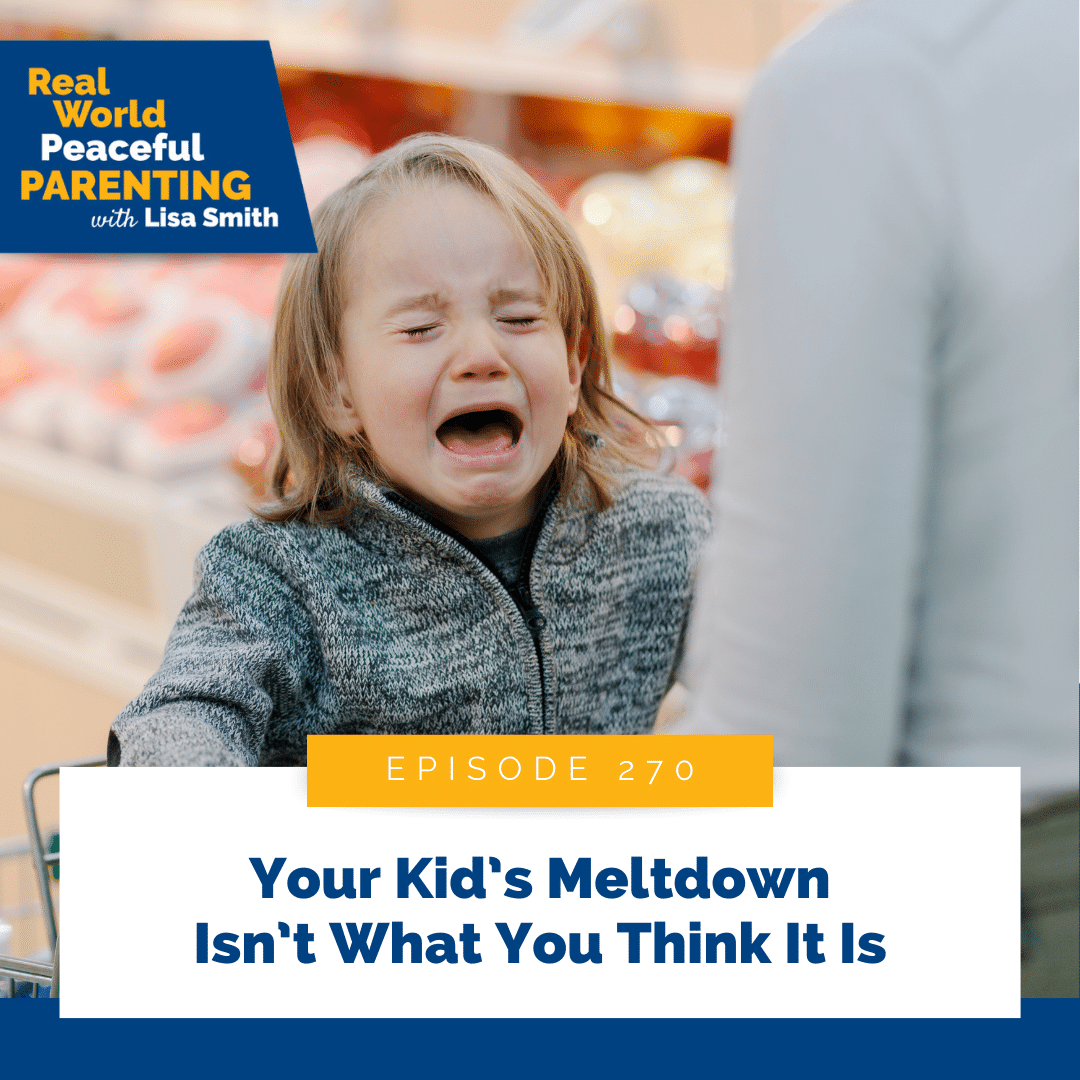
When your kid melts down over the wrong cup, weird socks, or turning off the TV, it’s easy to think they’re being dramatic, manipulative, or difficult.
But what if big feelings aren’t bad behavior at all?
In this episode, Lisa explains the neuroscience behind meltdowns, why your kid’s “upstairs brain” goes offline during big emotions, and how behavior is actually communication. You’ll learn why kids borrow calm from you, how co-regulation builds their brain over time, and what to do in the moment when emotions are high.
This episode will completely shift how you see tantrums, shutdowns, and teenage attitude.
Sign up for my free Peaceful Parenting mini-course! You’ll find everything you need to get started on the path to peaceful parenting just waiting for you right here!
What You’ll Learn from this Episode:
- Why kids are not born knowing how to regulate big emotions and what that means for your expectations
- The difference between the higher brain and the survival brain, and why logic doesn’t work during meltdowns
- Why “they’re not giving you a hard time, they’re having a hard time” changes everything
- How behavior is communication and what your kid’s nervous system may be trying to tell you
- What co-regulation really is and why your calm presence is your most powerful parenting tool
- How this applies across all ages, from toddlers to teens, and how to practice calm before chaos hits
Listen to the Full Episode:
Featured on the Show:
-
- Click here to sign up for my free Peaceful Parenting mini-course! You’ll find everything you need to continue on the path to peaceful parenting over there just waiting for you.
- Send us an email!
- Message me on Instagram and tell me how you felt after 10 minutes of undivided attention with your child.
- Click here to join The Hive!
- Peace & Quiet: The Crash Course For Peacefully Parenting Your Strong-Willed Kids
Full Episode Transcript:

Welcome to Real World Peaceful Parenting, a podcast for parents that are tired of yelling, threatening, and punishing their kids. Join mom and master certified parent coach Lisa Smith as she gives you actionable step-by-step strategies that’ll help you transform your household from chaos to cooperation.
Let’s dive in.
Welcome, welcome, welcome, welcome to today’s episode. I am so energized to be with you here today, and I need you to think about something for a second. You ready? Okay. Picture this. You’re standing in the kitchen trying to get dinner on the table. I mean, come on. We’ve all been there. It’s been a long day.
You’re exhausted and your kid, you’re sweet, lovable kid, completely loses it at the worst possible moment. Maybe they’re screaming because you gave them the wrong cup. Maybe they’re melting down because their socks feel weird. Maybe they’re throwing themselves on the floor because you said it was time to turn off the TV or put the iPad away.
Now let me ask you, what’s going through your head in this moment? Well, if you’re like most parents, it’s something like, why are they acting like this? Or why can’t they just calm down? Or maybe even, what am I doing wrong? And here’s where I wanna start today. I think most of us were taught, whether we realize it or not, the big feelings from kids may mean bad behavior.
Yeah. That if a kid is screaming, melting down, hitting, running away, or going completely quiet, you know, freezing up and shutting down and despairing into themselves that something is wrong with them, or worse, something is wrong with you. What if that’s completely backwards? What if those big feelings aren’t bad behavior at all?
But actually, are you ready for this drum roll? Please. Actually, communication, and this is exactly what we’re unpacking in today’s episode, and whether you’ve been on this journey with me for a while, or you’re just finding your footing with peaceful parenting. I think this episode today is going to give you a whole new lens on something we see every single day because this, this is foundational.
This is the stuff that changes everything. Everything. So there is a different way, and it starts with you understanding what is actually happening inside your kid’s body when those big feelings show up. So let’s dive in. I need you to hear this. And this is something that genuinely changed everything for me as a parent when I realized this.
And it’s that your kids and mine, all kids are not born knowing how to handle big feelings. They’re not. I really want you to let this sink in for a moment. And this is not the world according to Lisa. This is science. We know this through research. And studies and scanning the brain and studying the brain.
Kids are not born knowing how to handle big feelings. They’re not born with that skill. It’s not that they’re refusing to regulate. It’s not that they’re trying to manipulate you. It’s not a character flaw or parenting failure, I promise you, when your kid is screaming about the wrong cup. Sobbing because their toast was cut the wrong way.
Their nervous system is overwhelmed. That is a nervous system in alarm mode, not a kid who is bad. And here’s the neuroscience piece, because I think understanding this makes all the difference. The brain has two key operating modes in moments of big emotions. The first is what I call the higher brain.
You might have also heard it called the upstairs brain, and this is the thinking brain. This is where logic lives, where cooperation lies, and where problem solving and learning live. So that’s the upstairs brain, the higher brain, the second brain is the downstairs brain, or the survival brain. I call it the middle brain, the emotional center.
This is the part that fires up within milliseconds when a kid feels overwhelmed, unsafe, or scared. And when the middle brain takes over, the higher brain goes offline. Literally, this is so important, I wanna say it again. When your kid is in the middle of the meltdown, their higher brain is offline. I wanna be really clear, this is not just a toddler thing.
This is not just a little kid thing. This happens to your 10-year-old. This happens to your 15-year-old. This happens to your 21-year-old. Honestly, this happens to adults too. You’ve been there. I’ve been there. We’re gonna be there again, but, but we’re talking today about kids and I especially want parents of teenagers to hear this.
Your teens higher brain goes offline during big emotions just like your toddler’s brain did or does. Now, the behavior might look different, the stakes feel different, but the neuroscience is the same When your in your emotional middle brain having a meltdown, it is impossible in those moments to access logic.
Which means it’s also impossible to just calm down facts here. Your kid cannot hear your really great lecture about making better choices and or calming down. Let’s look at this from your own experience. Have you ever been so angry or so frustrated or so worked up that you said something you totally regret?
That when you were in your higher brain, your logical brain, you would’ve never in a million years said, that’s your middle brain taking over and your higher brain going offline. And you know what, my friend, it happens to all of us, every single human being roaming the earth. So here’s the first reframe I want you to take away from today’s episode.
I want you to remember. Committed to memory. Say it a hundred times a day if you need to. When my kid is melting down, they’re not giving me a hard time. They’re having a hard time. That shift from they being difficult to, they’re having a hard time, changes everything about how you respond, and the truth is how you respond is where the magic happens.
So let’s talk about that. The magic is in you understanding what those big feelings are actually saying, because here’s something I teach all the time. In the hive, every behavior is communication. Every behavior is communication. Every single behavior your kid shows you the screaming, the hitting, the running way, the shutting down, the freezing up, the going silent.
Every single behavior. Is your kid’s nervous system trying to tell you something? It might be. I’m overwhelmed. It might be I need connection. It might be My body doesn’t feel safe right now. Let me give you a really common example that I hear from parents all the time. Imagine a 6-year-old who absolutely loses it every day after school.
Like clockwork gets off the bus, comes in the door. Within 10 minutes, there’s a full meltdown. Parents often come to me so frustrated and they’re like, what is this, Lisa? I mean, my kids said their day was fine. They like school, they have friends. The school is safe. They like their lunch. Why are they falling apart the moment they get home?
Well, we talked about this in previous episodes. Here’s what’s really happening. That kid has been holding it together all day. School is a lot. For your kid’s nervous system, even under the best circumstances, following directions, sitting still, navigating friendships, managing transitions, handling disappointments, and by the time they walk in the door, their capacity is done, their emotional tank is empty, and home feels safe enough to finally fall apart temporarily.
And that meltdown at the door, that’s actually a sign that you, yes, you. A safe person for your kid. They trust you enough to communicate to you sometimes in the most ugliest of ways that they have a need and a feeling. And here’s the thing, this is just as true for your teenager. Maybe it doesn’t look like throwing themselves on the floor.
Maybe it looks like snapping at you. The second they walk in, slamming their backpack down saying, I don’t want to talk about it, and disappearing into their room. The same thing is happening. They held it together all day. They used everything they had, and the moment they get to you, the safe person, it comes out, the behavior looks different, but the communication is the same.
I’m overwhelmed. I need to decompress. I need to feel safe. Now, that doesn’t mean that the behavior is okay. It doesn’t mean there are no boundaries, but it means we understand what’s driving it. When we understand what’s driving it, we can actually help. So one of your takeaways from today is to pause and ask yourself, what is my kid’s behavior trying to communicate right now?
What might be going on underneath the surface? I used to, and over the years, I’ve asked myself and still do to this day, this question with Malcolm. All the time, all the time. And this is a question that will transform your parenting. I promise you, if all you ever learned from me and implemented was to pause and ask yourself, what is my kid’s behavior trying to communicate right now, what might be going on underneath the surface?
It’s a complete game changer for you, for your kids, and for your relationship. So try it. Okay. So we know kids are born without the ability to regulate big feelings. We know their behavior is a communication. Now, here comes the piece that’s going to change how you see your role as a parent. Kids learn to regulate their emotions by first borrowing calm from the adults around them.
This my friend, is called co-regulation, and it is. One of the most beautiful, important concepts in all of child development. Here’s how it works. Your child’s nervous system literally, literally sinks with yours. Their brain has mirror neurons that pick up your energy, your tone, your body language. When you are calm, regulated and steady, their nervous system starts to sink with that calm.
When you are activated dysregulating and escalating, their nervous system sinks with that too. This is why telling a dysregulated child to calm down doesn’t work. You cannot talk a nervous system, deregulation. They need to feel it from you, but first you have to be the calm before they can borrow it.
Think about a time when you were really stressed. Someone you love just came and sat beside you and maybe put a hand on your shoulder and said, quietly, I’ve got you and it’s gonna be okay. I bet your body responded that in a positive way. I bet you softened just a little bit. This is co-regulation and this is what your child is desperately needing from you when they’re falling apart.
Now I wanna be really clear here because this is where so many parents worry, and I wanna assure you, this is not about being permissive. Do not confuse co-regulation with letting your kid do whatever they want. Boundaries are absolutely still part of this. Absolutely. Your kid does not have to love your boundaries.
Many don’t. While setting the boundaries, the most important thing you can bring to a moment of dysregulation is your calm, steady presence, connection before correction, always, always connection before correction will lead to an absorption of the correction. Here’s a really simple but powerful scenario.
Your 4-year-old is losing their mind in a grocery store because you are saying no to a bag of Oreos. Your old approach might have been Stop it. Stop crying right now. You’re embarrassing me. I said no. Which all that’s gonna do is escalate their nervous system even further into dysregulation. So what would a co-regulate approach look like?
You might get down on their level, you might. Match their eye contact. You might lower your voice and say, I know. I know you really love those Oreos and you really want them, and it’s disappointing. And then you just stay calm and steady while they process what you’ve just said. You’re not giving them the Oreos, you’re not changing the boundary.
You’re just being the calm in their storm. The lighthouse, if you will. Think about it. The lighthouse shines the light no matter what the conditions are of the weather, and slowly, slowly, slowly, your kid will start to regulate because they’re going to borrow your calm. Your regulated presence is the most powerful parenting tool you have.
I promise you. Let me say that one more time. Your regulated presence. Is the most powerful parenting tool you have. Which leads me to a really important question, and I really want you to sit with this one. Think about your own childhood. When you had big feelings as a kid, what happened? Was there an adult who helped you feel safe in those moments?
Or were you told to stop crying or go to your room or pull it together? Because here’s the thing, my friend. So many of us never learned to regulate our own emotions because no one taught us, no one came alongside us and was the regulated presence we needed. And as a result, many of us learned to just bury our emotions or explode them or numb out.
And now we have kids of our own who are having big feelings because all human beings do. Our own nervous systems are firing right alongside our kids. Now, this is not about blame. It’s not about your parents doing it wrong or you doing it wrong. It’s about awareness. Because awareness changes everything, and you’re listening to this episode, you’re here.
That means you’re already doing something different. And I know some of you might be thinking, okay, Lisa, this sounds great for little kids. What about my 8-year-old? What about my 12-year-old? What about my teenager? Great question because loaning your kids, your emotional regulation isn’t just a toddler thing.
I promise this applies across every developmental stage and the need for co-regulation doesn’t disappear as kids get older. It evolves, and I know this with my own relationship with my 21-year-old. So let’s look at how it evolves as our kids age and grow. Right? Let’s look at toddlers and preschoolers.
Their brains are in such an early stage of development, the regulation is almost entirely dependent on you. Their meltdowns can feel completely out of proportion, and many times they are out of proportion because their nervous system has. No capacity or very little capacity to self-regulate yet your calm presence, your general voice, your physical closeness is the regulation tool they’re dependent on completely.
Now, as we get into the school age, years of kids, they’re starting to develop some self-regulation skills, but they still need a ton. I mean a ton of co-regulation support. This is the age where labeling feelings becomes very powerful, where saying, I can see you’re frustrated. I can see you’re disappointed.
I can see you feel left out. I can see you feel jealous. Becomes really powerful. This is the stage where just being seen helps their brains come back online. Yeah. Then we move into the tweens. You know, the 10 to 13. Oh, this age. Their brains are literally going through a renovation. It’s a great way to think about it.
A renovation and emotional intensity spikes. They need co-regulation and they need their independence respected, which is like being on Space Mountain for the parents. During this phase, your calm becomes even more important because they’ll often push us away, while also desperately needing our steadiness.
And then we have the teenagers end up, same principle, different packaging. Teens are often written off as dramatic or hormonal, but the truth is the brains are still developing. Still borrowing regulation from safe adults. The key is staying connected without controlling, being present, without prying, and across all these stages, the core truth stays the same.
Your kid cannot self-regulate until they’ve had the repeated experience of you offering them co-regulation. Every time you stay calm, every single time during their storm. You are literally building their capacity to eventually do it themselves. You’re not just managing behavior, you’re helping to build a brain, and that is profound work.
I always try to give you something practical to take away in every single episode because information without action is interesting, but information with action is transformation. So here are your two homework assignments for this week. Number one, every time your kid has a big feeling or behavior that drives you crazy or begins to trigger you, I want you to pause just for a breath.
Just for a breath, and ask yourself, what is this behavior communicating right now? Don’t try to fix it. Don’t try to respond. Just get curious, not furious. And the truth is your brain might not have the answer right away. That’s okay. The act of asking the question shifts your brain from reactive to curious and curious.
Parents are connected parents and homework assignment number two, you cannot access calm in a moment of chaos if you’ve never practiced it. So this week I want you to spend two minutes just to doing something that genuinely settles your nervous system. Deep breaths. A walk around the block sitting in silence.
Whatever works for you. The goal is to build your regulation muscle when things are calm, so it’s available to you when they’re not. Because remember, you are calm. It’s the most powerful thing you bring to your kids’ storm. Okay. Let’s do a quick recap before we go because I want these ideas to really land for you.
Number one. Kids are not born knowing how to handle big feelings, meltdowns, shutdowns, and tantrums. They’re not bad behavior. They’re signs of an overwhelmed nervous system. Number two, behavior is communication. Every big feeling your kid expresses is telling you something. Get curious about what’s underneath.
Number three, your kids borrow calm from you. Your regulated presence is the single most powerful tool in your parenting toolbox. You cannot talk a nervous system into regulation. You have to be the calm that they can borrow. Number four, this applies across every age and every stage. Your teenager needs your co-regulation just as much as your toddler.
It just looks different, and your homework is to get curious about the behavior. Practice your calm, so it’s there when you need it. And listen, if you spent years thinking your kids’ big feelings are a problem that need to be fixed, I want you to hear this. They’re not broken and neither are you. You’re learning a new way every single time.
You choose curiosity over control, connection over compliance every time you stay a little calmer in the storm than you did yesterday. You, my friend, are doing something extraordinary. You are changing the story for your family. And that that is everything, absolutely everything. Until next time, I’m wishing you Peaceful Parenting.
Thanks for listening to Real World Peaceful Parenting. If you want more info on how you can transform your parenting, visit the peaceful parent.com. See you soon.
Enjoy the Show?
-
-
- Don’t miss an episode, follow the podcast on Spotify, Apple Podcasts, or RSS.
- Leave me a review in Apple Podcasts.
-