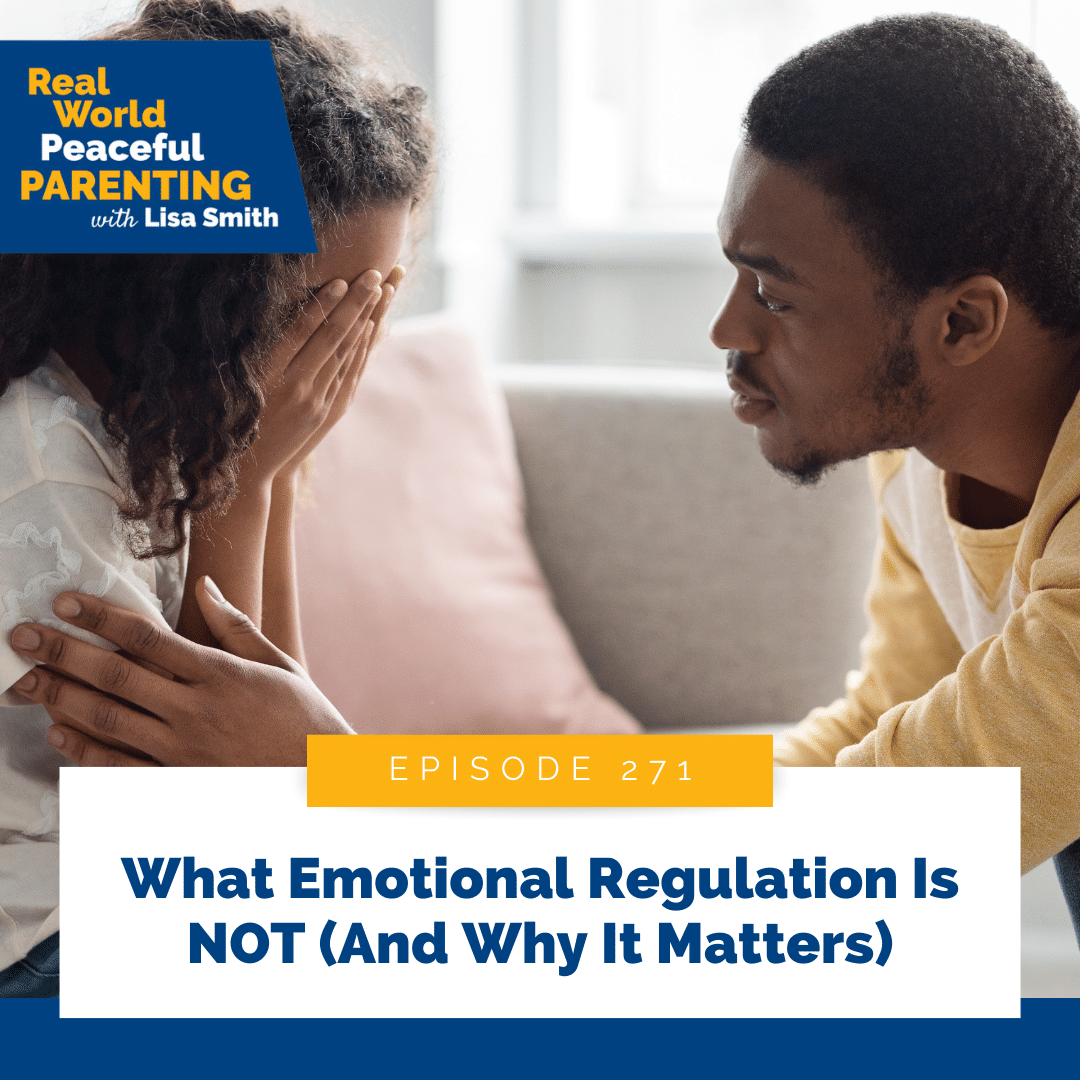
Many parents understand the idea of emotional regulation in theory. But in real life, when your child melts down in Target or your teen slams their bedroom door, everything you thought you knew can disappear in the moment.
In this episode, Lisa breaks down the four biggest myths about emotional regulation that trip parents up again and again. She explains why regulation is not about controlling behavior, why forcing calm doesn’t work, and why peaceful parenting does not mean removing consequences.
If you’ve ever wondered why your tools aren’t working the way you hoped, this episode will help you see emotional regulation in a completely new way and give you a clearer path forward.
Sign up for my free Peaceful Parenting mini-course! You’ll find everything you need to get started on the path to peaceful parenting just waiting for you right here!
What You’ll Learn from this Episode:
- The difference between emotional regulation and behavior control and why using regulation tools to stop behavior often backfires
- Why telling a child to “calm down” never works when their nervous system is overwhelmed
- How forcing breathing exercises or coping tools can unintentionally communicate that a child’s feelings are a problem
- Why emotional regulation does not mean removing consequences or boundaries
- The difference between punishment delivered from dysregulation and consequences delivered from calm leadership
- How a parent’s steady presence and predictable structure actually help children feel safer and behave better over time
Listen to the Full Episode:
Featured on the Show:
-
- Click here to sign up for my free Peaceful Parenting mini-course! You’ll find everything you need to continue on the path to peaceful parenting over there just waiting for you.
- Send us an email!
- Message me on Instagram and tell me how you felt after 10 minutes of undivided attention with your child.
- Click here to join The Hive!
- Peace & Quiet: The Crash Course For Peacefully Parenting Your Strong-Willed Kids
Full Episode Transcript:

Welcome to Real World Peaceful Parenting, a podcast for parents that are tired of yelling, threatening, and punishing their kids. Join mom and master certified parent coach Lisa Smith as she gives you actionable step-by-step strategies that’ll help you transform your household from chaos to cooperation.
Let’s dive in.
Welcome, welcome, welcome, welcome to today’s episode. I am so excited to be with you here today. Last week in episode two 70, we laid down something really foundational. We talked about what emotional regulation actually is. The kids aren’t born knowing how to handle big feelings. The behavior is communication, and that your kids literally borrow.
Calm from you. If you haven’t listened to that episode yet. I wanna encourage you to go and have a listen. It will change how you see your kids and their meltdowns. But today, today is one that I’ve been wanting to do for a long time because here’s what I’ve noticed. After years of coaching parents, and honestly after years of doing my own work as a parent, most of us can nod along when someone explains what emotional regulation is.
We get it conceptually, right? We think, yeah, that makes sense. I see what you’re saying. But then life happens. Your kid is melting down in the middle of target. Your teenager slams the door and the whole house reverberates and everything you thought you understood just flies right out the window and you’re left wondering, what am I even doing?
And why isn’t this working? A lot of the time, the reason it isn’t working isn’t because you don’t understand what emotional regulation is. It’s because you’re still unknowingly practicing what it isn’t. So today I’m here to help you bust the myths. Today I’m here to bring you the four biggest misconceptions about emotional regulation.
That I see tripping parents up over and over and over again. Now, one or two of these are going to feel uncomfortable, and some of them might make you go, oh no. Oh shoot. I’ve been doing that, and I wanna say right now that it’s okay. This is not a reason for shame. I’m not here to judge, and this is a reason to celebrate because awareness is where everything changes.
Remember the late great Maya Angelou said, when we know better, we do better. So we’re here to do better. You ready? Okay, let’s go. Emotional myth number one. Emotional regulation means controlling your kid’s behavior. Now, this is a big one, and I think it’s the root of so much frustration. Parents experience.
When most parents first hear about emotional regulation, here’s what they picture. A kid who stops melting down. A kid who complies, a kid who takes a deep breath and says, oh, okay, I understand. And moves on peacefully. Basically, a kid who’s easy. I get it because when we’re exhausted and we’ve been in the trenches with our strong-willed kid for years easier, sounds amazing.
It sounds like the finish line, but here’s the truth that I want you to see. Emotional regulation is not, not about controlling your kid’s behavior. It is not a compliance strategy. And the moment we start using it as one, the moment we bring out the breathing exercises or the calm down corner as a tool to make the behavior stop, we’re missing the entire point.
Think about it this way, if you came to me in tears about something really hard in your life, and I said, okay, take three deep breaths and use your coping skills, or take three deep breaths and then stop. All of your tears and get over it. How would you feel? It would feel dismissive. Right? It might even feel like your pain was inconvenient for me and I’m rushing you through it.
Like I just wanted you to stop feeling it. Yeah. That’s how our kids feel when we use regulation tools to manage their behavior instead of supporting their emotions. Now I wanna be really clear here because this does not mean there are no boundaries or limits or that they can do whatever behavior they want.
There absolutely are limits and rules, and we talked about that last week. Calm is not permissive. Steady is not soft. You can can be supported through a big feeling and still face the consequence. Those two things are not in conflict. But the goal of emotional regulation is not to control your kid. The goal is a kid who feels safe inside their own emotional experience.
Let me say that again. The goal is a kid who learns to feel safe inside their own emotional experience, who learns over time that big feelings are survivable. That they won’t be abandoned or shamed for having the big feelings. That’s what we’re building together, you and me, for and with your kids. So the question to ask yourself is, am I trying to help my kid feel safe right now or am I trying to help them stop?
This one question will tell you everything you need to know. I wanna share something with you that still stings a little bit when I think and talk about it. I’m sharing it because I think you might recognize yourself in it. Malcolm was about eight, remember? He is 21 now, and bedtime had become a full on battleground every single night.
Stalling arguing. One more drink of water. One more question. One more Anything. And frankly I was exhausted. I was starting my business. I was. Managing the entire household. My husband was traveling a ton, and remember, Malcolm is a strong-willed, full contact sport kind of kid. So one night I decided I was gonna do it right.
I was going to use the tools I was tonight to night, I’m gonna use them perfectly. So he started getting amped up and I said, in my calmest voice, let’s take a big deep breath together. He said, no, and I tried again. Your body is having big feelings. Let’s calm your nervous system. He got louder. One more time.
You’re safe. You’re okay. Just breathe. And then it hit me. I wasn’t really trying to help him. I was trying to make him stop. I wasn’t curious about what was underneath the no and the resistance and the drink of water, and the one more hug. I wasn’t attuned. I wasn’t actually present. I was managing. I was trying to rush through everything.
I was using the language of regulator as a behavior control tool, and underneath my calm, sweet, sugary voice was tension, urgency, and this silent message. I need you to be easier right now. Again, hard to talk about. The truth is kids feel that. Malcolm felt that and he escalated even more, and I finally stopped talking.
I sat on the floor in his room and I just exhaled. And for the first time that night, maybe the first time ever, I asked myself, what is actually happening here? He wasn’t dysregulated because he didn’t know how to breathe. He was dysregulated because bedtime meant separation. It meant the end of connection for the day.
And I was dysregulated because I felt trapped. I needed space, I needed quiet. I was ready for the night to be done. Two nervous systems, both overwhelmed, both trying to control the other to feel better. Yeah, so instead of another breathing script, I said, I imagine that there’s a part of you that really doesn’t want this day to end.
You really don’t wanna go to sleep. And there’s a part of me, Malcolm that’s really tired, and I’m just gonna sit here with you for a minute now. He didn’t magically jump in bed and go to sleep, but he did soften and so did I, and that was the moment that I truly understand the difference. If I use regulation to control behavior, my kid feels managed.
If I use regulation to connect, my kid feels safe. Safety, not compliance is what actually changes behavior over time. Okay. Myth number two. This one is sneaky because it sounds so much like the right thing to do. Let’s regulate. Let’s take deep breaths. Let’s use our tools. These aren’t bad phrases. I use them myself, but the way most of us say them in the heat of the moment when our kid is activated.
Storming dysregulated. When we’re activated storming and dysregulated, what happens is these statements land as commands, and what we’re really communicating underneath is your feelings, kid, your feelings are making me uncomfortable, so please stop having them. And here’s the light bulb moment. Kids feel that, I promise you.
They feel that. And what they hear is. That my big feelings as the kid, my big feelings are a problem. My intensity is too much and I need to be different so that you, the parent, can handle me. Here’s what I want us to really hear as the parent. Emotional regulation is not about shutting our kids’ emotion down.
It’s about helping our kids move through the emotion without shame. Anger itself is not dysregulation. I need to say that again because it might blow your mind a little. Anger is energy. Anger is a signal. Anger is sometimes a very healthy boundary being communicated. A kid who says, I’m so mad right now, and stays connected to themselves while feeling it, that’s actually working towards regulation.
We don’t want emotionless kids. We want kids who can feel their big feelings without being hijacked by them. So forcing calm, sending them to a room to reset, telling them to breathe when their nervous system is flooded, threatening consequences if they don’t settle down. That is not co-regulation, that is compliance and training, and there is a profound difference.
Real co-regulation sounds like. I see you. I’m here. Your feelings don’t scare me and I will stay with you. It is nervous system to nervous system. It’s your presence saying to your kid, you are safe. Even in the middle of this, even in the middle of this, here’s the real question. When your kid is in the middle of a big feeling, can you stay with them?
Or are you waiting for them to stop? Yeah, that’ll tell you all you need to know. Alright, myth number three. This one I hear from parents all the time, especially parents who are new to peaceful parenting or who think peaceful parenting means kids get to do whatever they want with no consequences. And sometimes we hear emotional regulation, and we think it means no consequences.
No limits. You just validate everything and let your kid do whatever they want, and then something happens, right? Your kid hits or lies or completely disregards a boundary, and you feel paralyzed. Because you think if I respond with a consequence, I’m not being peaceful. I’m failing at this friends. This is not what this is.
Emotional regulation is not absence of limits or consequences. A regulated parent, a parent who is calm, connected, and grounded can absolutely say, I will not let you hit me. I will not let you hit your sister. This behavior has a consequence. We can talk about this when we’re both calm and figure out what to do next.
But what happened today is not okay. The difference is not whether there’s a consequence. The difference is the energy you bring to the conversation about the consequence. Consequences delivered from a dysregulated parent. Dare I say, punishments are delivered when one is yelling, threatening, shaming that teaches fear.
It activates the child’s survival brain and shuts down the very learning centers that we need our kids to access in order to learn. But a consequence delivered from a calm, regulated parent, one who’s steady, clear, and connected that teaches that lands, that actually has a chance of changing behavior over time.
So no emotional regulation does not mean. There are no consequences. It means the way you hold, present and enforce the consequence matters as much as the consequence itself. Your kid doesn’t have to like your limits. They really don’t, but they need to feel your steadiness when you are presenting and enforcing and holding them.
Calm is not permissive. Steady is not soft, and regulation is not the same as surrender. I wanna tell you about the mom. A mom inside the hive. I’m gonna call her Marissa. She came into the hive with tears in her eyes, and one sentence she kept repeating. She kept saying to me, I thought peaceful parenting meant I didn’t have to give consequences.
Her daughter, Lila, is 12. Middle school, had changed everything. If you’ve been there, you’ve been there. If you know, you know. Right attitude, sharp sarcasm, eye rolls, that feel like daggers. Homework avoidance, slam doors, wanting endless time on social media, though you don’t get, it, had become the family anthem.
Now, Marissa had worked really hard not to parent the way she was raised. She was raised with yelling, shaming, and threats. So when Lila began to push back for the first time in junior high. Marissa defaulted to explaining, trying to reason, trying to get her daughter to understand, agree, and follow the rules while she sweetly explained them.
What Marissa wasn’t able to do was hold the line if Lila refused homework. Marissa negotiated if she was disrespectful. Marissa tried to unpack the feelings underneath. If screen time went over Marissa’s side and let it slide because she feared creating a disconnection and quietly on Marissa’s part, resentment started building, not because she didn’t love her daughter, but because she felt powerless in her own home.
What she was too ashamed to say out loud at first was, I feel like my daughter runs the house. Underneath was something even more tender. I’m scared she won’t like me if I’m firm. That was the real thing. She had tangled consequences with rejection and firmness with emotional harm. Here’s what Marissa started to notice.
Lila wasn’t calmer. She was more reactive, more argumentative, more anxious, because as a 12-year-old kid without predictable structure. All that middle school intensity had no container, and it was making Lila more defiant and more anxious, which was making Marissa more anxious. So inside the hive, we separated something that had gotten twisted in Marissa’s mind.
Calm does not equal permissive. Consequences are not. Punishment and predictable structure actually creates safety. The shift began to happen over phones. Lila had been staying up past midnight, scrolling every night. Mornings were miserable, and instead of a long conversation where Marissa was trying to gain Lila’s approval, get her to understand and agree.
Marissa simply said, if the phone isn’t plugged in in the kitchen by nine 30, it won’t be available tomorrow. That was it. No lecture, no Ted talk. That was it. No gaining Lila’s approval of the consequence. Now, Lila, she tested as they do strong-willed kids. She pushed back hard. She accused her mom of being controlling.
She said some really ugly things. She stormed off and slammed the door, stayed in a room for an hour. Marissa told me while this was happening, Lisa, my body was shaking. Every old fear was screaming at me. She’s going to hate you, and you’re just like your parents. But with support and guidance and coaching, Marissa followed through day in and day out, steady, calm, regulated, offering Lila co-regulation, and over the next two weeks, things began to quietly shift.
The arguments got shorter. The sarcasm softened. The phone started showing up in the kitchen at nine 30 every night, first couple nights at Mom’s reminders, and then slowly over time, Lila began putting the phone away on her own. Now, this all happened, not because Lila liked the role. She was still mad as heck that she had to put her phone away at nine 30, but the shift started happening because the boundaries stopped moving.
Here’s the part that surprised Marissa most through all this. Lila started coming to her more because firm didn’t equal mean it equaled safe. 12 year olds don’t need softer, permissive parents. They need grounded ones. So let me remind you, peaceful parenting didn’t mean removing consequences or avoiding them.
It meant removing shame. And when Marissa was able to show up as the calm authority instead of the anxious parent. Her daughter relaxed and felt safe. That’s the part many people miss. Structure, not punishments and threats, but structure, calm. Structure is regulating, and here we are at myth number four, the one that is probably the most common thing that parents do, and the one that flat out does not work ever, not once, 0.0% of the time.
What is it? It’s telling another human being to calm down. I want you to think about the last time someone told you to calm down when you were really upset or even moderately upset, how’d it go? Did it work? Did you instantly feel soothed and rational, or did you feel even more upset, more frustrated, more dismissed, and more dysregulated, right?
Because. You cannot command a nervous system into deregulation. You just can’t. When a kid or an adult is flooded with the motion, the thinking brain, the the prefrontal cortex, the higher brain is offline. We talked about this last week. The higher brain, the part that can hear the words and process them and make a different choice is not available.
When we’re dysregulated, it literally cannot receive the instruction to calm down. So when we say it, and I know we all say it, I’ve said it too in the past, we’re essentially asking them to do something that their brain is physiologically incapable of doing in that moment, and then when they can’t do it.
We think they’re being defiant, but they’re not. They’re just dysregulated. Their nervous system is in alarm mode, and alarm mode doesn’t respond to verbal commands. What does work? Presence. Proximity. A lowered voice getting down on their level. Breathing slowly yourself, because remember, their nervous system sinks with yours.
You become the regulation, you become the calm down, not your words, but you. And here’s the piece that I think is so important and doesn’t get said enough. You, the parent cannot just do this in a moment of crisis if you’re not practicing it. In moments of calm regulation is built slowly over hundreds and hundreds of small moments.
The times that you name their feelings, when nothing big is happening. The times you stayed curious instead of reactive over something small, the times you repaired after you lost it, that’s the investment and it pays off hundreds of small moments back to back to back. Maybe not today, maybe not this week, but one day you’re gonna see your kid pause in the middle, something hard.
Take a breath and find their words instead of exploding. And you will know. You will know that that came from every moment you chose to be their calm. Telling kids to calm down doesn’t build regulation. Being calm builds regulation. There is a world of difference. Okay, I wanna ask you something before we wrap up, and I really want you to sit with this one.
Of all the four myths that we talked about today, emotional regulation as behavior control, forcing calm thinking. It means no consequences and defaulting to calm down. Which one do you recognize most in yourself? Now, I ask this not to judge yourself, not to spiral into guilt, but to just notice because the one you recognize is probably the one keeping you the most stuck right now.
Noticing it. Just naming it honestly is the first step to doing it differently. Awareness is always, always, always the beginning of change. Okay. Here’s the deeper truth underneath all of what I’ve shared with you today, and it’s the thing I really want you to take away. Emotional regulation is not about fixing your kid, it’s about helping your kid or kids.
Build an internal sense of safety and that safety, it comes from you. If some of this felt hard to hear today, if you recognize yourself in one or more of these myths, please be gentle with yourself. You’re probably doing what you were taught. You’re doing what feels natural because of how you were raised.
A lot of us grew up in homes where big feelings were not welcomed, where calmed down actually meant. Stop bothering me or take your feelings and hide them from me, where there were plenty of consequences, but very little connection. But here’s the good news, that is not a life sentence, and today is a starting point.
You are here, you are learning you every time you catch one of these myths playing out in real time, and every time you intervene or stop or do over or course correct, that’s a win. That’s a total win and that’s growth and that’s you choosing something different for your family. And I’m with you every single step of the way, and I wanna end by telling you how proud I am of you for doing this work.
I am sincerely for of you, for showing up, for listening, for applying the tools, and for choosing something different for you and your family. Yeah. Yeah. Okay. Until next time, I’m wishing you Peaceful Parenting. Thanks for listening to Real World Peaceful Parenting. If you want more info on how you can transform your parenting, visit the peaceful parent.com.
See you soon.
Enjoy the Show?
-
-
- Don’t miss an episode, follow the podcast on Spotify, Apple Podcasts, or RSS.
- Leave me a review in Apple Podcasts.
-