
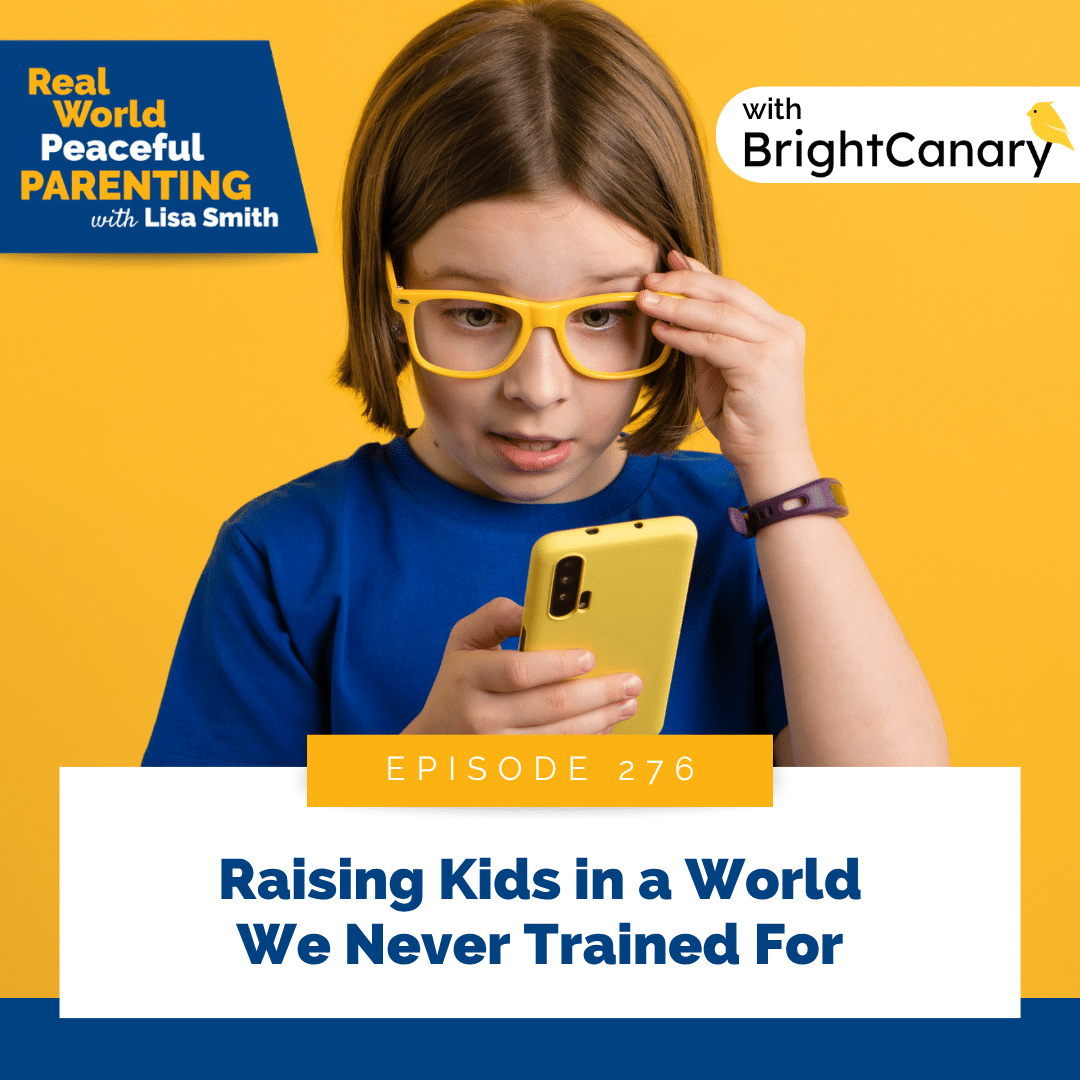
In this eye-opening episode, Lisa sits down with BrightCanary co-founder and dad, Karl Stillner, to talk about one of the biggest parenting challenges today—raising kids in a digital world we were never trained for.
From social media and texting to AI and online safety, you’ll learn how to stay informed about your kid’s digital life without controlling, punishing, or disconnecting from them. This conversation will help you shift from fear-based parenting to calm, confident leadership in a world that’s changing fast.
Plus, if you’re ready to take action, you can try BrightCanary risk-free with their 7-day trial—and get 20% off the annual plan using code PARENTS20.
Sign up for my free Peaceful Parenting mini-course! You’ll find everything you need to get started on the path to peaceful parenting just waiting for you right here!
What You’ll Learn from this Episode:
- How to stay informed about your kid’s digital world without damaging trust or connection
- Why blocking and restricting alone doesn’t work—and what actually does
- The concept of “digital training wheels” and how to guide your kid safely online
- How to approach tough digital conversations from your calm, regulated brain (not your triggered one)
- Why phones should come with clear boundaries and expectations (not as a free-for-all gift)
- How to turn digital challenges into opportunities for connection, curiosity, and leadership
Listen to the Full Episode:
Featured on the Show:
-
- Click here to sign up for my free Peaceful Parenting mini-course! You’ll find everything you need to continue on the path to peaceful parenting over there just waiting for you.
- Send us an email!
- Message me on Instagram and tell me how you felt after 10 minutes of undivided attention with your child.
- Click here to join The Hive!
- Peace & Quiet: The Crash Course For Peacefully Parenting Your Strong-Willed Kids
Full Episode Transcript:

Welcome to Real World Peaceful Parenting, a podcast for parents that are tired of yelling, threatening, and punishing their kids. Join mom and master certified parent coach Lisa Smith as she gives you actionable step-by-step strategies that’ll help you transform your household from chaos to cooperation.
Let’s dive in.
Welcome, welcome, welcome, welcome to today’s episode. I am so thrilled. To be with you today, and I’m just gonna call it like it is today. You and I are raising kids in a world that none of us trained for. None of us grew up worrying about what our kids were doing on TikTok at midnight, or whether someone was in their dms, sending them something they shouldn’t see.
And yet, here we are. Navigating technology, smartphones, social media, ai, chatbots, all of it, while also trying to stay connected, regulated parents along the way. I mean, hashtag the struggle is real. Am I right? And the tension is real, and I hear it from parents in the hive all the time. Lisa, I wanna trust my kid, but I’m terrified of what I don’t know.
Sound familiar? I thought so. So I went out and I found us an expert that we can talk to, learn from, and rely on. And here’s what I know to be true. Peaceful parenting isn’t about being naive. It’s not about turning a blind eye and hoping for the best. Absolutely not. Peaceful parenting is about staying connected, even when, and especially when things feel uncertain or scary.
Today’s guest, he’s here to help you do exactly that. Stay connected to your kids’ digital worlds without resorting to fear, punishment, and a total phone ban. That, let’s be honest, probably doesn’t work very well. Yeah. Okay. So that’s why I’m excited today, and I’m gonna introduce you to Carl Stiller. Carl, I’ve had the opportunity to get to know him and his team over the last few months, and I’m telling you what they’re doing is amazing.
Carl’s the co-founder and CEO of Bright Canary say what? What? Lisa? Bright Canary. It’s an AI powered child safety app. Those words don’t usually go together very often. AI powered and child safety. Is an AI powered child safety app that helps parents, that helps you. Yes, you stay informed about what your kids are doing.
Online Bry is gonna help you monitor text messages, YouTube, Instagram, TikTok, snapchat, discord AI apps, all on Apple devices, and send you real time insight and alerts. About your kid’s activity. Pretty amazing, right? But here’s what makes Carl different from other tech founders in this space. He’s a dad, first dad of a 14-year-old and 11-year-old, and he didn’t build this app because he saw a business opportunity.
He built it because he was a sitting exactly where you are wondering how to be present, informed and connected in the digital age as a parent. Bright Canary has been featured in New York Times, N-B-C-A-B-C News Fast Company and USA today, and after our conversation today, you’ll understand why. So Carl, welcome to the podcast.
Thanks for having me, Lisa. Very excited to be here. Yeah, we’re excited. Carl, before we talk about bright Canary, let’s start with you as a dad. Take us back to the moment when you realized the digital world was becoming a challenge in your household. What was happening with your kids? Yeah, so as you mentioned, Lisa, I’m the father of a 14-year-old and 11-year-old, two boys, and a few years ago, my co-founder, who I worked with at numerous other businesses in the past was twins that are now 16.
We would often lament the fact that there weren’t tools built for parenting the digital age, the tools that existed were really around limiting and blocking, which there’s certainly a role for, but that’s not sufficient anymore. It’s really about understanding the qualitative nature and the big realization I had was.
This idea of keeping kids off devices is really antiquated. It’s impossible. Kids have devices at school, they have ’em on the bus, they have ’em at their friend’s house. You really can’t expect to keep them off devices in general, and there’s a huge difference between high quality and low quality engagement.
So kids can be doing all kinds of really productive things online. Likewise, they’ve been doing all kinds of really horrible things online and that nuance is what parents need to understand. So we saw an opportunity because we had kids and we realized they were gonna be online and is saying, Hey, I’m turning it off at 11:00 PM which obviously parents should do, wasn’t enough.
You need to be able to say, Hey, I, I see your interest in this kind of thing. You’re engaged in this kind of content. How can I explore that with you? How can I engage with you? Because being a parent is about being engaged with their interests and kind of helping usher in those curiosities and kind of encouraging them in many ways.
And so that was the big wake up for us was we realized that just using a VPN of block access wasn’t going to be something that was pragmatic or useful parents for parents in, in this current age. I love it. I, I, as you know, big fan and you know, further, if I’m giving my kid one to two hours or three on technology, but they’re doing things during those three hours that could potentially take him in the wrong direction or create harmful thoughts or allow someone to approach them.
We need to know that right. Absolutely. I mean, it’s, I mean, there’s all kinds of analogs here that exist. Um, Jonathan Haight brings a lot of these in his book, the Anxious Generation, which I think is, should be required reading for any parent who has kids in this kind of target age range at this point.
But he makes the point that there’s kind of over parenting in the offline world, in under parenting in the digital world. So parents are very informed about exactly where their kid is, what they’re doing, uh, at the park, et cetera, but totally blind to what they’re doing online and arguably. You can get a lot more trouble much faster online than you can in the, in the physical world at this point.
And so it’s imperative. Parents need to have some understanding. It doesn’t mean they need to monitor and, and understand everything their kid is doing. And we can get into the nuance of what age we think there’s a transition from really being fully aware of everything your kid is doing to having more of a, of a kind of a, a general idea.
Because, you know, a 11-year-old is vastly different than a 17-year-old in terms of their maturity and their privacy needs. Yes. Um, but we, we believe that parents have to be more engaged than they have been. And I think to your point earlier, this is all new. There’s no. Wisdom that’s been accumulated, passed down for generation after generation about parenting with these devices.
These devices are new in the last 10, 15 years, and so parents are very flatfooted. So I think it’s, I think parents should feel that this is something new and they shouldn’t feel guilty about not having understanding because again, this has come outta left field, but there are now hopefully tools that parents feel that they can trust and use to help parent in this way.
Yes. And onboarding tools and support. Mm-hmm. So you feel like you have an army of people helping you achieve the goals? You know that that’s so important. I mean, I. I always say if you, you know, if you don’t know how to stay calm and regulated when you’re parenting or you don’t know how to set boundaries or you don’t know how to approach something, get help and support that you need.
Mm-hmm. And that’s, you know, what I feel Bright Canary really offers. So I love how you describe Bright Canary as digital training wheels. Can you, can you unpack that metaphor? For our parents, because as a peaceful parenting coach, the phrase really landed for me. Yeah, so one of the things that we reflected on when we were thinking about starting this business was the fact that there were all kinds of other tools for these major life events or milestones for kids.
When a kid starts getting their driver’s license, there’s driver’s ed and there’s all kinds of courses that kids take, uh, to prepare them to be responsible drivers. There’s nothing like that for digital. And so you have kids that are being onboarded without any kind of real formalized support around how to become responsible digital citizens.
And there’s really a window of opportunity, right? When you, when a kid’s getting their first iPad or phone eight, nine, ten, eleven, who you know, it depends, of course, there’s an opportunity for that parent to become a guide for that child and teach them how to be responsible digital citizens. And we actually hear from a lot of our parents that they want.
Something better than they have for themselves with their kids. Right. A lot of parents don’t have a great relationship with digital because again, it’s come outta left field for them and they weren’t taught how to deal with this, but they want something much better for their 10-year-old because they see how it can be a distraction machine, how it can create mental health issues, and so they are hoping and wishing and working towards something much better for their children.
I love that. My son and I were just talking about this. Listeners, you know, Malcolm’s a junior in college and I was visiting him recently and we were talking about technology. I was telling him about Bright Canary. Mm-hmm. And we were having this whole conversation about he got a cell phone, his first phone when he was 13.
And although it wasn’t that long ago. In the digital world. It was long ago, Carl. Mm-hmm. And we were talking about how when he got his first phone, Instagram, Snapchat, like none of these were around. And so he had the digital training wheels sort of automatically. Mm-hmm. Because the app at the time, that was all the rage was Facebook.
And kids didn’t wanna be on Facebook because. You know, their moms were on Facebook and so he eased into apps and technology and AI certainly wasn’t around then. And we were actually talking about your concept of digital training wheels. And you know, he who loves his phone and is a gamer and you know, loves to watch the Office on Netflix, he himself said.
Kids need digital training wheels. You can’t throw everything, you know, you can’t throw a buffet at a little kid and expect them to pick the broccoli. Right, right, right. Yeah, no, it it, it’s a really good point. It’s one of the things we did not expect to see was this notion or this where kids who are in college or even graduated from college, who have younger siblings.
Who are reaching out to their parents and to us saying, I really wish you’d use something like Bright Henry on me. You should use it on the younger sibling, because the t the type of stuff I was exposed to without any context, without any parental guidance was really something I don’t want for any other kid.
And we didn’t expect to see that, but we see that pretty often now where we see older siblings really taking this kind of perspective, which is, which is great. Of course, I, I, I could totally believe that. And you know what I love about bright Canary? So in the real world, peaceful parenting, I’m all about helping parents turn on the internal compass within their children, right?
I mean, as parents we have the fully developed brain. We do need to be in charge. We need to set limits, but in the same breath, we need to guide rather than control. Mm-hmm. And, you know, have having a, a, a, a child who’s not, or I mean a kid who’s now an adult who’s launched. I can really see the value over the years of guiding rather than controlling because one day they’re sleeping in their bed and the next day they’re out in the world.
Mm-hmm. Taking care of themselves with their independence. Right. And so what I really love is the concept of guiding instead of controlling and restricting and. The way Bright Canary works is it really gives you a chance to be fully present with your kid, and then on top of it, learn about what they’re interested in so that you can also tap into that.
Maybe you can give us a rundown of how Bright Canary works in layman’s terms, and then speak to the things you can learn about your kids as well. Happy to do that. Yeah, so Bright Canary is an application that sits on the parent’s phone. And in that application you can log into various services. So you can log into Google, for example, which covers YouTube as well and allows you to see, um, everything that your kid has searched on or any videos they’ve watched and actually the ads they’ve seen, which has been really illuminating because we actually see, like my 11-year-old has served Jack Daniels ads recently, uh, which, um, was pretty eye-opening.
We also allow you to log into iMessage and then collect. All the messages that are sent and received on iMessage and text messages. Um, so with Android users as well. And then we also allow the parent to install, um, a keyboard, a third party keyboard on the child’s device, which collects all the keystrokes that kid types in.
And then we take all that data and all those are modular. You don’t have to do. The text messaging, if you wanna do Google, you don’t have to do the keyboard if you wanna do text messaging, they’re all independent of each other in many ways. But all that data is collected by our AI and then it’s analyzed.
And so the first thing we do is run the the text strings through an AI to make sure that what the kid is typing is how it should be translated to the parent. Because oftentimes there’s a big disconnect in terms of what the kids’ language they’re using and even just typos and things like that. So we translate it.
It’s run through an AI layer for, for content moderation. And so we’re looking for things like suicidal ideation, drug use. Um, of course on the alarming side there’s many like that. And then we’re also looking for general themes as well. So, hey, your kid’s interested in a. Roadblocks, your kid’s interested in this particular sports team or is interested in astronomy or birding.
And then we’re also looking for emotional states. So your kid seems to be rather agitated or depressed or happy or anxious, and we’re providing all that back to the parent in a dashboard saying, here’s a summary of your kid’s activities and emotional state. And that can be obviously very informative for understanding concerning topics, but it can also be really illuminating for understanding your kids’ interests.
Because what we found is that kids go online for upwards of five hours a day outside of school, and they don’t share anything they’re doing with their parents or very little. It’s like a, a, it’s like a black box. It’s, it’s, it’s a strange phenomenon. We don’t know exactly why it happens, but kids just don’t want to share because it’s, maybe it’s considered a different world and so.
This provides insight into your kids’ interests. Maybe they’re watching science videos, maybe they’re doing things that you would like to foster their interest in, and so we provided a dashboard back to them, and this dashboard is adaptive. I mentioned earlier that we recognize that a 11-year-old is vastly different than a 17-year-old in terms of maturity.
We believe that an 11-year-old, 10-year-old nine, and anything younger, of course. Parents should be engaged in everything they’re doing, and there’s no pushback from the kids in terms of privacy. My 11-year-old, he actually feels, I think, a level of comfort knowing that I’m, and my wife is aware of what’s going on in this digital life because he’s heard the Internet’s a scary place and so he doesn’t have any notion of that, and I feel like we need to be fully involved.
At a certain age, and each kid’s slightly different, so there’s no magical age, but at a certain age, 13, 14 kids start needing more autonomy and privacy, and our tool allows for that using ai. And so a parent doesn’t have to go read every text message or every keystroke that kid is sent when they’re 14 and upwards.
Instead, they can rely on these AI generated summaries saying, Hey, your kid is anxious or happy this past week, and here are a few themes they’ve been interested in. There’s nothing to worry about or here’s something you might want to talk to your child about, right? As opposed to understanding every granular detail.
Not, not saying that there’s, there aren’t certain circumstances where that’s required because we do have parents who have kids who have very difficult situations, and parents need to be much more involved, but it can be modulated based on the relationship the parent has with the child and their child’s maturity.
I like it. The other thing I like about it is that summary allows the parent to have some context. Mm-hmm. And maybe cogitate on what’s being offered and get regulated. Mm-hmm. And ground themselves before approaching. Kid about the information. Yeah. And that’s a, that’s a really important point. So we provide this information to the parent, but we know it’s not enough to say, just to say, Hey, your child was looking at some pornography last week.
We know that parents oftentimes become emotional when they’re, when they get some of this information. Understandably so. And like, like I said before, don’t necessarily have a playbook on how to handle this. And so we use AI that is. Context aware. So it’s aware of what this child has been doing online to provide the parent with a foundational level set of guidelines or, or talking points for a conversation.
So what is the first conversation you should have with your child when X or Y happens? And the AI does a remarkably good job of providing that first or second conversation. I’m not gonna say it should be a replacement for a child’s psychologist or a therapist or anything like that, or parent codes. Or parent coach.
Absolutely. Um, but it really provides that parent with an ability to sit down and have a conversation that is based on facts, based on reason, not emotional and productive. You know, I’ve, I’ve found this even with my kids. Occasionally we get alerts and sometimes they’re not always what I want to hear, and it provides me with a way to kind of take a, take a breath and Yes.
And have a few talking points going into it. So it’s been super useful. Yeah, I, well, let me say, when parents need the playbook on how to handle things, they come to me and that’s what I do. And in the meantime, so often we’re triggered. By the surprise, right? Yeah. I didn’t think my kid would be querying vaping or saying this back to another kid or being bullied, or we made an agreement that she wouldn’t have a Snapchat account, and now I find out she does.
Yeah. And so just having that layer to help you gather your thoughts and get back into your higher brain. Right. Mm-hmm. Which is, whereas the parent, right, you’re logical, your critical thinking, you can see a couple steps ahead. You’re, you’re reasonable, you’re regulated. This is what I love about Bright Canary.
It gives you the opportunity to approach your child in your higher brain. Mm-hmm. Rather than your middle brain where you’re in your emotional center, cortisol’s raging through your body. You might say something you regret, you might accuse your kid rather than being curious. Right. You, you go in guns a blazing, right?
Yeah. And we don’t want a parent from that middle brain. I always say, Carl, there’s a right time and a wrong time to parent. Yeah. And the wrong time is when we’re dysregulated. Right. And I, what I really love about your product, your app, is that it, it encourages the parent. Mm-hmm. Get in their higher brain.
Before approaching that conversation, and I think you and I both know you have 11 and 14-year-old, those conversations can go south very quickly. Mm-hmm. If the parent is not in their higher brain. That’s right. That’s right. And it’s. Antithetical to what we’re trying to set up with the, with this, um, service, which is trust between the child and the parent.
And so one thing I should mention is we advocate for being very upfront with your kids about the fact you’re using a service like Brighton Air. And so you say, Hey. You position as an enabler more than anything else. You get to have a phone, you get to use your iPad. You get to use Snapchat. Yeah, because your parents are using the service.
It’s not hidden and it’s really upfront. Admittedly, that’s a lot easier to do when the kid’s getting their first device or their first services versus taking this to a 16-year-old who’s already been using a phone for a few years. I, I recognize that is actually a challenge. Well, I, I, let me jump in here and say, as a parent coach who’s been doing this for 18 years, a phone is a privilege and what I recommend is the parents not gift a phone.
Mm-hmm. Right? If I give you a sweater, you get to decide if you wanna wear the sweater, put it in the goodwill pile, save it for the ugly Christmas sweater contest. It’s a gift. Mm-hmm. You get to decide if I’m. Offering you a phone under these conditions, right. You hire me to come work at your company. You say to me, Lisa, you come under these conditions of, this is your scope of work.
Mm-hmm. And I either do it and I keep the job or I don’t do it, and I lose the job. And I think a phone or an iPad or a computer should be offered with rules. Mm-hmm. And guidelines and a contract. Yep. And you know, because I. Own the phone. I’m the adult that paid for it and they are not cheap and I’m paying for the monthly service and I am offering you this under these conditions.
And you know, for us it was location services never go off. Mm-hmm. I always know the password to the phone, right. There were conditions that my son needed to meet in order to continue to enjoy. The privilege of having a phone. Yeah. And I think I’m agreeing with you being, you know, forthright. Like this is a condition, right.
That we’re, and, and I’m doing it as the parent to, I always say trust, but verify. Trust your kid, but verify the right amount of trust is appropriately placed. So the conversation can be around trust, autonomy, safety, and accountability. Mm-hmm. Right. Like I’m sure one of the things, your 11-year-old.
Appreciates, if not in the front of his brain, but in the way back. Is that I’m being held accountable mm-hmm. To a certain amount of rules. Yeah. With my parents in order to have this phone. What that does for an 11-year-old is it takes away the stress of should I go on that side or not? Right. My friend doing it, I want to, should I, should I, is it okay?
Like they’re, they struggle because they have an underdeveloped prefrontal cortex with these important decisions. And when you say. These are the rules and I trust that you’re gonna follow ’em. And I’m gonna verify with bright canary, imagine the safety. That kid can rest it, right? Yeah. I mean I think that’s, gosh, that offers our kids like they don’t have to sneak and decide and plot, and it’s just it.
It must be so comforting. Yeah, no, I think that’s right. And, and we, we, we totally agree with you that device contracts should be part of the equation and it needs to be set up in the right way with a, with a child. Because I think oftentimes it’s just given as your, to your point as a gift without any kind of real thought about it.
And that becomes a very different relationship. So, yeah. Alright, Carl, here’s the big question ’cause I know a lot of my listeners are loving Brett Canary, and as soon as we wrap up, they’re gonna go check it out. Here’s what they’re also thinking to themselves. I’ve tried other things. We don’t need to name the other things out there, but I’ve tried other things and every single time my very smart, very determined mm-hmm.
Very impulsive, strong-willed kid has found every work around in loophole. And the other things I’ve tried are sitting in a pile in the corner in a closet right now, so, right. What do you say to the parent whose kid is tech savvy enough, right, to try to beat the system? So there’s always going to be the super tech savvy kids that can figure out workarounds.
Like it’s, it becomes a challenge for certain kids. We recognize that, and so I’m not gonna pres present us or anyone as being a hundred percent foolproof in that way. What we try and do in our application is provide. Information to parents to know if their kid is circumventing it. So if they’ve installed a keyboard, we’ll let them know that the keyboard hasn’t been used in 24 hours, for example, which is a pretty clear indication they’re using the native keyboard as opposed to our keyboard.
Or if they haven’t received any I messages or text messages and 24 hours, we’ll let them know, which means they probably try to disconnect the server as well. And so. We, we encourage parents to have conversations around this, right? And say, Hey, again, to your point earlier, this is about having that relationship with the child saying, Hey, this is an enabler.
This is not a right. You don’t have a right to a phone. Um, and so we’re gonna have an ongoing dialogue about this, and if you’re not gonna be supportive of using those kind of services, then we may need to re rethink what we’re doing together. It’s more of an issue with older kids, of course. Right? They get more tech savvy as they get older and.
Uh, to the earlier point I made about the autonomy, you know, there may be an opportunity for the parent to step in and say, Hey, we’re not going to, I’m not going to use the service that allows me to look at everything you’re doing. I’m just gonna relied on safety issues or things like that. And so that might help Right.
The ship with those older kids as well. But yeah, it’s, it’s a challenge and I’m not gonna present it as anything other than that. Yeah. And I, the fact that you can alert the parents to take a deeper look. I mean, I just feel like everything you guys offer pushes the parent and child into more connection and communication rather than less.
Right. So if I’m a parent and I get that notice that the keyboard hasn’t been used, but I know my kid’s been on their phone, it gives me an opportunity to go to the, my child, my kid, young adult and say, talk to me. What’s happening here? Yeah. And likewise, you know, there were many of times my son would come to us and say, listen, I wanna challenge.
One of the rules that we have around technology and our rule in our family was we need to have those conversations when they’re planned, when we’re in our higher brain, when we’re both prepared. Right? And so, you know, we didn’t allow our son to have his cell phone in his bedroom ever, and I think it was two months before he graduated high school, he came to us and he said, Hey, I feel ready.
Mm-hmm. To have my phone in my bedroom overnight. Here’s my reasons. If you don’t let me, you know, in two months I’m going to college. Right? So let’s practice now. It seemed reasonable, right? Yeah. There, you know, in junior high, the phone had to be put in the kitchen at eight o’clock. When we got to high school, he was like, Hey, can we move it to nine?
Right? So it again, I think what Bright Canary gives the peaceful parent the opportunity to do. Is open the lines of communication because there’s fact-based information coming your way rather than catastrophizing or assuming or hitting the five alarm bell or doing nothing, sticking your head in the sand.
Right? That’s right. Absolutely. Totally agree. Yeah. Speaking of that, tell us a story, if you will, when Bright Canary gave a parent information that opened up an important conversation. So I can use my own experience. I have two kids, as I mentioned earlier. Um, my older one recently, he had a friend whose dog died unexpectedly.
This is in the past couple weeks. And the dog was very, he, the kid was very close to the dog and it was a pretty tough situation for the child. And my son was actually struggling with how to actually interact in. Can I offer his condolences? This is not something he’s had any experience with. And so it was a good opportunity for us to step in as parents and say, this is how you comfort someone who’s going through a grieving period.
And that was all kind of informed by understanding what our son was going through with this other child at school. And then, uh, more, uh, a little while ago, my younger one, we got an alert on, on the Breaking Air app. Saying that he was searching for drugs online. And so of course that raised all kinds of anxiety in our cortisol levels.
Spike immediately. Uh, it ended up being a false AI flag, and we get those. So AI is not perfect. It’s getting better all the time, remarkably fast. But what it picked up on was my son had been searching on what is the price of an ounce of California. California, I guess, is the most expensive element in the world.
I, I’ve learned since. Uh, but my son had an interest in elements and he was doing all kinds of Google searches on this. This is my 11-year-old. And so it, what we became originally was this alarming alert that we received, ended up being a topic of conversation that we had as a family about his interest in science and elements and California in particular.
So those are two real world examples that have happened both in the BA in the past month, and I don’t wanna represent that. They happen every day. ’cause they don’t like, there’ll be months where we don’t get anything. That is alarming, of course, but also in terms of informing of new interests of things like that.
But when it does happen, it’s extremely valuable for a parent to have. And you can get so much engagement with your child when you have that in your arm with that tool. I couldn’t agree more. Okay. Can you share a message for the parent who’s listening right now and they’re feeling a little overwhelmed?
They’re inspired, but they’re like, oh. Overwhelmed by the apps, the algorithms, the ai, all of it. Maybe you know, a mom that doesn’t consider herself super high tech or a busy family with lots of kids, and in the past they have kind of stuck their head in the sand. And now again, they’re inspired, but they’re sort of freaking out a little bit.
Help them. What do you want them to hear? We, we want them to know that this is challenging, right? We, we, we don’t expect parents to fully understand how to manage these services, um, without something like a dashboard, right? If you were to log into Google and Instagram and, and Snap and all these different services, have parental controls and try and do it that way, it’s totally overwhelming as you have multiple services and multiple kids of course, as well.
And so what we’re trying to do is make it as easy as possible. Um, so our app. Attempts to onboard parents in the lightest friction way possible. You still need to have things like a password for your child’s iCloud account or their Google password, or have access to their device to install the keyboard.
But if you have all that, it’s about a 15 to 20 minute investment to get all those services up and running. And it, I’m not gonna present it as being super easy, but it, once it’s connected, it’s actually works incredibly well and it stays connected for a long time. And so the investment’s really on the front end.
So you need to have the passwords associated with the accounts you want and you need to have possession of your child’s device for that first setup. We have a free seven day trial in our application in the app store, in iOS app store currently, so any parent can try it. Uh, risk free. After that, it’s, we have two different levels of service and we have a a $30 tier, and we have a current a hundred dollars a year tier.
We also have a monthly option on the a hundred dollars a year tier. We also, I should mention, give free subscriptions to anyone who can’t afford it. You just need to send us an email. Uh, it’s very much part of our mission to make this available to anyone who can’t afford it, who wants it. We also make it free for any mental health professionals and any educators as well.
And so you can just email us and we’ll give you a free code for that. I love it. I love it. I, listener can tell you I’ve downloaded it, I’ve worked with it. I would not consider myself high tech. I’m, I’m medium to low tech, and I was able to work through the questions and get it configured. So if you’re at all curious about it, take Bright Canary up on the seven day free offer.
It’s not an overwhelming system to get started with, I promise. So give that a go. One other thing, Lisa, is I love to offer your listeners, uh, of real world peaceful parenting since we’re such huge fans of your podcast. 20% off our annual higher tier plan called Text Message Plus. So if they type in Parents 20 at the o at the offer wall within the app store, uh, when they’re buying the application, they’ll get 20% off.
So that changes it from a hundred dollars to $80 for the annual plan. Oh my gosh, Carl, that’s amazing. Did you hear that? You get 20% off just for being a real world peaceful parenting listener. Carl, thank you. That’s very generous. And sweetens the pot and encourages the parent to jump in. So listener don’t delay.
That’s parents 20. You put that in as the code and you’ll get 20% off the annual plan, and that brings the price down from a hundred to $80. Thank you, Carl. Our pleasure. Okay, last question, Carl. Tell the listener where they can find Bright Canary and what would you say to the parent that’s on the fence about trying it?
Yeah, so you can find bright canary in the Apple app store, the search on term bright canary, and to anyone who’s on the fence. Um, again, we have a seven day free trial, so there’s no risk associated with it. Try, download it, set it up, and see how it works for a few days. And if you like it. Great, continue.
And if not, no, no issues of course as well. And the other thing I’d like to do is solicit feedback from parents. So if you do use the application and you have ideas, we’re constantly evolving the platform. Um, and you know, we’re a small, early stage company and so we listen to our customer feedback and we incorporate that into our roadmap pretty aggressively.
So if you have ideas for what would be useful, please let us know. Awesome. Yeah, real world peaceful parents have ideas, so I’m sure you’re gonna be hearing from people. Excellent. That’s awesome. Okay, thank you so much, Carl. I mean, this has just been awesome. You’ve given every parent listening something to think about and more importantly, something to act on.
This work matters and I’m, I’m just, I’m thrilled to know you all at Bright Canary and I’m thrilled to bring this technology to my listeners and. On behalf of all the parents out there, thank you for doing this. It, it really matters. Thank you, Lisa. Appreciate it. Yeah. Okay, listener, take a breath with me for a second.
What Carl just shared, it’s not just about tech. This is about staying present in your child’s world, even the parts of their world you can’t physically see. And here’s what I want you to hold on to from this conversation. Monitoring is not the opposite of trust. When you stay informed, whether it’s through a tool like Bright Canary or through conversations you’re having at the dinner table, you are being a connected parent.
You’re saying Your world matters to me and I’m paying attention to you because I love you. That’s peaceful parenting. That’s power with not power over. So here’s your homework from today’s episode. I’ve got two for you. Homework number one, have a conversation with your kids this week about their digital life.
Not to interrogate or lecture, but to be curious. Ask ’em, what’s your favorite app right now? What do you love about it? Lead with interest, lead with connection, and see where the conversation goes. Resist the urge to turn it into a lecture once they’ve opened up, but just be curious. And homework number two, visit bright canary.
Take a look. There’s a free trial, so there’s no pressure, no judgment, just information, because you deserve to be an informed parent, and your kid deserves a parent who’s paying attention. Now, here’s the thing I wanna leave you with. The online world can feel big and scary, and when things feel big and scary, our nervous systems wanna shut down or take over.
We either wanna check out completely or slam down restrictions and start yelling about screen limits. Well, none of those. Fall into the category of peaceful parenting and they certainly don’t build relationships. Connection and cooperation. What does build the relationship is staying curious. Informed and connected, and you can do all that.
I know you can. Okay. Until next time, I’m wishing you Peaceful parenting. Thanks for listening to Real World Peaceful Parenting. If you want more info on how you can transform your parenting, visit the peaceful parent.com. See you soon.
Enjoy the Show?
-
-
- Don’t miss an episode, follow the podcast on Spotify, Apple Podcasts, or RSS.
- Leave me a review in Apple Podcasts.
-