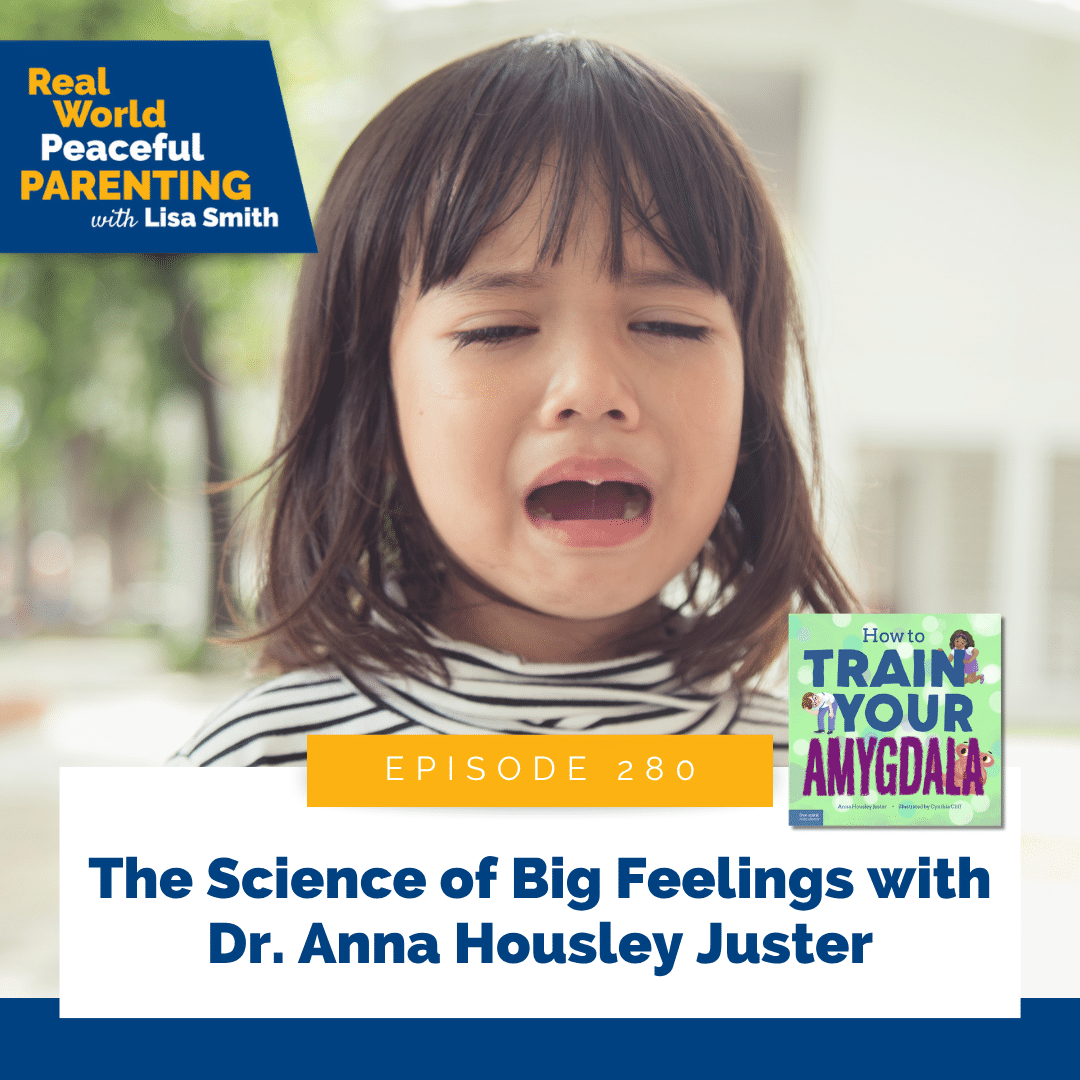
What if your kid’s big reactions weren’t bad behavior… but a brain doing exactly what it was designed to do?
In this powerful episode of Real World Peaceful Parenting, Lisa sits down with child mental health clinician, education consultant, and author Dr. Anna Housley Juster, PhD, LICSW, to talk about the amygdala — the tiny but mighty part of the brain responsible for fight, flight, and freeze responses.
Together, they unpack why kids melt down, shut down, or lash out, how co-regulation actually rewires the brain, and why play is one of the most powerful tools we have as parents. Dr. Anna also shares practical ways to help kids understand their emotions without shame, fear, or punishment.
If you’ve ever wondered why your kid reacts so intensely — or why you do — this conversation will leave you feeling informed, empowered, and deeply hopeful.
Website: www.annahousleyjuster.com
Amazon link – How to Train Your Amygdala
Amazon link – The Best Good Thing
Sign up for my free Peaceful Parenting mini-course! You’ll find everything you need to get started on the path to peaceful parenting just waiting for you right here!
What You’ll Learn from this Episode:
- Why the amygdala exists and how it impacts your kid’s emotional reactions
- The real neuroscience behind co-regulation and why calm parents matter so much
- Why “just take a deep breath” often backfires during a meltdown
- How play helps kids process fear, anxiety, and overwhelming emotions
- Practical ways to help kids regulate before they hit emotional overload
- Why your kid’s behavior is not a character flaw — and neither is yours
Listen to the Full Episode:
Featured on the Show:
-
- Click here to sign up for my free Peaceful Parenting mini-course! You’ll find everything you need to continue on the path to peaceful parenting over there just waiting for you.
- Send us an email!
- Message me on Instagram and tell me how you felt after 10 minutes of undivided attention with your child.
- Click here to join The Hive!
- Peace & Quiet: The Crash Course For Peacefully Parenting Your Strong-Willed Kids
Full Episode Transcript:

Welcome to Real World Peaceful Parenting, a podcast for parents that are tired of yelling, threatening, and punishing their kids. Join mom and master certified parent coach, Lisa Smith, as she gives you actionable, step-by-step strategies that’ll help you transform your household from chaos to cooperation.
Let’s dive in.
Welcome, welcome, welcome. Welcome to today’s episode. I am super excited to be with you here today, and I have to tell you, today’s guest is someone whose work I’ve been pointing families toward for a while now. And when she kindly agreed to sit down and let us pick her brain, I jumped at it. My guest today is Dr.
Anna Housley-Jouster. Anna is a child mental health clinician, an education consultant, and an author with over 25 years of experience supporting children and families. And y’all, she started her career Head Start teacher, which if you know anything about Head Start, you know that this is where you see kids and families at their most real.
And then she went on to serve as the director of content for Sesame Street. Yeah, you heard that correct, Sesame Street, where she shaped educational content for one of the most trusted names in children’s learning. And now she’s a, in private practice, specializing in early childhood trauma, anxiety, and behavioral challenges.
But here’s what I want you to know about Anna. She wrote a book, oh, and it’s such a favorite of mine. It’s called How to Train Your Amygdala, and if you’ve ever said to your child or to yourself, “Why do I react like this?” This book is for you. I recommend it to families all the time, and I’m just absolutely thrilled to have you here on Real World Peaceful Parenting.
So welcome, Anna. Thank you so much for having me, Lisa. That’s such a nice- Yeah … introduction. Thank you. You’re welcome. It’s, it’s honestly a real treat. I’ve been up since 5:00 AM looking at my notes- Oh, no. … about recording this, so this is great. Awesome. So let me ask you this. You start as a Head Start teacher, and I’m assuming that’s in the trenches with some of the most vulnerable kids and families in our country, and then you became the content strategist for Sesame Street.
Mm-hmm. And now you’re in private practice. What’s the thread that runs through all of this for you? Mm-hmm. So I was thinking about that question before we started today, and realized that ever since I was about 13 or 14, every, every job I’ve ever had had something to do with children and families, with the exception of waitressing in college and as, acting as a host in a restaurant.
Every other job from, like, 14 to my age now. So I think I’ve always, even as a teenager, been fascinated by kids and how they think. And early on, um, I loved Sesame Street and said out loud, like, “This is what I wanna do someday with my life.” So I, I had Sesame Street as a goal, but at, the through line is that, you know, Head Start
Sesame Street was designed initially to reach kids that maybe not getting access to literacy and math skills, et cetera. And I think, you know, Head Start was obviously designed to make sure that there was more equity in early childhood education in this country, um, starting in the ’60s into the ’70s into now.
So it’s fantastic, right? Like, how long it’s inv- evolved. So when I first graduated from college, that was the one place I wanted to work, was I wanted a job at Head Start to work where I felt like I could make a really big difference. And I liked the model of wraparound support, where it’s not just, um, seeing the child in the classroom for a period of time each day, but I ran parent groups, I was working with social workers on, um, home visits, so I loved that wraparound piece.
And then the through line into Sesame Street is that’s where I, I’d always wanted to work, and I love the impact globally. Uh, there’s such good, strong work that they’re doing to this day. Um, I loved the power of the show and how funny it was, ’cause I’ve always found that, like, the way to engage kids best is through play and humor and engaging characters.
Uh, when I moved from New York to Boston, I had finished my PhD, um, at NYU, and I was studying play, so I ended up at Boston Children’s Museum doing a lot of, like, in- uh, community engagement and play-based work in the museum. And then I got interested in the increase in anxiety, and I was doing a lot of work, um, with communities and a lot of social workers.
Went back to school, did MSW to get the licensing for doing clinical work, worked at a community mental health center, and then started a private practice. So I’ve always worked with kids and families, and I would say that the through line is wanting to support their healthy development, and the way of doing that is what has evolved kind of throughout my career.
And, um, yeah. And the idea for the book came from my day-to-day conversations with kids about how their brains work, and how to create a compelling character like Sesame … Inspired by Sesame, how do you create a compelling character to teach something that’s actually pretty complicated, but to break it down in a way that’s simple enough for very young kids to understand?
Yeah, the light bulb just went on for me. I r- I re- as I mentioned, I recommend your book a lot to families really of all ages. And what I love about the book is that you made the amygdala a character. Right? A fuzzy creature who overreacts instead of a brain structure. You know, something I say to kids and parents all the time is, “Your amygdala is a part of you, but it’s not all of you.”
Mm-hmm. “And it doesn’t define you.” Mm-hmm. And I think, you know, you, that I can feel that playfulness, that study of play. I understand that, uh, desire or that experience teaching kids to play, and the characters in Sesame- Mm-hmm … then probably spoke to you to create the amygdala as a character. Yes. Tell us about that.
So I think, you know, it was inspired by the idea of, like, bringing content to kids in ways that are engaging and playful, and you can’t ever overestimate the power of a good story, right? So I mean, if you sit with a child and just tell them how to be, as you know, they will not take in everything you’re saying, and, like, a lot of it gets lost.
If you create a, an interesting narrative where there’s a draw- a character that draws them in and makes them care, they’re way more likely to participate if you’re looking for participation or listen if you’re asking them to read a story with you, or if you’re teaching a class, or if you’re their parent trying to get them to put their shoes on.
You know, all the things that we want kids to do, their language is play. There’s no question about it. We know that, so if you can e- engage them in a playful way, it’s, it’s really likely to be more impactful. And the reason I wanted the amygdala not to be a scary character, a lot of books for kids about anxiety or, like, managing their fear will have, like, a worry monster or some sort of, like, inherently scary creature, and I always found that when I was working with kids a little bit extra scary because the, it, it kind of, I think, feeds into the idea that there’s something wrong with you.
I think something I read on your website is, like, we’re not broken. Mm. As parents who yell or as kids who can’t figure out in that moment how to behave, I wanted the amygdala and the, the reader to align. Mm-hmm. So we’re not trying to fight back against our amygdala. We need to be partners, right? It’s part of us.
We can’t get away from it. Right. It’s gonna be there no matter what. So it’s about how it works for us. The meaning of self-regulation is really to recognize when what’s happening in your body and your brain and, and, and understand that maybe in this case I’m acting or saying things I don’t wanna say.
Understand that that could be starting with the threat response, and then how do you reset? Not, how do I make this never be a part of me again? Yes. Like, that it’s a bad- Yes … part that you have to get rid of or something, which is impossible and not necessary. Right. It’s really about training, which is why it’s called How to Train Your Amygdala.
Yeah, I love the title and the concept of, of w- You need your amygdala- Yeah … right? I mean, we wanna have an amygdala, we just want to train it when to show up for work and when to lay down and rest. Exactly. Take a nap. Yeah. Yeah. It will still be there when you need it. And obviously, like, there are real threats in the world.
I mean, the example that the amygdala shows in the book is if you’re about to step into traffic and your brain, your amygdala works in a, in a space that we can’t possibly fathom. It’s instantaneous, that it hears the car that has suddenly turned the corner and it’s racing towards you, that makes your muscles, those messaging to the muscles is to freeze.
Yeah. Right? Like, but you have to have… I mean, we need that. Without that, it’s very dangerous. Um, the problem is that it’s not, the amygdala didn’t catch up with the way that human development has caught up. So it’s more likely to go into threat response and think it’s helping you survive, when in fact what you’re really frustrated about is your child’s time on an iPad, and your brain convinces you that if you fight against the iPad and your child, you’ll survive, when in fact this isn’t a lion that’s charging at you.
This is, like, a conversation with your child about a, about time on a screen. So I, I work with parents, like you do, to try to help break down, like, what is actually happening neurologically, and then how do you kind of work within that framework to figure out what to do next with some knowledge. Yes. Yeah.
Yes. And that’s a perfect lead-in to the next thing I’d like us to talk about. I spend a lot of time on this podcast and with my clients really talking about the value of co-regulation. Mm-hmm. Right? Uh, you know, the idea that our kids’ nervous system literally borrows calm from ours. Yes. They cannot get there alone.
I grew up in a very dysregulated home- Mm … and really made an effort to break the cycle with my now 21-year-old. Mm-hmm. And the turning point in my parenting was when I really understood the co-regulation and that he was gonna feed off of whatever energy or regulation or dysregulation I brought into the room, right?
So I always try to help parents understand your kids are not gonna get there alone. I call the parent the redwood tree, rooted deep and wide so the children’s nervous system can feel the stability- Mm … and start to sync with it, right? Mm-hmm. Mm-hmm. So through the lens of the amygdala, help us understand what’s actually happening biologically in that moment when a calm parent helps a dysregulated kid find their way back.
Mm-hmm. S- I agree with you 100% that all of human behaviors are learned in the context of relationships, and we also learn who we are in the context of relationships. So these patterns start, you know, in infancy. We’re wired to survive and we’re wired to connect, and I always feature those two- Like, what I mean by wired is, like, we’re programmed almost at birth.
Our brains are, are blueprinted for, to survive and to connect, and those are the most important things. So what happens with the amygdala is the amygdala’s job is to help us survive, and the connection piece is like this is how to regulate that so you don’t have to always think you’re in threat response mode.
And if there’s been one or several really dangerous things that have happened to a human brain or growing up in a space that was dysregulated, the wiring of that brain is going to look for threat more closely, and, and, and experience it more fully. And so the adult’s job is to rewire the brain through co-regulation essentially.
So that, it’s, it’s crucial. So what I help parents try to think about is with r- respect to the amygdala. So the amygdala, for people that don’t know or maybe have never heard this word before, it is a, a tiny part of the brain. There’s actually two sections, one in each hemisphere, um, but we call it singularly the amygdala, and its job is to take us into fight, flight, freeze.
So it’s the automatic response to a threat. Um, in kids, that can look like fighting, like actual that you would recognize. It can look like turtling I call it, where they just freeze and they’re under a desk in the classroom, or they’ve shut down in your home and they won’t say a word, or, um, running away, so just trying to get away from the threat and not face it at all, which is what happens a lot with an- anxiety.
If I just avoid this thing for long enough, I will never have to deal with it, until you do. Um, so what I help parents and kids… Kids can say the word amygdala at three years old. I have kids in my practice that at three or four are saying this word, and we practice, and in the book it breaks it down, so you have like syllable by syllable.
It’s a fun word to say. So what I help people understand is that when you feel hot like that and you get tense, and you’re, like you feel like you could actually fight, your brain is telling you this is a really dangerous situation, and you need to fight until you survive. W- And we would call it win, and as you know, when you think you’re trying to win an argument, like a conflict back and forth, and it’s a power struggle, you’re not going anywhere.
And you can yell as loud as you want. Mm-hmm. And it’s gonna get worse. The neurobiology of why that gets worse is because what do you look like to the child’s amygdala when you’re screaming? A second lion. Already there was something that was making me angry. A lion is charging at me. My brain f- my amygdala thinks there’s a lion coming, and now my mom looks like a lion.
So now I’m really in fight response mode. And at some point what happens, and the reason language doesn’t work, is it’s just one amygdala in the brain trying to survive against another perceived threat, another amygdala, and you basically have two brains going at it. Co-regulation looks like the adult first noticing that, down-regulating, bringing them, their s- their own central nervous system down a notch in order for the child to see they’re not a lion, right?
They’re, they’re regulated, so I can be regulated because I’m not surviving anymore. I don’t have to be scared that this other lion is coming in and, um, attacking me. So it’s really just about understanding the kind of like … I will actually e- encourage people to look inside their head. Like, if you could actually for a second close your eyes and picture this tiny but mighty part of your brain.
Ask it to calm down, maybe give it a hug. Mm-hmm. Like, at the back of the book there’s a training manual for kids, and one of the tips that the amygdala says is, “Give your amygdala a hug. Nurture it. I see you trying to protect me. We’ve got this.” Yes. “Let’s bring it down.” And that’s the s- it’s the central nervous system of one human with the central nervous system of another regulating together and to, to be calm.
Yes. Yeah. Mm-hmm. A lot of times when I talk to parents about the amygdala, because, you know, I, I like to say when a storming child meets a storming parent- Yep … there’s gonna be an explosion- Yep … 100% of the time. Mm-hmm. And explosions solve no problems. Mm-hmm. Right? Or you get withdrawal. Right. Like, withdraw.
Or one, one is fighting so the other one’s gonna do the other thing, which is to run away or freeze, and then you have nothing. They can’t communicate then either. That’s right. Yeah. The child can’t hear and learn- Right … when they’re storming and there’s been an explosion. Right. And so I literally notice, I’ve trained my amygdala very well.
Mm-hmm. And, and I notice when it shows up to report for duty- Mm-hmm … when it doesn’t need to, right? Mm-hmm. My 21-year-old calls from college and says, you know, “Mom, bad news.” You know? Yeah. And it really, the bad news is the bookstore was closed when I went to get my books, or- Right … Target was out of blah blah blah, right?
And so literally I can feel my amygdala like, “Reporting for duty, ma’am.” Yep. And I will say to it, “Thank you. You may stand down.” Mm-hmm. “You, you’re not needed.” Mm-hmm. “You can go rest.” Mm-hmm. And the way I frame it and encourage other people to frame it is save it for when, you know, you really do need it, right?
Mm-hmm. It’s … You know, I like to say, you know, it’s 2:00 AM. You and I have been to a great concert. We’re walking arm in arm back to our car, and all of a sudden we hear hoots behind us. Uh-huh. In the dark, right? That’s when you want your amygdala to show up for work. When, you know, you’re … Like, you gave the great example.
Your kid won’t get off the iPad upon your first command or put their shoes on, or they tell you at 8:00 at night they need poster board. Yes. Right? They come home from school and they’ve had a fight with their best friend. Mm-hmm. As the parent, we need to recognize that our amygdala likes to show up for work.
Like, “I’m here to perform my very best job I possibly can.” Mm-hmm. And I think the more we model that for our kids, like, “Okay, I’m dysregulated. Let me gather myself before I proceed.” Mm-hmm. Don’t you agree we’re also modeling that for our children, and then they learn it? 100%, and I think … I mean, one of the misperceptions of regulation, I think we use that word, is that it’s only called upon when there’s dysregulation.
Right? Like, there’s dysregulation and then you know have to reg- you know have to know h- how to regulate. It’ll never be learned only in the context of a storm. Mm-hmm. You practice regulation like you brush your teeth. Right. You know, it’s all the time. It’s every day. It’s like breathing, and breathing is one of the ways you regulate, obviously.
But, like, and the, the people th- people always… Sometimes I think these days we say, “Oh, take a deep breath,” and it’s actually kind of, like, dysregulating because it seems like you’re not listening. The science of why that works is that if we were being threatened really, like in real danger, if the car is approaching, you’re not gonna stop and take, like, really easy, long, deep breaths.
So the message from your body back to your amygdala is like, “We can’t be in actual danger or we wouldn’t be behaving like this in our bodies.” So that’s the science of, like, why it works to breathe, but it has to be part of that other… There’s so many ways we can regulate, and it’s unique to each person.
But you have to practice it all the time to make it available, and help kids practice it all the time so that it’s available when the amygdala says, “Hey, I actually think I’m really threatened right now.” That can’t be when we teach the amygdala, right? It has to be learning it like it’s going to school all the time.
Amydala’s riding the school bus to school all the time to, to study and practice. Right. And we help it do that so that when it’s necessary to regulate, we already have those skills. Yeah. Yeah. I have a, a… I just did a teacher tr- uh, I was on a teacher summit recently, and one of the feedback, one of the pieces of feedback was that this analogy helped people more than anything.
So I have this snow globe. It’s pretty small, but I c- my bigger one is at work. So when the amygdala is threatened, it’s like your brain goes into snow, a snow globe, circling like a storm, and all the re- all the regulation really means is doing something that settles that and allows more space and less chaos to use a strategy, be calm and connected.
So the visual of this is important ’cause we can’t see our amygdala. So I use the snow globe as the visual. So if you notice you’re snow globing, picture the snow globe, ’cause we all know what this looks like, right? Picture this. Picture it settling before you make your next decision about the thing you’re gonna say about the bookstore when you think that there’s actually something that’s really risky.
So it’s just a nice, um, analogy for what it looks like, and then what it looks like when it’s calm since we can’t look inside- Yeah … unfortunately and see what the activity is in our brain. Yeah. Well, I think you hit on something that, that I, I would like us to reinforce for the listener. I talk about this all the time as well.
I call it front-loading, you know? Uh-huh. So, so practicing, I mean, bringing in your, your experience in play. Mm-hmm. Kids learn through play. They learn through repetition. They learn through practice, as do adults as well. Yes. Right? Yep. Mm-hmm. I practice going to the gym- Mm-hmm … for so long now at 7:30 in the morning, three days a week, that it just feels like what I do.
Yep. I don’t have to think about the 18 steps- To get- Yep … from the bed to the gym. Yep. So I think that you’ve, you’ve really hit on it, that practicing. If, let’s say your kid is a, is a little anxious or worried about riding the bus. Mm-hmm. Right? And the amygdala shows up when it’s time to get on the bus on the way to school.
Mm-hmm. And suddenly the kid has a tummy ache. Right? Mm-hmm. “I have a tummy ache.” Mm-hmm. Creating a, a f- a, a bus in your living room- Love that … with a bus driver and seats and practicing- Yep … getting on the bus and riding to school with the tummy ache, right? We’re not gonna make the tummy ache go away in the beginning.
It’s riding to school with the tummy ache and understanding you can survive it. That’s where the play is so powerful. Yes. Yes. And when adults play, they teach the child that they’re willing to be vulnerable, and when we’re willing to be vulnerable, we’re not in threat response mode. Mm. The, one of the reasons play just scientifically is so important is because if you’re doing that bus play and you’re willing to be an adult that’s like, “Okay, I’ll get on the bus now,” and like, “No, I’m gonna…”
Or like, “Let’s take this stuffed animal, and the stuffed animal’s getting on the bus,” is that the child sees, “This adult is willing to be vulnerable and speak my language. Now I have, like, more trust.” And the trust and the, their, the adult avail- the ability to be vulnerable makes it more likely that the child will be able to regulate.
So that’s a key part. That’s how play is part of co-regulation as well. Yeah. I didn’t realize that. And- So that’s super helpful. Yeah. Yeah. It’s really important. Yep. Yeah. Yeah. Yeah, and the reason we feel nauseous when we’re anxious is the amygdala sends a response, a message to the abdomen, to the body, to send all the blood to the large muscle groups and back to the heart, because that’s what you’d want if you were gonna run and sprint, as- Yeah
you know, get away from something or fight. And so what I tell kids is, like, this is the science. You’re not actually gonna throw up most likely, and you’re not actually sick, like virally or infectious sick. This is, your amygdala’s trying to help you, send the blood away. And if you breathe into the abdomen or lie on a pillow and do your belly breathing or put your hands in, you’re directing the blood back to the abdomen, and that’s what makes the nauseous feeling go away.
So that’s, there’s a part of the back of the book with a tip for kids, like, this is the science, and once you know that and you can say to yourself, “I’m not actually sick. Like, this isn’t, like, I’m not… This isn’t like a s- an illness sickness. This is just my amygdala saying, like, you’re getting ready for some s- super scary thing.”
But is it really scary? Right. Like, have I done this before? I’ve gone to school before. You know? Yes. Like, I, you can logically understand that it’s not as scary once you get out of that threat mode. Yeah. And even if it feels scary, it’s still okay to do things while feeling all these feelings, right? I think- Yeah
that is something that parents of worried, anxious, fearful, high amygdala response kids can’t hear enough. Yeah. The goal isn’t to remove the fear. No. Mm-mm. The goal is to, like I said, go to school- With the tummy ache- Mm-hmm … understanding all that’s happening to the body- Yes … and not accommodate the amygdala.
Yes. Right? Because then it just jumps from thing to… The worry. Yeah. Not the amygdala jumps, but the worry- Mm-hmm … jumps from thing to thing to thing. But really help the kid, at any age, be able to live their life- Yes … while feeling uncomfortable. Yes. It’s not the feeling. The feelings are really important, because we need our feelings to teach us about how we’re interacting with the world and what the world is like.
We need our feelings. But it’s about coping with them, right? So it’s not that you won’t feel worried, but I know you’ll cope with your worry. Right. Cope with your worry, yeah. Well said. The coping and handling of it, yeah, that will- Well said … make… Yeah. Okay, I wanna ask you a couple questions about the book.
Okay. Um, because I really want parents to be able to understand this. You, and I think you sort of already answered this, but I wanna circle back around to it. Okay. You give kids and families real strategies. Deep breathing, visualization, progressive relaxation. Mm-hmm. But here’s what I hear all the time.
Okay. “I tried just breathe.” Mm-hmm. “And my kids rolled their eyes or escalated or looked at me like I had three heads.” What’s the difference between a regulation tool that actually works and one that completely backfires? Well, so I think timing is everything, right? So if the child is, uh… Like, I help kids with scaling.
So if you’re at a 10 for anger, “Please take a deep breath,” is not gonna work. The child would have to regulate a little bit first, and maybe m- you could model what you’re ask- what… You could do what you… Kids always, we know this old saying, like, they’ll do what we do, not what we say, right? So it’s always better, in my opinion, to model something near a child if that’s what you want them to do, versus, especially this.
“Take a deep breath. Just take a deep breath. What are you doing? Just take a…” Like, yeah. Because then you’re, you’re the lion telling the child to take a deep breath, and that’s not trustworthy at all. Like, “Well, why would I wait with you and do that? You look scary.” So it’s first about, you know, regulate yourself first.
Maybe model it and show it, and then let the child see what’s happening, see that you’re not the, not a lion anymore. Become not a lion, something other than a lion, and then maybe you can engage with them. But like I said earlier, you can’t wait until that moment at a 10, or even an eight, if 10 is the most anger, the most dysregulation, to say, “Take a deep breath.”
Mm. This has to be something that you’ve done yourself and showed. Like, you come home from work, you’re trying to get dinner ready, you realize that you’re spinning a little bit or you’re anxious, you’re going to threat response mode about little things. Actually stop and be like, “Wow, this was a day. You know, I need to really calm my amygdala.
I’m gonna take a deep breath.” And you’ve showed yourself doing it when the child’s not dysregulated. That builds a new way of being, like I said earlier, that rewires the pattern so that hopefully, and like your work shows, you create a pattern of less dysregulation over time. But the reason it won’t work if you say, “Just take a deep breath,” is the words.
The amygdala takes over the language-based center of the brain, and you’re not talking anymore, and there’s no communication. So it has to happen, like, earlier in the process. Yeah. Yeah. I, I always use a scale of green, yellow, orange, and red, and I say- Yep … if, if one of you is in red, all bets are off. Like, at that point- Yep
it’s just staying with the child through the storm. Mm-hmm. But then the t- goal also i- as the parent is to- Mm-hmm … look, know your kid, know their tells, look for them as they’re moving up the scale, right? Mm-hmm. Green, yellow. Because wouldn’t you agree, and you said it, like, if you can intervene at a lower number and not let it get to 10, then we can get back to green much faster, or lower the number on the scale.
Yes. So you do have to know your kid and know their tells. So for example, if you’re at a birthday party and you’re in the pool and I say, “Time to get out.” Mm-hmm. “We’re gonna go home,” and your kid ignores you, that’s a tell that they’re building up on the scale. You don’t keep saying, “Get out of the pool, get out of the pool, get out of the pool.”
Then they’re dysregulated at a 10, and now you’re telling them to breathe, right? You might need to go over and call them aside. “I, I listen, I can see you’re having an amazing time, and you don’t want to leave this party. And in five minutes it’s gonna be time for us to get out and go.” Yeah, and you can even say, “I know that might make you frustrated, and I’m confident we’re gonna be able to cope with this together.”
Oh, there you go. Like, you can even, like, you can, like, I… Like, it’s okay to have the feeling. “I know you’re feeling worried. I’m confident you’re gonna be able to cope with this, and we’re gonna be able to move through whatever comes up.” What you wouldn’t do is stand on the other side of the pool and scream across the entire pool so that all the other kids see it and hear it, because now you are a lion.
Yes. You’re embarrassing me. You are threatening to me. Now I’m a little scared. Why would I get out of the pool with you? Right. My amygdala now is saying, like, “You just stay in this pool.” Because this is a safer place to be than that Yeah Um, and so it’s just really important. And to your point, you’d have to first, as the parent, have the ability, which comes with your own practice, to not scream across the pool.
Of course, I have done this. I talk about this all day long. I have done this before, right? Like, like even these days, once in a while, like, I will find myself unable to slow that down. Yeah Which brings me to a really important point. It is never too late to come back to regulation. What I mean by that is that if I screamed across the pool, and I embarrassed my child, and I, and I feel bad about it later, and that’s contributing to some sort of narrative of shame, it’s really essential to slow down.
I think you talk about this, too. Like, slow down the shame piece and r- regulate in the f- in the future about a past event. So yesterday, when I screamed at you across the pool, I realized that what was happening in my brain is I was looking around and thinking, “All these parents think that I can’t get my child out of the pool.”
So now they’re all hawks, and I’m a mouse, and my amygdala is saying, “You’re in danger because this is threatening. They…” And so I’m actually feeling threatened by all these other people, but who did I direct that fight response to? You. And I’m sorry. Like, I, I regret that I did that because normally what I try to do is recognize where the threat might be coming from and not displace it onto you.
So I, I’m sorry, and what I wanted to do was X. Now, the child sees not only that your main commitment is to connection and having a relationship with that child, and that you’re not really a lion. It was a momentary glimpse of what someone looks like when they’re in fight response, when the amygdala’s taking over and sending that message through the body that you have to protect yourself from all these other parents.
I mean, this is a problem, which is that parents are constantly under a microscope- Mm-hmm … and I think feel threatened by the idea that they would not look perfect in that moment of the parenting. So then they’re coming to their parenting moment already in threat response mode. Mm-hmm. Does that make sense?
Yeah. Not because of th- the child’s doing, but because of this existential, bigger threat of, like, “I’m not good enough, and I’ll never be good enough.” And so that narrative spills over into our ability to be mindful and parent our kids, and it’s just a really important thing to take, to take care of in yourself and know that you are good enough.
Yes. If you’re trying to connect with your child, and you’re taking them to the pool in the first place, you’re at the party, you’re good enough. Like, you’re, you’re doing it, right? You’re doing the thing. So there’s a narrative. There’s, like, you know how we say, “Kids will do what we do, not what we say”?
They’ll also do what we think. So if we think we have a bad child who’s, like, constantly- Mm-hmm … just getting in trouble, and that’s the narrative, like, it’ll never be different, we are gonna bring that in our tone, our, uh, how quick we go to threat response mode. So we have to fundamentally believe about our kids- That they wanna be good, and they are Yes And if you act like they already are, we will see the behaviors that go with that narrative, not the narrative of like, “My kid’s always gonna be this way.
My kid’s always misbehaving. It’s always embarrassing.” Does that make sense? Yes There’s like the step back before the behavior that’s the thought, and I think that’s gets missed sometimes- Yes … when we try to change behaviors, I would say. I think that gets missed a lot. Yeah. You go to the pool party pre-triggered.
Right, I know. And you’re anticipating. Right So now your, your amygdala is saying, “There will be a threat.” Yes. So your body is- Get prepared. If I’m right here- Like, it’s like- … I’m, I’m ready. It’s like the- Yeah … amygdala says, “I’m ready to report for duty. You just give me the slightest wink-” Yeah “… and I am on it.”
Yeah. The amygdala- If I talk about- … is not on like, the amygdala’s not on a raft on the pool- Right … relaxing. The amygdala’s, like to your point, is like braced. Yeah And so sometimes parents will say this out loud to other parents, right? Like, “Oh, I’m just waiting for when he causes a problem.” Yeah. Or, “I’m anticip-” It’s not always externalizing.
Sometimes it’s the kid that won’t go in the pool. It, the kid that was like too scared to even interact with everyone. So that parent is already prepared for the child to freeze or run, but that, ’cause those are the two things that they might do, right? Fight, flee, f- flee, or freeze. So they might run away and not wanna participate.
They might just sit down on a chair and not wanna even go in the pool. They might not talk to any other kids. I deal with a lot of kids that have this like social anxiety, and they’ll… But if the parent is already prepared for that, they’re anticipating that. So they’re saying things like, “Okay, I think I know.
It’ll be okay this time. When we go to this pool party, I just want you to, you know, at first you can sit with me, and I’ll stay with you.” And so they’re saying, “I see the lion too. It probably is dangerous to be at this pool party,” right? So they’re aligning with the anxiety. Mm-hmm Not yelling, just aligning with that sort of freezing or like, like, and the, it’s the anticipatory threat.
It’s the, uh, the threat response because of anticipation- Mm … of something that might not actually happen. So could you show up at that pool party neutral- Mm-hmm … in your own story- Mm … assuming that the child is gonna go in the pool, assuming the child will get out of the pool? ‘Cause those are two different problems.
Right. But they, you know, but g- different kids respond differently at the pool party. So it’s like could you be neutral and regulated? There’s no lion. Right. I’m, we’re gonna chill out at this pool party and be happy that we have a, a pool party that we’re invited to, and just be. And it’s okay if my kid gets in the pool, and it’s okay if my kid doesn’t get in the pool.
Yeah. And- And everyone, and I’m doing my best. Like, and it, it, exactly. Right. And my kid is doing their best. Yes. And if we are both doing our best, our amygdala are gonna be more regulated. If we, no, sorry. If we both believe that we are both doing our best- Yeah … already, just by the nature of that thought process, now we have calmed the threat response.
And so it’s less likely- That if something does happen, it’s an automatic trigger into fight, flight, freeze. It’s already more likely that you’ll be regulated. So I like to help people think about the thought before the behavior and the feeling. Mm-hmm. Right? So the thought process matters a lot, too. The movie you’re seeing in your head of how this is gonna go.
Yes. ‘Cause we all see movies. And I feel like I have to mention this as well, in this, in the story of the swimming pool- Mm-hmm … and getting there, and my kid getting in the water and refusing to get out, or my kid not getting in the water, there’s our own experience and childhood wounds coming to that pool party as well- Yeah
unless we’ve done the work to set it on the shelf, right? So maybe you were the popular kid and it’s hurting you that your kid’s not popular, or maybe you are over-relating to not having any friends at that age and not being comfortable to get in the pool. So that is running in the background like B-roll in the back of your brain, unless you’ve done the work to heal those wounds, because that also shows up and your amygdala is performing based on that as well, right?
Yeah. Yes, ’cause don’t forget, you have the same amygdala in your brain today that you did when you were an infant. Yes. The same, the same one. It, it shifts and there’s different structural aspects of it. What’s interesting, though… So it is the same. It has evolved, and what’s really cool is you can change it- Mm
even as an adult. So even though it’s the one you’ve had through maybe traumatic experiences or neglect or someone who did shame you, like if you’re used to being shamed, then the shame, then that, that pattern is gonna be there. But there are studies that show that mindfulness training over time actually changes the size of the amygdala.
So e- even as a, an adult, you could be 85 years old and shift your practices to change the structure of your brain, which would change the narrative that you’re bringing to that pool party, right? So there is never a time that it’s too late. So if you’re listening to this and thinking, “Well, you know, my kids are 30 years old, so I, whatever I did, it’s done.
I wish I had known this at the time.” Mm-hmm. Uh, I understand that, and it’s a real feeling and thought to have. And there’s an and, which is that you can come back to this at any time in changing your own way of thinking about yourself and your own patterns that shift amygdala use and the s- actual, uh, size of it, and also how you come to your kids, even if they’re adults.
So it’s just so super important to not think of this… I mean, people have bought this book for their grandchildren, and I’ve gotten feedback that says like, “I didn’t know that I had an amygdala in my brain and I’m 65 years old,” and it explains so much- Mm-hmm … about like, “Oh, now I understand what’s happening in myself,” and it kinda just takes away some of the shame and blame, honestly, ’cause it makes it like a, a science versus, um, some sort of internal flaw.
Yeah. Yeah. I see this a lot with multiple generations, where- You know, the, the grandparent raised the parents, their adult children, a certain way, and now they’re retraining their amygdala with their grandchildren. Yeah. Right? And the, the, the adult child who’s now the parent is a little confused- Right
right? Or in some cases, happy. Yeah. Grandchildren are getting the benefit of it. But yes, it’s, it’s exciting that we’re never stuck, and there’s always room for growth- Mm-hmm … if we’re open and willing to. So speaking of that, here’s what I wanna ask you. Last question. Uh, what I really, one of the things I love the most, Anna, about the book is the training playbook in the back- Yes
of the book. Yep. And what I’d like you to do is walk us through how a family could use this. Mm-hmm. And what I want the listener to hear is this isn’t just a book to read at bedtime. Mm-hmm. Like, this is actually a working book- Mm-hmm … that you can get out and work with your kids. So w- and, and I, I refer to it a lot.
So tell us how you would recommend using- Yeah … the training. Yeah, no problem. Well, I’m holding… I wanted you to know, too, this is the bilingual copy, so I have, that’s in Spanish and English now. So I have How to Train- Oh, nice … Your Amygdala to Amygdala, so that’s the one I have. Great, and the whole thing is, um, in English and Spanish, including the playbook at the back, the manual.
So the way it’s organized is that there’s the story, and like a third of the way into the story, after the amygdala says, “I’m powerful. I protect you from danger,” it mistakes a sound at the door and a shadow for something dangerous and scary. It turns out to be a kitten delivering a large cheese pizza, and that’s not scary.
And so the rest of the book is asking the reader to help it to be calm. So it teaches breathing, progressive muscle relaxation, and visual imagery, which is just basically using your imagination to change the story of what’s happening. But at the back, I have the amygdala training manual for kids that was written by the amygdala.
And so it goes a step further to teach three different types of breathing. Lazy eight breathing, which is really a good one to do ’cause it involves, uh, moving your bo- moving your hand and also breathing. Square breathing, and then dragon breathing, which is where you, like, breathe out all your hot air and anger first before you try to regulate in other ways.
Tip number two is to breathe that way every day to make it really a part of your life, like we said. Mm-hmm. And then three, give your amygdala a hug. Like, actually close your eyes and imagine that you could go in and give it a, a squeeze and take care of it. Then for parents, the, there’s another guide at the back that is about, um, basically expanding on that.
So helping the child to… Here, I’ll pull it up. Okay. So the four tips at the back for parents are to pay attention to your own threat response. Then tip two, what to do when words don’t work. Tip three, the power of breath, and tip four, a prescription for play, which gets back to our, the piece about play. So what I recommend is that maybe if you have this book- And you’re going to share it with your child.
You could either just read it right off the bat all the way through, share the story, and then read it together at the back. Or if you wanted, you could read the back, the part that’s specifically for adults, the guide for adults, to give a little, like, framework or for the, for a little bit about the science of what’s happening in the story and how to help kids be calm, and then go and read it with them.
But what parents have told me is it’s not a one and done- Mm-hmm … situation. They make it… The kids will ask to read it before bed because it’s regulating. And because those practices are built into the story, it’s sort of like as you’re reading, you’re doing the breath to help the amygdala. And then the illustrations show it work, so that you can see the amygdala go from being more dysregulated to being calm.
So I’ve had people say that they like to just re- you know, read the story several times each night, and then occasionally go to the back and say, like, “Let’s read this.” Sometimes they want to start with the guide at the back before they underst- before they read the story with their child. But you can use it, I think, either way.
Mm-hmm. Yeah. It’s very powerful. It’s, it’s… Yeah. Thank you. It’s an incredible book, and very helpful and useful, and a guide or a sidekick, right? It takes a village, so- Yes … reading it over and over and over again, and again, I come back to the idea of, you know, helping the child understand their amygdala is a part of them, but not all of them.
Just like they’re not just hair or fingernails or legs. Yeah. And really trying to wrap your arms around the fact that this is a part of me, but it isn’t all of me. Yes. And I am more than this. Yeah. And you want to be friends with it. Yeah. Like, I think it should be kind of your BFF versus like thank you for helping me to stay safe, and sometimes I got it, so I don’t need my BFF all the time, right?
Yeah. Like, but it’s not about, like, I have to figure out how… Like I said at the beginning, it’s not about fighting against it or it’s not your enemy. It’s really your friend. And coming from that place, it feels very nurturing, supportive, and, like, aligned. We’re connecting the brain and the body, not trying to, like, fight back against part of the brain that is, it, that should be in trouble.
Which is the same way we want to feel like we’re talking to our kids, like, right? Like, specific, the characters trying to model… The, the way, the approach to the way that the reader would relate to the amygdala is the way you’d want a parent to relate to a child, which is coming from a place of empathy and wanting to be curious and understand, um, you know, what’s driving a behavior versus just punishing it.
Yeah. Yeah. Yeah. So great. So great. All right, before I let you go- I hear rumor there’s a new book coming out. There is The Best Good Thing. Tell us about that. Well, there is, and what’s really exciting is that this is the first time I’m talking about it, ’cause I just got the, um, ’cause you’re the first person to talk to outside of my publisher.
So it’s called The Best Good Thing. It’s from the same publisher, Free Spirit Publishing, which is part of Teacher Created Materials, and it kind of picks up where this book leaves off. It’s not a training manual. It’s more of a narrative story. But it’s about a child who has a terrible day at school.
Every single thing goes wrong. They identify a new emotion called snad, which is when you’re sad and mad or merged together and you can’t piece them apart, and that happens with all our emotions. They don’t happen, like, singularly all the time. But she tells her mom at the beginning, and it follows them.
She says, “Everything is bad about this day. It’s just a horrible, horrible, um, very, very, very bad day.” And her mom says, “Well, no matter how bad my day is, I can usually find one good thing.” She says, “No, there’s no way. There’s nothing good.” And the mom says, “Well, you’re one good thing about all my days,” which gets her thinking, but she’s still skeptical.
And the rest of the story is them in their community, in their neighborhood, she starts to change the narrative, open her mind, and find good things and realizes she can turn the day around. So it kind of picks up from where you’re regulated- Mm-hmm … to labeling feelings, expressing feeling, and then it, the fancy word is cognitive restructuring, which is essentially in cognitive behavioral therapy how we change the narrative.
We change our thoughts to change how we feel and how we behave, which in turn changes our thoughts- Yeah … in this really, like, circular way. So it’s an extension of the book, but it’s a little bit more of, like, a narrative, um, story. Yeah. Well, I had a sneak peek at it, and I can tell you all, listener, it’s fantastic.
So I would put August 11th on your calendar. And it’s, it’s a beautiful way to introduce thought work, which in the community that I run of parents, we do a lot of thought work. Mm. And working on our, identifying our narrative and then- Mm-hmm … deciding being intentional. Mm-hmm. I always say, you know, you want to c- uh, direct your brain, not let the 50,000 thoughts a day that you have direct you.
Yes. Because we’re hardwired for negativity, right? For survival. Yep. So, uh, you know, we work to be very intentional of our thoughts about our children, about our- Yeah … parenting. And this, I, I, I, as I was looking at this, it’s a great way to introduce thought work to kids, again, through play, through this- Yep
example. You know, it’s just beautiful. I, I can’t wait to recommend it to- Oh, thank you so much. There’s also back matter, like the same as this, that there’s, like, ways to extend that, the cognitive restructuring and everything you’re talking about, um, with thou- coming from a scientific lens again about sort of how to ex- I think of a, I always think of a book as a catalyst.
You know, it’s like the book is the story- Mm … but then how does it lift off the page? And there’s, that’s why it’s so important to have the information at the back, too, for parents about how to do this with themselves, ’cause we all have a narrative. You know, we all walk around with that story you’re talking about.
Yeah. Um, and then how to help our kids do it early, ’cause it’s just- Yeah, your, your playbooks at the back are just a real gift to the parent. It’s not, you know, it’s, it’s not enough to read a children’s book. The parent, we need guidance and support and help implementing the tools, so you do a nice job of that.
Yeah. Thank you so much. Yeah, yeah. All right. Well, anything else you wanna say before we wrap up here? Uh, tell people where they can find you. The book’s available on Amazon. They both are. You can pre-order The Best Good Thing. How to Train Your Amygdala is available Spanish and English, and also just in English on Amazon.
If you like it and you wanna leave a review, I would love it, ’cause I am… It makes me anxious, this is something that happens with my amygdala, that like asking people to say nice things is, like, really hard for me, so I’ve been practicing by expos- exposure to ask. If you like either one of them and you wanna leave a review, that’d be awesome.
And you can also find me and email me through my website, which is annahousleyjester.com. Awesome. Yeah. Yes. A- asking for a review can be awkward. I reframe it as paying it forward. Ooh, I like that. Okay. So if we can help one family out in the world- Yeah … by letting them know about the book, we can change the world one family at a time.
Love it. That’s beautiful. Thank you. Yeah. Thank you for, for that reframe of the story. Exactly. See, we did it live. We did thought work just there. We did it, yes. Right? I offered a reframe, you picked it up and- It’s okay … ran with it, and- I’m gonna use that … everything feels easier, so there you go I can see the, I can see the neural pathways changing as we’re talking about it.
Yes, paying it forward. Yes. Yeah. Beautiful. Well, Anna, it was a real treat to have you. I’m, I’m grateful. Oh. I appreciate it. I know the listeners got a lot out of our conversation today, and your ideas and support and information, so a million thank yous. Thank you so much. I’m so grateful to be here. Thanks for the invitation.
You’re welcome. All right, listener, I loved it. Didn’t you? I mean, it was fantastic. Until we meet again, I’m wishing you peaceful parenting.
Thanks for listening to Real World Peaceful Parenting. If you want more info on how you can transform your parenting, visit thepeacefulparent.com. See you soon.
Enjoy the Show?
-
-
- Don’t miss an episode, follow the podcast on Spotify, Apple Podcasts, or RSS.
- Leave me a review in Apple Podcasts.
-