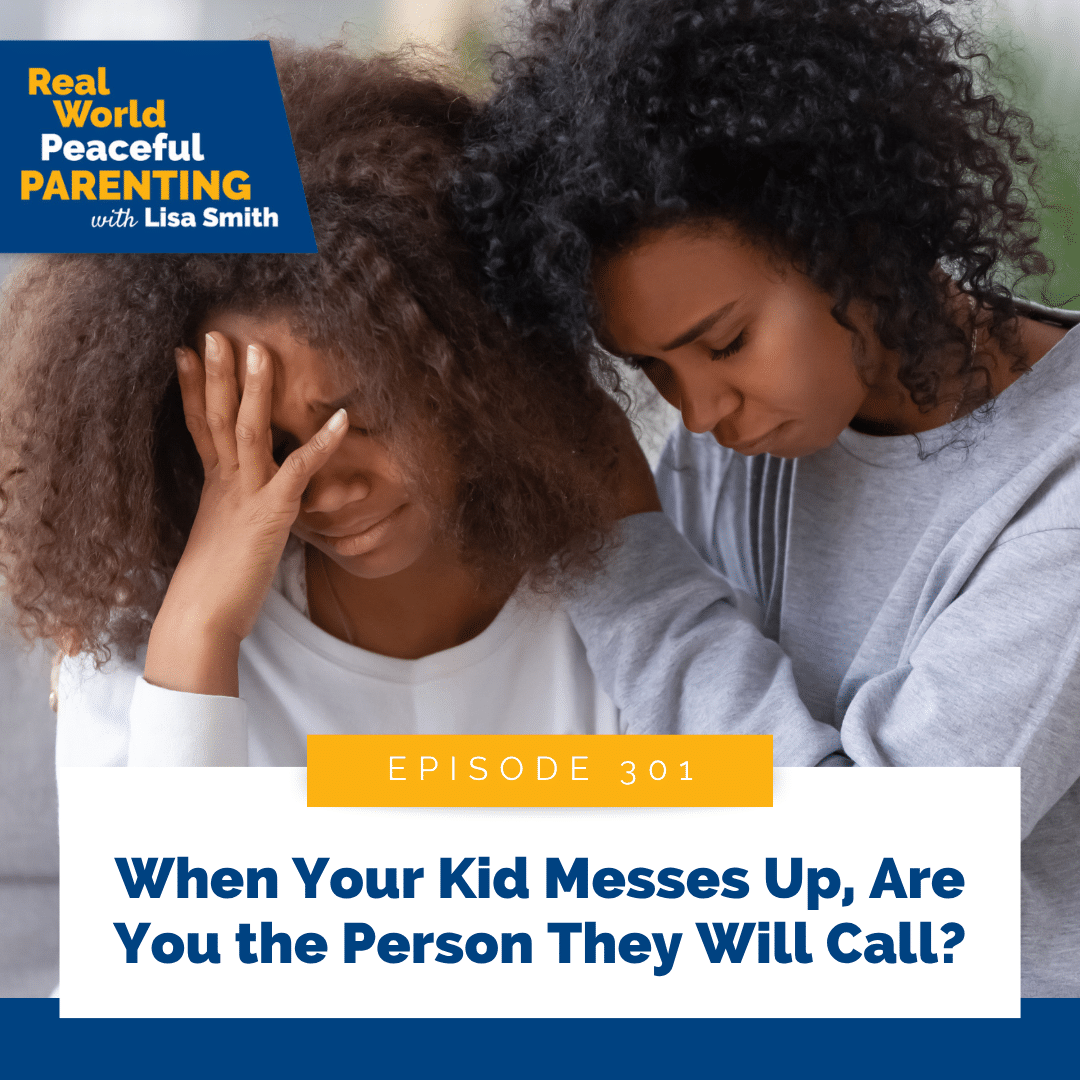
What if the most important thing you’re building as a parent isn’t a kid who always listens, follows the rules, or makes the right choices—but a relationship where your kid knows they can come to you when life gets hard?
In this episode of Real World Peaceful Parenting, I’m sharing what I’ve learned about connection now that my son, Malcolm, is 22 and living his own life. From toddler meltdowns in Target to phone calls from college, I’m reflecting on how thousands of ordinary moments, loving limits, and imperfect repairs created a relationship where I’m still his safe place.
You’ll learn why connection and leadership aren’t opposites, how to stay connected while holding firm boundaries, and why repairing after difficult moments matters more than getting everything right.
Because the goal isn’t raising a kid who never makes mistakes. It’s building a relationship where, when they do, you’re the person they want to call.
Sign up for my free Peaceful Parenting mini-course! You’ll find everything you need to get started on the path to peaceful parenting just waiting for you right here!
What You’ll Learn from this Episode:
- Why connection is the foundation of peaceful parenting, not something your kid has to earn through good behavior, obedience, or cooperation.
- How to stay connected while holding firm limits, so you can say no, enforce boundaries, and teach responsibility without threatening the relationship.
- Lisa’s calm leadership sequence: regulate yourself first, offer co-regulation, hold the boundary, and teach once everyone’s thinking brain is back online.
- How ordinary moments build extraordinary trust, from bedtime conversations and car rides to listening without lecturing and showing genuine interest in your kid’s world.
- Why connection becomes even more important as kids grow into teenagers and adults, when parental control naturally decreases and influence through trust becomes essential.
- Why repair matters more than perfection, and how taking responsibility, apologizing, and reconnecting after difficult moments teaches your kid that relationships can survive conflict.
Listen to the Full Episode:
Featured on the Show:
-
- Click here to sign up for my free Peaceful Parenting mini-course! You’ll find everything you need to continue on the path to peaceful parenting over there just waiting for you.
- Send us an email!
- Message me on Instagram and tell me how you felt after 10 minutes of undivided attention with your child.
- Click here to join The Hive!
- Peace & Quiet: The Crash Course For Peacefully Parenting Your Strong-Willed Kids
Full Episode Transcript:

Let’s dive in.
Welcome, welcome, welcome. Welcome to today’s episode. I am really glad to be with you today. Last week, in episode 300, I got to do something really special. My dear friend Melissa interviewed me, and we talked about my story and my own parenting journey and how I found peaceful parenting, and one of the beliefs that sits underneath absolutely everything I teach, kids are people too.
I’ve been thinking ever since we recorded that conversation that there’s a really important follow-up to that idea. Because if kids are people too, then one of the biggest questions we have to ask ourselves is, what kind of relationship am I building with this person? And today I want to talk to you about connection.
But what I want to tell you right out of the gate is that this is not going to be a podcast about 10 cute ways to connect with your kid. I’m not gonna tell you to play Legos for 20 minutes a day and call it good. No. What I want to talk to you about is much bigger than that. I want to talk about connection as the foundation underneath peaceful parenting.
I want to talk about why connection matters when your kid is melting down, when they’re refusing, when they’re making bad choices, when they’re pushing you away, and even when they’re 22 years old and living a life of their own. Because here’s something I know now that I could not possibly have understood when Malcolm was little.
Connection’s the long game, and I can see that more clearly now than I ever have before. As you may know, Malcolm’s 22, and he’s a senior in college, and he has a whole life that does not revolve around me. He makes his own decisions. He has his own schedule. He has his own goals, frustrations, disappointments, friendships, relationships, responsibilities, all of it.
And when something goes sideways for him, when he’s stressed, when he’s worried, when he’s made a mistake, when he doesn’t know what to do next, very often he calls me. And over time, I’ve come to understand something. He’s not always calling for advice. I mean, occasionally he is. Sometimes he wants my opinion.
He wants help thinking through a decision. Sometimes he wants me to help him problem solve. But sometimes he just needs a connection. He needs somebody who knows him, loves him, understands him, someone who’s not gonna be afraid of his feelings, someone who’s not gonna panic, is not going to immediately make it about themselves, and can help his nervous system settle enough for him to hear himself think again.
And the two of us have actually talked about this, that I’m his person, and I feel that, and I can hear it in his voice sometimes. He’s not calling to say, “Mom, solve this.” He’s saying, “Mom, be with me in this.” And here’s what I want you to hear today. That relationship, that connection did not start when he went away to college.
I did not become his person when he turned 18. Nope, not one bit. Malcolm and I built that relationship, that connection one interaction at a time, one ordinary moment at a time, one repair at a time One limit at a time. One time I regulated myself instead of unloading on him. One time I listened instead of lectured.
One time I stayed connected even when I didn’t like the behavior, and that is what I want to talk about today. Because connection is not what you give your kids after they’ve earned it. Connection is what you build so that everything else becomes possible. And one of the things I often see parents get tangled up in is the idea that connection and leadership are somehow opposites.
Like we have two choices. Either we are connected, warm, empathetic, validating parents, or we hold limits, have expectations, create structure, and make our kids do hard things. And I want to tell you that that is a false choice. Peaceful parenting is not connection or lead. It is connection and lead. You can be deeply connected to your kids and still say no.
You can be deeply connected to your kids and still require homework to get done. You can be deeply connected to your kids and still say, “No, you may not hit your brother.” You can be deeply connected and still say, “The phone is coming out of your bedroom tonight.” You can be deeply connected and say, “You’re still going to school.”
You can be deeply connected and hold the consequence. Connection does not mean approval or agreement or giving in. And listen to this, connection does not mean your kid is always happy with you, and it definitely does not mean permissiveness. So what does it mean? What connection means is even when I’m leading you through something you do not like, our relationship is not in jeopardy, and that’s a really big deal.
Let me take you back. When Malcolm was little, I had to learn this. I didn’t know it naturally. I was raised in a dominant environment. What I knew was compliance. What I knew was adults in ch- are in charge and kids do what they’re told. And if the kid does not do what they’re told, you make them, you force them.
And when I became the parent of a very strong-willed kid, a full-contact sport, those tools crashed and burned pretty quickly for me. There were so many moments when Malcolm did something and my whole nervous system lit up, and I wanted to make him. I wanted to dominate the moment. I wanted to win, if I’m honest.
I wanted to make sure he knew I was the parent. One of the stories I’ve told before happened when he was young and we were in Target He was mad at me over something he wanted, and I was saying no to it, and he did something really disrespectful. In fact, he stuck his tongue out at me. It was the first time he’d ever done that, and last actually.
And I remember feeling that immediate surge, the feeling of, “Oh no, you don’t.” If you have a strong-willed kid, you know what I mean. Your whole body goes from zero to 60 in about a half a second. I remember being so angry at him and wanting to come down hard, but I also remember interrupting myself, pausing, regulating, not because his behavior was okay.
It wasn’t. Not because I was going to ignore it. I didn’t. But because I had started to understand something important. I do not have to disconnect from him in order to lead him. Those are two different things. What I started to understand is that I could hold a boundary and protect the relationship at the same time, and that right there is one of the biggest shifts in peaceful parenting.
Now, a lot of us were raised with connection being somewhat conditional. If you know, you know. Things are warm when behavior is good, and when behavior goes south, everything changes. Tone, facial expression, affection, availability changes. Sometimes the silence comes in or the sarcasm or the cold shoulder.
Sometimes the parent withdraws until the child behaves. And without even realizing it, in those scenarios, what happens is connection becomes a reward for good behavior. The parent is sending the message to the kid, “If you behave well, I will be warm. If you behave badly, I will pull away.” But that, that, my real-world peaceful parent, is backwards.
Connection is not a reward for good behavior. Connection is what makes cooperation, learning, repair, honesty, and influence possible in the first place. Now, I need to be clear here, ’cause I don’t want you to get the wrong message. I’m not saying that if you connect perfectly, your child will always cooperate.
No. I’m not saying if you’re warm enough, your teenager will never slam a door. Nope. And I’m not saying connection is a magic wand. What I am saying is that when a child experiences the relationship is safe and intact always, their nervous system is in a better position to receive your parenting, your coaching, and your leadership.
And this is where the science of regulation matters so much. Because what science shows us is that when a kid is overwhelmed at any age, overwhelmed, stressed, scared, furious, ashamed, embarrassed, frustrated, disappointing, their thinking gets harder. Their higher brain, their prefrontal cortex, is not fully online.
This is why telling a regulated child, I mean, honestly, a regulated human, but this is why telling a regulated kid to calm down is not effective at all. Kids cannot flip a switch just because we command them to. You know this or you wouldn’t be here, right? So this is why I teach the calm leadership sequence.
We, the parent, regulate ourselves first, then we allow our kids to come alongside us and co-regulate, and then we hold the boundary, and then we teach. That means before I go charging into the room, before I start correcting, before I start lecturing, before I try to fix anything, I check in with myself first, even now at twenty-two.
What is happening in my body right now? Am I regulated? Can I offer co-regulation? Can I soften my voice? Can I slow my breathing? Can I stop moving so fast? Can I pause? Then can I offer co-regulation? Now, this doesn’t mean I fix all the feelings. It means I bring a steadiness. I bring a calm presence. I bring a, “I’m here.
I know this is hard. We’ll get through it. Take your time.” This is connection, and then I hold. And this is where parents sometimes get confused. The boundary still stays. The answer can still be no. We’re still leaving the park You may not hit your sister. You may not have that package of M&M’s. You may not stay out past curfew.
We’re still turning off the Xbox. You may still need to repair what happened. Connection does not erase the limit that we’re holding. And then the next step is that when everybody’s brain is back online, we teach, but not until then. When everybody’s brain is back online, we talk, we problem solve, we ask what happened, what were you feeling, what can you do differently next time, what do you need to do to repair, what is the plan?
Make sense? Here’s the thing, you can have the greatest teaching in the world, you can have the most brilliant explanation, and if the relationship bridge is up, nothing gets across. Connection is the bridge that allows the teaching to cross. I love that image. Because many of us spend so much time trying to teach the perfect lesson.
What should I say? How should I say it? What is the script? What consequence is gonna work this time? And sometimes the real issue is not the lesson, it’s that the bridge is up and your child cannot receive you. And this is why I care so much about all the little daily everyday deposits into the relationship.
I’m not trying to turn this episode into another parenting checklist, and I don’t want you to leave here thinking, “Okay, I need to do seven connection activities a day.” That’s not what this is about. Connection is built in so many tiny, almost forgettable moments. It’s the bedtime conversation. It’s laughing at the joke.
It’s driving in the car together and talking. It’s listening to the story that you’ve already heard four times or doesn’t even really make a lot of sense. It’s getting interested in the thing they’re interested in. It’s watching the basketball game. It’s asking how the test went and actually listening to the answer.
It’s your face when they walk in the room. It’s the repair after you blow it. It’s the moment they say something and you don’t constantly immediately turn it into a teaching opportunity. It’s all the little deposits. And the funny thing is, most of the time you don’t even know which moments are the deposits while you’re making them, because they don’t feel monumental.
They feel ordinary. Tuesday night, Thursday morning, taco night, walking through Target, picking them up after practice. These are the moments that build the relationships, and adolescence changes the game. When kids are little, connection can look very physical. Come sit with me. Climb in my lap. Let’s hug.
Let’s rock. Let’s play. Let’s build Legos. And as the kids get older, connection often starts to look like more respect for autonomy. I see that you’re becoming your own person. I hear that you have unique thoughts. You have opinions I may not agree with You have friends I may not know or didn’t choose for you.
You have interests that I know nothing about. During adolescence, the kid begins to separate themselves little by little, and our job is not to stop that. The older the kid gets, the less control you have, and the more valuable influence becomes. And influence comes through connection. This is such an important shift.
I see many parents get very scared in adolescence because they feel their control slipping, and yes, it is. They’re right. This is developmentally appropriate You are not supposed to control a 16-year-old the way you control or make decisions for a four-year-old. The relationship is destined to evolve, and if your kid believes, “My mom wants to understand me, not just control me.
My dad can hear something uncomfortable without exploding. I can tell the truth, and we can deal with consequences afterwards. I’m allowed to be a separate person and still belong here,” then the chances that they keep letting you into their world go way up. Way, way, way up. And this is where I can look back and see things so differently now.
When Malcolm was little, peaceful parenting often felt immediate. Can I get regulated in this moment? Can I handle his tantrum? Can I hold the limit? Can I repair after I yell? Can I not make this power struggle worse? And all this mattered when he was little, but now at 22, I can see the bigger return on the investment.
When life gets shaky, he moves towards me, and that’s the part I couldn’t fully see when he was little. He’s in college. He’s independent. He has his own life. He makes mistakes. Of course he does. He gets stressed. He gets disappointed. He worries. Sometimes he does things that probably would not have been my first choice, and he still calls me.
And I know now that this is what we’re building. Not a kid who would always obey, not a kid who would never make a mistake, not a kid who would never disappoint me. That was never the goal. We’re building a relationship where when he makes a mistake, he doesn’t have to or want to hide it from me, and this is huge.
I want you to hear this. When he messes up, I’m not the person he avoids. I’m the person he calls, and that to me is one of the deepest rewards of this work. Because if I’d stayed in that dominant model, if every mistake had been met with explosion, shame, disappointment, lectures, control, well, our relationship would l- not look like this today.
I can’t tell you exactly what it would look like, but I can tell you this. Every interaction teaches your kids something about what happens when they move towards you. They, they’re subconsciously asking themselves, “Do I feel safe? Do I feel ashamed? Do I feel understood, or do I feel judged? Do I feel like I can tell the truth?
Do I feel like I have to manage your emotions? Do I have to protect you from what I did? Do I feel like you can handle me?” That matters. Now, I don’t want you listening to this and thinking, “Well, great for you, Lisa. You did all of that- And I’ve already screwed mine up. No, absolutely not. Connection does not require perfection, and there is not a window that closes.
You and your kid are going to disconnect sometimes. You’re gonna get irritated. You’re gonna yell. Sometimes you might say the wrong things. Sometimes you might overreact. You’re gonna miss a cue. You’re gonna be tired. You’re gonna have moments where you’re not your best self. You’re a human, and this is a human relationship.
And I don’t wanna sugarcoat this for you, Malcolm and I still storm sometimes. I still get dysregulated. He still gets dysregulated. We still have moments. The goal is not never rupture. The goal is to become very good at finding our way back Because that is connection too. Repair is connection. Repair is saying, “I don’t like how I spoke to you.
I was frustrated, and that did not give me permission to yell. I think I made that more about me than it needed to be. I wanna hear your side. I misunderstood you. I wanna try that again.” This is not weakness. This is leadership. This is connection. This is showing your kid that relationships can survive hard moments.
We can come back. We can repair. We can tell the truth. We do not have to pretend nothing happened. We do not have to stay disconnected. We can find our way back. And I think this is one of the most valuable relationship skills we can give our kids. Not the fantasy of never hurting each other, the skill of repairing when we do.
So I wanna ask you a question, and I want you to really sit with this one. When your kid is struggling, do they experience you as someone they have to manage or someone who can help them manage what they are experiencing? This is a very different thing. Do they think, “I better not tell Mom or Dad. She’s gonna freak out.
Dad’s gonna lecture me for 45 minutes. They’re gonna make this about themselves. I’m going to disappoint them. I can’t handle their reaction”? Or do they think, “They’re not gonna love this, and there may be consequences. We are going to have to deal with it, but they will help me figure it out”? That is what we are building.
And if you don’t love your answer to that question today, I want you to hear me. It’s not a lifetime sentence. It’s information. And you, yes you, can start now. You can work on the next interaction, the next car ride, the next bedtime, the next repair, the next moment your kid tells you something you don’t wanna hear.
The next time you feel the urge to control, you can pause and ask yourself, “What would connection look like here?” Not permissiveness, not giving in, connection. How can I stay connected with my kid while still leading? How can I make sure my kid knows you and I are okay, and we’re gonna deal with this together?
I’m here, and this is the work. And now when Malcolm comes home from college, I feel the long game. I feel the investment that I put in over the years. Sometimes he wants advice. Sometimes he wants me to help him think. Sometimes he wants me to tell him what I see, and sometimes he just wants to connect. He needs his person.
And every time this happens, I’m aware of all those tiny moments that came before The target moment, the apologies, the dinners, the driving, the late night conversations, the basketball games that I watched with him, the limits I held, the times I got regulated, the times I didn’t and repaired, the thousands and thousands of ordinary moments that quietly said, “You can come towards me.
You can bring your whole self here. We may not agree. I may not like what happened. There may be a consequence, but you do not lose me.” That, my friend, is connection. Connection is not something you give your kid after they behave well. It is the relationship that you build so that when life gets hard, and it will, they know where home is.
And home is not only the house they grew up in, sometimes home is the person, and I get to be that for Malcolm. And my hope is that through this work, you get to be that for your kids, too. Yeah? Yeah. I want that for you, and I want that for them. Until next time, I’m wishing you peaceful parenting.
Thanks for listening to Real World Peaceful Parenting. If you want more info on how you can transform your parenting, visit thepeacefulparent.com. See you soon
Enjoy the Show?
-
-
- Don’t miss an episode, follow the podcast on Spotify, Apple Podcasts, or RSS.
- Leave me a review in Apple Podcasts.
-