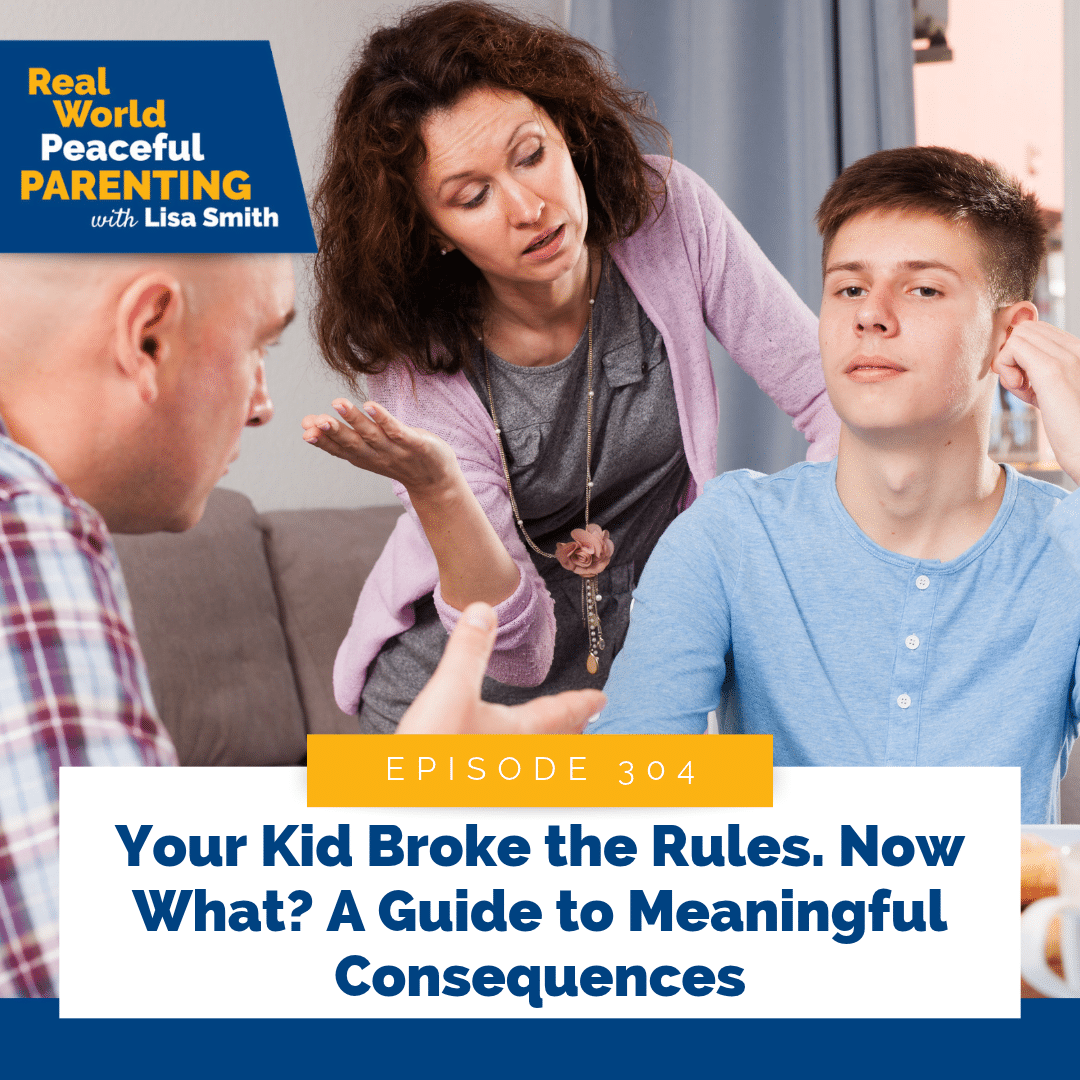
Your kid breaks the rules. Now what? Ground them? Take something away? Give another lecture that goes in one ear and out the other?
In this episode of Real World Peaceful Parenting, I’m breaking down how to use consequences that teach responsibility instead of punishment that creates resentment. You’ll learn how to set clear expectations, choose age-appropriate consequences, and follow through without getting sucked into power struggles.
Because peaceful parenting isn’t consequence-free parenting. It’s leading with a strong spine and a soft heart. ❤️
Sign up for my free Peaceful Parenting mini-course! You’ll find everything you need to get started on the path to peaceful parenting just waiting for you right here!
What You’ll Learn from this Episode:
- Why peaceful parenting includes consequences and how clear limits help kids feel safe and secure.
- The difference between consequences and punishment and how to make accountability a learning opportunity.
- Why fair doesn’t always mean equal when choosing age- and developmentally appropriate consequences.
- How to hold kids accountable without their agreement or getting pulled into endless debates.
- Why consistency matters and how to follow through even when your kid pushes back.
- Three tools for effective consequences: connect them to the behavior, set clear expectations, and follow through calmly.
Listen to the Full Episode:
Featured on the Show:
-
- Click here to sign up for my free Peaceful Parenting mini-course! You’ll find everything you need to continue on the path to peaceful parenting over there just waiting for you.
- Send us an email!
- Message me on Instagram and tell me how you felt after 10 minutes of undivided attention with your child.
- Click here to join The Hive!
- Peace & Quiet: The Crash Course For Peacefully Parenting Your Strong-Willed Kids
Full Episode Transcript:

Welcome to Real World Peaceful Parenting, a podcast for parents that are tired of yelling, threatening, and punishing their kids. Join mom and master certified parent coach, Lisa Smith, as she gives you actionable step-by-step strategies that’ll help you transform your household from chaos to cooperation.
Let’s dive in.
Welcome, welcome, welcome Welcome to today’s episode. I am so glad to be with you here today. Now, I want you to picture this. Your teenager asks to go out with friends. You say yes, and you both agree on the plan, be home by 10:00. Text me if anything changes. Your kid says, “Got it.” At 10:15, you’re looking at the clock, wringing your hands.
At 10:30, you’re getting frustrated. Finally, your kid walks through the door, and before you can say much of anything, you hear, “Mom, relax. Nothing happened. Everyone else stayed later. You’re making such a big deal about this.” Well, now you’re angry, and maybe you’re scared, too, and you’re thinking, “What am I supposed to do here?
Ground them? Take the phone away? Cancel the next outing? Lecture them until they finally admit they were wrong? What am I supposed to do?” Or maybe it’s not a teenager at all. Maybe your seven-year-old has been told screen time is finished, and they’re still holding the iPad 20 minutes later. Maybe your 12-year-old borrowed something that belongs to a sibling, damaged it, and refuses to acknowledge it.
Same question, what am I supposed to do here? Well, my friend, today I’m gonna answer that question because peaceful parenting is not consequence-free parenting. Never has been, and never will be. And I want you to hear that clearly. Your kids need limits. Your kids need accountability, and sometimes your kids absolutely need consequences.
Absolutely. And here’s something I’ve been teaching parents for years. Rules, limits, and consequences help kids feel loved, safe, and secure because they know what’s expected of them. Let me say that again. Rules, limits, and consequences help your kids feel loved, feel safe, and feel secure because they know what’s expected of them.
And I want you to think about that. When your kid knows what the rules are, when they understand the limits, and knows what will happen if they don’t follow through, there’s predictability, and predictability feels safe. They’re not constantly guessing what’s okay today and what’s gonna make mom or dad lose their mind tomorrow, and that predictability creates safety.
Kids need to know that the adults in their lives are willing to lead, that the adults are going to be clear about what’s expected, that they’re going to follow through, and they’re gonna do it with love. That’s strong spine, soft heart. And when we do this consistently, we’re not just teaching responsibility, we’re building trust.
But there’s a huge difference between a consequence that helps a kid learn responsibility and a punishment designed to make a kid pay, and that’s what we’re unpacking today. So let’s start with the big idea. A consequence is an outcome connected to a choice or behavior. Sometimes it happens on its own.
Sure. And sometimes a parent needs to step in and establish it, right? If you leave your bike outside in the rain, let’s say, the seat gets wet. That’s a natural consequence. I didn’t have to engineer it. Now, if you damage someone else’s bike, you may have to help repair it or contribute to replacing it.
That’s a parent-guided response connected to the harm. But if you leave your bike out and I say, “That’s it. You’re not going to your friend’s birthday party,” I want us to stop and ask, what does that teach about caring for a bike? Maybe all it teaches is that when I’m angry, I take something away that you love.
Now, don’t turn this into a test you have to pass every time. A consequence does not need to be a perfectly elegant teaching device. Parenting happens in kitchens and on sidewalks and in cars and in the five minutes before everybody has to leave. But the purpose matters. The purpose. I’m not trying to hurt you enough that you’ll remember.
I’m trying to help you understand that choices have outcomes, and that other people are affected by what you do, and that you are capable of making good choices and taking responsibility. Sometimes a consequence protects safety. Sometimes it repairs damage. Sometimes it puts a pause on a privilege until the kid is ready to use it responsibly.
And sometimes it gives you a chance to practice a skill. And sometimes, friends, what your kid needs isn’t a consequence at all. They need a limit. They need help. They need practice. They need us to realize the expectation wasn’t realistic in the first place. And that’s an important part of calm leadership.
Responding to the actual problem as parents, not just reaching into our parenting toolbox and pulling out the biggest penalty we can think of. Yeah? Yeah. Okay, let’s talk about age, because I really don’t want us to skip this. Age-appropriate and developmentally appropriate are not always the same thing.
Suppose two 10-year-olds are forgetting their homework. One has a system, knows what to do, and occasionally chooses to play instead. Another 10-year-old is genuinely struggling with working memory, planning, organizing papers, and remembering to bring the assignment home. Maybe in the second 10-year-old, ADHD is a part of the picture.
You get where I’m going with this? Same age, same report from the teacher, two very different problems. Would it make sense to give both kids the identical consequence and declare it fair? I don’t think so. The second kid may need more support, may need a visual checklist, a backup routine, help breaking the work into steps, and more repetition than the first kid.
Holding that kid responsible can include participating in a plan. It shouldn’t mean threatening an underdeveloped skill as a character flaw. Or think about a three-year-old knocking over a glass of milk Does that kid need to lose screen time? No, I don’t think so, but we do need to clean it up together, and maybe we practice carrying the cup with two hands, or maybe we need to go back to a cup with a lid, right?
I, as the parent, can be irritated about the mess without turning the accident into a moral crisis. How about a seven-year-old who gets angry and breaks his sibling’s game? Safety and stopping the behavior come first. Later, that seven-year-old can help figure out how to repair, replace, or make amends in a way they can realistically participate in based on their age, right?
You don’t demand a seven-year-old come up with the $50 they don’t have. That wouldn’t make any sense. Now, think about a 16-year-old who’s agreed not to drive friends in the car and then does it anyway. That’s a different level of responsibility, a different level of safety, and a different consequence.
You may need to pause driving privileges and make a clear plan to rebuild trust. And even at 16, development matters. If your teen struggles with impulsivity, we don’t just say, “Well, your brain isn’t fully developed, so I guess there’s no consequence.” No, we support the skill and hold an appropriate limit with a strong spine and a soft heart.
And I want you to remember this. Fair doesn’t always mean identical. Fair means the expectation and the response fit the kid, the behavior, and the skills we’re trying to develop. We are not lowering every expectation until life becomes effortless. We’re helping kids grow towards meeting expectations with the right amount of support and accountability.
I want to tell you about a parent I coached. I’ve changed the name and several details about the family to protect their privacy. This mom has a teenage daughter, and her daughter wanted to spend the afternoon around the neighborhood outside with a close friend. So the mom and daughter talked about where the girls could go and where they couldn’t go, and the daughter agreed to the plan and indicated to the mom that she understood the plan and was going to follow it Later, Mom learned that they had gone somewhere that she had specifically told her daughter was off limits, and her daughter had agreed she understood and wouldn’t go there.
And here’s the part that really got under the mom’s skin. When she addressed it, her daughter didn’t say, “You’re right, Mom, I broke our agreement. I’m sorry.” Instead, her daughter said, “It’s not a big deal. Nothing happened, and you’re overreacting.” Ah, been there? I know I have. Okay, friends, so I imagine you can visualize how that landed.
The mom was already upset about the broken agreement, and now it felt like her daughter wasn’t taking responsibility. So Mom started explaining why it was a big deal, and her daughter kept explaining why it wasn’t, and around and around they went in a classic power struggle. So the mom brought the story to the hive, and during coaching, I said to the mom, “What if you’re arguing about the wrong thing?”
The mom said, “Oh, tell me more.” Well, the two of them did not have to agree on whether the outing was a big deal or not. The daughter could think it was harmless that they went into the area they weren’t supposed to go, and the mom could believe that it was unsafe or unacceptable. Those were each of their thoughts about the situation.
But there was a fact underneath all of this disagreement, and the fact is that they had made an agreement, the mother and the daughter, and the agreement had been broken. So I coached the mom to stop trying to win the debate about how serious the behavior was. I told her, “You can say, ‘I hear you that you don’t think this is a big deal.
I understand that’s how you see it.'” And I see it differently, and we’re not here to debate whether you should feel the same way I do. We made an agreement, and you chose something different. And then comes this line, which I mu- love so much. You made a choice, and now you’re responsible for the result of that choice.
Let me say that again because I want you to write this down and memorize it. You made a choice, son or daughter, and now you’re responsible for the result of that choice. Here’s what I want you to hear in today’s episode. Accountability does not require agreement. Your kid does not have to admit you’re right.
They do not have to perform the perfect apology. They do not have to say your rule was brilliant and reasonable. They can, in fact, be disappointed. They can disagree. They can have thoughts about how it wasn’t a big deal. They can even have thoughts about how unfair you are, and you can still hold a responsible, previously communicated limit.
And here’s another part of that coaching conversation that matters. This mom could see that she hadn’t always been as clear and consistent about agreements as she wanted or needed to be, and sometimes the consequence hadn’t been discussed ahead of time. So the work wasn’t just about the daughter’s choices.
The mom had something to practice, too. Because when we, the parents, are vague about the expectation, when we’re inconsistent about the follow-through, and then furious when our kids don’t respond the way we had hoped or expect, we make the situation much, much, much more difficult. A useful consequence is not one you invent in a burst of anger while your kid stands in front of you.
Let me say that again. A useful consequence is not one you invent in a burst of anger while your kid stands in front of you. Whenever possible, it’s one you’ve calmly thought through because it makes sense for the situation. And if you didn’t lay it out ahead of time, own that You can still address what happened, but don’t pretend a surprise penalty was an agreement you made together.
I don’t have a later report proving this teen made a different choice the very next weekend. The breakthrough in that call was the parents, she could stop wrestling with her daughter’s opinion and start parenting the actual agreement, and that was the big shift. Now, I wanna get even more practical. When a kid causes a mess, we can invite them into cleaning up.
When a kid damages property, they can participate in making it right. When a teen uses a privilege in an unsafe way, we may temporarily restrict that privilege and explain what rebuilding trust looks like. Notice that I’m not saying the consequence has to be pleasant. Cleaning up a mess isn’t always fun.
Saving money to replace something you damaged might be disappointing. Losing access to something like a car can be deeply unsettling. Those feelings do not automatically make the response a punishment. The question is whether we are protecting, repairing, teaching, or reasonably managing a privilege, or whether we’re trying to cause pain because we’re angry.
And sometimes parents get stuck thinking, “I have to find a consequence for everything, Lisa?” Or they get stuck in this idea that my kid was rude this morning, so what’s the consequence? My kid forgot their water bottle. What’s the consequence? My kid made a face when I said no. What’s the consequence? Let me say, you do not have to run your home like a courtroom where every offense receives a sentence.
If your kid’s having a hard time switching off a game, you might need a transition plan, a timer, an agreed stopping point, and your calm co-regulation helping them put the device away. If your kid keeps forgetting chores, you may need a system and practice, not a week-long ban from their favorite activity.
If your kid speaks disrespectfully, you can hold the limit on how people speak in your family and invite a redo without inventing a punishment. That doesn’t mean that your kid isn’t accountable for the mess or the tone they used or the inability to get off gaming. It means you’re paying attention to what will genuinely help build the skill.
The skill. We’re talking about skills. And yet there are situations where allowing a so-called natural consequence would be irresponsible You don’t let a young kid wander into traffic to learn why roads are dangerous. You don’t let a teen continue unsafe driving because the natural consequences might teach them.
I mean, that just sounds silly even as I say it. In those instances, we intervene first because safety always wins. So the consequence is not the point. The learning, the responsibility, and the safety, those are the point. Developing and building the skills are the point of the consequence and the limit.
Hopefully, you’re having a light bulb moment right now. Now, I wanna talk about what might be the hardest part of all this for parents, and I know that because I hear it on the Hive calls over and over and over again. It’s consistency. You might know exactly what limit you wanna hold. You might have thought through carefully about a reasonable consequence, and you might have explained it to your kid beautifully, and then your kid pushes back, especially if they’re strong-willed.
I know this one, my friend. I know this one. You know, where they argue or they cry or they negotiate or they try to debate, and then they tell you everyone else’s parents are nicer, or they promise you they’ll never do it again. And let’s be honest, you have dinner to make, and you’re exhausted from the power struggles, and you think, “I can’t do another 45 minutes right now,” so you change your answer, or you give in, or you let it go, or you pretend you didn’t see it Right?
I get it. I really do. Holding a limit through someone else’s disappointment can be really, really, really hard. Holding a limit through your kid’s disappointment? Oh my gosh, that’s hard on steroids. But if the answer changes every time the reaction gets big enough, then your kid learns that the agreement is still up for negotiation, and the next time, they try again, and again, and again.
Here’s the point. The most thoughtfully chosen appropriate consequence isn’t very helpful if we don’t follow through on it consistently. Now, consistency does not mean rigidity. It does not mean refusing to listen to new information. It doesn’t mean sticking with a bad consequence because you announced it when you’re angry.
Not at all. If you realize a limit was development- developmentally inappropriate, change it. If you discover you misunderstood what happened, reconsider. If there’s a safety issue, make the safe choice. That’s good parenting, not weakness. But, but, but, but if the limit is reasonable, the expectation was clear, and nothing meaningful has changed except that your kid doesn’t like it, you can stay steady.
You can. I know you can. You can say, “I know you’re disappointed, and the answer is still no.” You can say, “I hear you want more screen time, and we’re finished for today.” You can say, “I know you’re angry about losing the car- We’ll talk about what rebuilding trust looks like when we’re both calm. That’s strong spine, soft heart.
And listen, I think there’s an entire conversation to have about why we parents struggle so much with staying consistent, why their anger, their tears, or their disappointment can make us second-guess ourselves, why some of us feel compelled to fix their feelings. That’s a conversation for another day, and I promise to deliver it soon.
Today, I just wanted you to see that consistency is a very large part of what makes a reasonable consequence understandable and predictable. Yeah? Yeah. Okay, let me give you three tools you can start using that are gonna help this tremendously. Tool number one, connect the response to the behavior. Before you announce a consequence, ask yourself, “What is the actual problem?
Does my response address it, repair something, protect safety, or help rebuild trust?” If the answer is no, take another look. If the issue is misuse of the family car, focus on driving and safety. If the issue is damaging a sibling’s belongings, focus on repair. If the issue is getting stuck on homework because organization is hard, focus on the system.
You don’t have to make the consequence bigger, you have to make your response more useful. Tool number two, match the expectation to the kid and make the plan clear. Consider your kid’s age, development, skills, and circumstances. Then say what you mean as simply as you can. You can take the car Friday if you following our…
It might go something like, “Yes, you can take the car on Friday if you follow our driving agreement. If you break the agreement, we’ll pause car access and make a plan for how you can earn back that responsibility.” This isn’t about a long legal contract, it’s about clarity. And if your kid needs a reminder, a visual cue, help planning, or more practice, build that in.
Support and accountability can coexist. Tool number three, follow through with a strong spine and a soft heart. Your kid may not agree. They may be furious. They may think it’s unfair. They may cry. They may say you’re the worst parent ever. You don’t have to become cold, and you don’t have to change your answer just to make the feeling disappear.
You can listen, you can empathize, you can remain connected, and you can hold the limit. And one more thing, if you find yourself thinking that the response needs to hurt more because your kid doesn’t seem sufficiently upset, that’s your invitation to pause We are not using distress as the scoreboard.
We’re building responsibility and skills over time. In closing, I want you to think about the adult you’re raising, an adult who keeps agreements, who can make a mistake and own it, who can repair harm without collapsing into shame, who can recognize that a choice has a consequence even when they don’t like the consequence.
That’s what accountability can teach. Holding your kid accountable is not the opposite of loving them. It is one of the ways we prepare them for a life where we won’t always be there to guide them. And it’s okay if they don’t love every limit you set. It’s okay if they need time and help and support to develop a skill.
It’s okay if they feel disappointed about the result of a choice. You can stay their safe, steady parent without removing every uncomfortable feeling or making the feeling worse on purpose. Yeah. So before you choose a consequence, ask, “What am I hoping my kid will learn, and is this response appropriate for my kid and the situation?”
And choose one reasonable limit you’ve already communicated. Practice following through calmly, even when your kid isn’t happy about it. I want this for you, and I want this for your kids. Because remember, rules and limits help our kids feel safe, loved, and know what is expected. And again, I want that for you and your family.
Until next time, I’m wishing you peaceful parenting.
Thanks for listening to Real World Peaceful Parenting. If you want more info on how you can transform your parenting, visit thepeacefulparent.com. See you soon
Enjoy the Show?
-
-
- Don’t miss an episode, follow the podcast on Spotify, Apple Podcasts, or RSS.
- Leave me a review in Apple Podcasts.
-