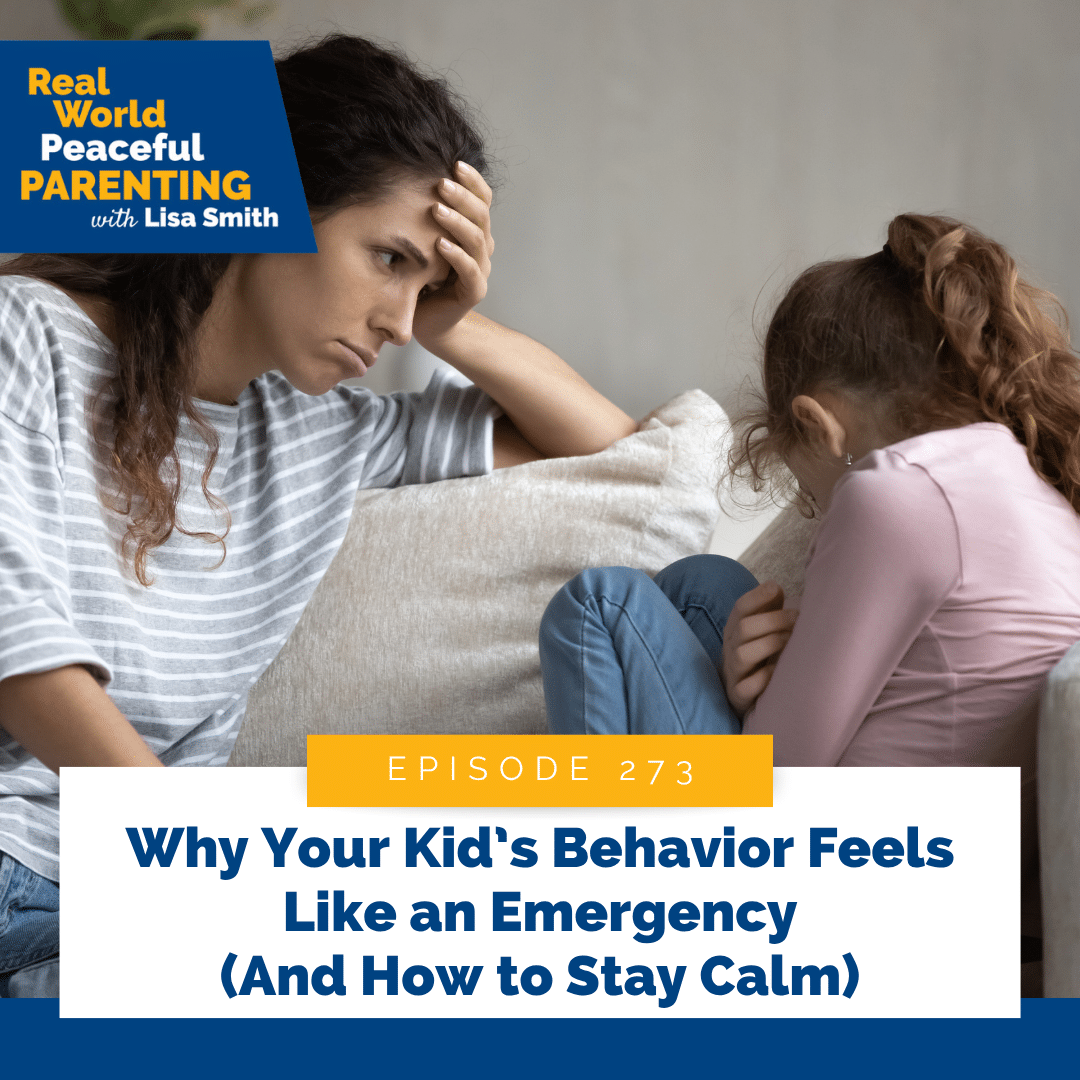
Ever feel like your kid’s behavior instantly sends you into panic mode?
In this episode, Lisa breaks down why even small moments with your kids can feel like a full-blown emergency in your body—and how your brain is actually wired to do exactly that.
But here’s the shift: most of the time, it’s not an emergency… it’s a moment.
You’ll learn how to stop parenting from fear, interrupt the urgency cycle, and show up as the calm, steady leader your kid needs—even when emotions are high.
Sign up for my free Peaceful Parenting mini-course! You’ll find everything you need to get started on the path to peaceful parenting just waiting for you right here!
What You’ll Learn from this Episode:
- Why your brain turns everyday parenting moments into “5-alarm emergencies”
- The difference between what’s actually happening vs. the story your brain is telling
- How fear-based parenting escalates your kid’s behavior (and what to do instead)
- A simple way to pause and interrupt your emotional reaction in real time
- How to shift from future-focused panic to present-moment leadership
- Why your calm presence is the most powerful tool for helping your kid regulate
Listen to the Full Episode:
Featured on the Show:
-
- Click here to sign up for my free Peaceful Parenting mini-course! You’ll find everything you need to continue on the path to peaceful parenting over there just waiting for you.
- Send us an email!
- Message me on Instagram and tell me how you felt after 10 minutes of undivided attention with your child.
- Click here to join The Hive!
- Peace & Quiet: The Crash Course For Peacefully Parenting Your Strong-Willed Kids
Full Episode Transcript:

Welcome to Real World Peaceful Parenting, a podcast for parents that are tired of yelling, threatening, and punishing their kids. Join mom and master certified parent coach Lisa Smith as she gives you actionable step-by-step strategies that’ll help you transform your household from chaos to cooperation.
Let’s dive in.
Welcome, welcome, welcome, welcome to today’s episode. I am so grateful. To be with you here today, and I wanna ask you something personal right off the bat. Have you ever had one of those moments where your kid does something and your body reacts before your brain even catches up? You know your child refuses to do the homework, your toddler loses it because you gave them the wrong cup.
Your teenager rolls their eyes and says something that just cuts right through you. Before you even realize what’s happening, your heart is pounding, your voice gets sharper, your jaw tightens, and suddenly your brain is no longer in the present moment at all, right? And instead of being in the moment, you’re 10 years into the future, and your brain is saying things like, what if they never learn responsibility?
What if this becomes a pattern? What if I’m actually messing this whole thing up? A small moment? Suddenly the interaction with your kid feels like a five alarm emergency. Well, if you’ve ever felt that, and I mean really felt it like in your chest, in your throat, blood whooshing through your ears, a gorilla sitting on your chest, today’s episode is for you.
Over the last few weeks, we’ve been building something really powerful together. In episode two 70, we talked about what emotional regulation actually is. We talked about how kids aren’t born knowing how to handle big feelings, how behavior is communication, and how our kids literally borrow calm from us.
Then in episode 2 71, we busted the four biggest myths about emotional regulation, the things you might be doing thinking you’re helping, but that are actually backfiring. In episode 2 72, you had a chance to hear Dina’s story, A Real mom, three years of real work and a family that’s genuinely transformed today.
I wanna go underneath all that because there’s something I see in almost every single parent I coach or work with, including myself, that is quietly running the show. And until you understand it, no strategy in the world. Is going to stick the way you want it to. And here it is. Your kid’s behavior can feel like a five alarm emergency, and your brain is the one pulling the alarm.
Now you might be saying, what, Lisa? No, my brain is not the one pulling the alarm. I know, I know. But I want you to hang with me here and be open-minded as you listen through today’s episode. So let’s dive in. I wanna start with some brain science, but don’t worry, I’m gonna keep it real and practical because that’s what we do here at Real World Peaceful Parenting.
Here’s what you need to know. Your brain has one primary job, one job above all others, and it’s to keep you safe. That’s it. You self-preservation your brain. Specifically your lower brain, your downstairs brain, your survival brain has been wired since the beginning of human history to scan for danger 24 7 and protect you from it.
And this part of your brain never clocks out. It never takes a day off, it never goes on vacation or gets fired from its job. Its dedication level is extreme. It works 24 7 365. And here’s what happens when we become parents. That survival instinct doesn’t just cover you anymore. It expands your kid or kids become an extension of your sense of safety and a threat to them registers in your nervous system, almost the same, not completely, but almost the same as a threat to you.
Which means your brain is now scanning for danger for two people, you and them, or maybe more. Now. Thousands of years ago, these threats were physical, predators, famine, danger in the wild. But today for us parents, these threats look very different. They look like a failing grade. A childhood won’t listen. A meltdown in public.
A teenager who pushes back hard, a toddler who seems to be behind where you think they should be, siblings that can’t seem to get along. A kid who has big emotions and struggles with friendships in your brain. Your brain doesn’t just register what’s happening right now. Unfortunately, it fast forwards. It runs a threat detection simulation at lightning speed.
Your kid refuses homework tonight. And your brain shows you a movie of them failing in school. Your kid lies once and your brain fast forwards to them being dishonest. As an adult, your toddler melts down in target and your brain whispers they’re never going to be able to function in the real world. Now, here’s what’s so important to understand about all this, this mental movie, it happens fast.
We’re talking milliseconds faster than conscious thought. And before you’ve decided to feel anything, your body is already reacting. You with me on this, right? Your, your heart rate increases. Your muscles tighten, your voice gets sharper, maybe louder. It gets a distinct tone. Your thinking gets more rigid and urgency takes over like a wave.
You are no longer calmly guiding your kids through a moment. You are in emergency mode trying to stop what your brain has already decided is a crisis. But here’s the truth, that will start to change everything for you. Most of the time, what’s happening is not actually an emergency. Your kids’ behavior in this moment is a moment.
It’s not a prediction. It’s not a destiny. It’s not proof of anything terrible about. Who they are or who they’ll become. It’s just a moment, and the most powerful thing you can do in that moment is stay in it instead of living 10 years in the future. One of the most important shifts parents make in this work is learning to separate two things that the brain loves to mash up together.
The moment you’re in and the story your brain is telling you about the future. These are not the same thing. They are not. But when the alarm goes off, they feel like identical twins. The fear about the future feels just as real as what’s happening right now. And so we parent the future instead of the present.
Yeah. Let me show you what this looks like at different ages. ’cause I really want you to see yourself in these examples. Your 3-year-old has a full meltdown in the grocery store because you said no to the candy bar, and your old brain story is she’s learning the tantrums. Get her what she wants. She’s going to be manipulative.
She doesn’t respect boundaries. Now, what’s actually happening in this moment, she’s three and her prefrontal cortex, the part of the brain that handles self-regulation and impulse control is barely there. She’s overwhelmed. She wanted something, she was told no and her nervous system flooded. That’s it.
That’s the whole story. There’s no manipulation. There’s no character flaw. Just a tiny person with a big feeling and no tools to manage it yet. Can you see that? Okay. Let’s say your 6-year-old lies to you about finishing their homework. In the past, your brain might have told you the story that your kid is being sneaky.
I’m raising a dishonest kid. He’s gonna be a liar. No one’s gonna believe him. Yeah, been there. I know I had been. Here’s what’s actually happening. Lying at this age at six is developmentally normal. It often signals that your kid is starting to understand cause and effect, and they’re scared of disappointing you or getting in trouble.
And if you can stay present in the moment, this is a moment to teach. Not evidence that the character train has already left the station. Yeah. Let’s say your 9-year-old refuses to do chores every single time. Your old brain might tell you the story that you’re raising, an entitled kid. They expect to have everything handed to them.
They don’t have a work ethic. They’re never gonna survive in the real world. Well, what’s actually happening is they’re a kid who doesn’t like to do chores. Which honestly is pretty much every kid who’s ever lived the skill of doing hard things, even when you don’t want to, that takes years to build and your 9-year-old is in the middle of building it.
Can you see that? Let’s say you have a 12-year-old that rolls their eyes and snaps at you, and you ask them how their day was. I remember these days very well. I used to say, oh my gosh, my breathing irritates Malcolm. So if you’re stuck in this cycle, your story might be your kid doesn’t respect you, we’re losing connection.
It’s only gonna get worse. So what’s actually happening is your kid just endured seven long hours of school along with social pressure. They can barely name and a nervous system that’s being reconstructed from the inside out. They’re exhausted, they’re overwhelmed, and maybe they’re starving. You’re the safe person that they can fall apart in front of that snap.
It’s not rejection, it’s trust. Let’s say your 15-year-old fails a test and your old brain story is they’re gonna take their GPA. No college is gonna take ’em. They’re not smart. They’re not gonna be able to make it. I’m watching their future collapse in real time. What’s actually happening? They failed one test.
Maybe they didn’t study enough. Maybe they froze up. Maybe it was a really hard week. Maybe they need some extra help understanding the concepts. But the point is, one test is a data point, not a destiny. And maybe you have a senior who’s procrastinating on college applications. It happens a lot. Your old brain story is.
They’re self-sabotaging. They don’t appreciate this. They’re gonna miss every deadline. How are they gonna go away to school and be successful? I, I remember those days too, but what’s actually happening? They’re terrified. The thought of leaving everything familiar behind is overwhelming, and procrastination is often anxiety, wearing a lazy outfit.
Can you see the pattern? In every single one of these moments, the brain is treating normal developmental behavior like a five alarm emergency. And when we parent from that emergency feeling with urgency, with lectures, with fear, with anger, our kids don’t feel guided. They feel like a problem to be solved.
And here’s the kicker. When we show up with urgency, it escalates our nervous system and their nervous system. So now we have two dysregulated people in the room trying to interact two nervous systems in alarm mode, and suddenly the moment there was never actually an emergency has become one. Can you see this?
I wanna share a story with you that I’ve never told publicly before because I think it captures this moment better than anything I can explain. Malcolm was about 11 and it was a Sunday afternoon. Which in our house usually meant homework time. And he flat out refused. Not the ugh, fine, kind of refuse the arms crossed, jaw set, full body.
I’m not doing this. Kind of refuse. And I remember feeling it happened inside me. The shift first came irritation. Then came the Fast Forward movie. He never follows through. He’s going to develop a pattern of avoidance. He won’t be able to handle hard things. As an adult. He’s going to struggle and it’s going to be because I didn’t hold the line right now in this moment, and listen, I’m not exaggerating that.
I tell you within about 30 seconds I’d gone from Malcolm is refusing to do homework to. He’s gonna be living under a bridge with a shopping cart. And I’m not proud of this, but I came in hot. I mean hot. I use the, I mean business voice. I lectured about responsibility. I brought up every other time he dragged his feet, I made that homework.
Refusal carry the weight of his entire future. And he, as a strong-willed, full contact support kid, he shut down completely. Walls up, eyes down, not a word. And I remember standing there in silence, feeling the heat of my own urgency, hearing the blood whooshing through my ears and my heart pounding. And I realized something in this moment that stopped me cold.
I wasn’t parenting the kid in front of me. I was parenting the fear inside me. I wasn’t responding to an 11-year-old who didn’t wanna do homework on a Sunday. I was reacting to a story that I told myself about what that moment meant. So I took a deep breath, I sat down, I lowered my voice, and I said, Hey, talk to me.
What’s going on here? He looked up at me slowly and he said, what broke my heart a little bit. I don’t understand the assignment, mom, and I didn’t wanna tell you because I thought you’d be mad. He wasn’t refusing because he was lazy. He wasn’t exemplifying a character flaw. He was a kid who was confused, had forgotten about what had been taught that week in class, and frankly didn’t understand it.
He was probably embarrassed about being confused and scared of my reaction in my urgency, my emergency mode parenting had confirmed every fear he had, so we took a break. We each went off and did something fun, unloaded our emotional backpacks, and then we came back together. We sat down and we figured out the assignment.
It took about 20 minutes and we got it done. What I remember most about that afternoon isn’t the homework. It’s what happened when I stopped treating the moment like an emergency. The walls came down, the connection came back, and he got the homework done. That is the power of slowing down the alarm.
That’s the power I wanna tell you about. A mom who will call Joanne. She joined the Hive about eight months ago, and she came to the hive in a state that so many of you will recognize. Joanne had a 13-year-old daughter, and we’ll call her Zoe. And Zoe is intense, highly sensitive, emotional, easily overwhelmed, and constantly pushing back on every limit.
And Joanne, well, she was exhausted. And I’m not just talking physically exhausted. Joanne was emotionally exhausted from living in a state of permanent high alert. She described their evenings like this. The minute Zoe walks in the door, I brace, I scan her face to figure out what kind of night we’re going to have, and then I spend the whole evening trying to manage whatever’s coming.
You might relate to this. So in one of our coaching calls inside the Hive, I asked Joanne what she was most afraid of, and she didn’t hesitate. She said, Lisa, I’m afraid Zoe’s gonna be this way forever. I’m afraid she doesn’t know how to manage herself, and I’m afraid I’m failing her. When I dug a little deeper, when I asked Joanne what was happening inside her body, the moment Zoe started escalating, Joanne said, it’s like a siren goes off inside me.
Everything in me goes into fix it mode and I feel compelled to make it stop. Well, that my friend is emergency mode parenting and it makes complete sense. Joanne’s brain is trying to protect her daughter and herself, especially herself from the intensity of her daughter. Joanne’s brain had decided long ago that Zoe’s dysregulation is a threat that needs to be neutralized immediately.
Stat. Right now, right now. But listen to this. Here’s what’s actually happening. Every time Joanne came in with the urgency trying to fix, manage correct or stop the behavior, so his nervous system would escalate further. Because to Zoe and to our kids, urgency feels like a threat. So Joanne would come in with urgency trying to calm her own threat, which would activate Zoe’s alarm system because Zoe felt like a threat and Zoe’s alarm system would get even louder.
Two nervous systems, both in alarm mode every single evening. So we got to work, Joanne and I, and the truth is we started with Joanne, not with Zoe. We worked on Joanne learning to recognize the moment the alarm went off inside her and to pause before acting on it, to pause and to ask herself, is this actually an emergency or is this a moment that needs my calm, steady presence?
It wasn’t a quick fix, I wanna be honest with you about that. It took weeks of practice and there were setbacks. There were times Joanne came to our hive calls and said, I did the thing again. And we debrief about it and she’d go back and try again. And about six weeks in, Joanne came to our call and said something I’ll never forget.
She said Zoe had a big meltdown. Night and I just sat with her. I didn’t try to fix it. I didn’t make it mean anything about the future. I just stayed calm and I sat with her, no words, just my calm, steady presence. And Zoe regulated in about 15 minutes. And Joanne said prior to the work she did that would’ve taken about two hours, 15 minutes down from two hours.
Joanne didn’t change Zoe. Joanne changed the emotional climate she was bringing to Zoe’s storms. And when that climate changed, everything else shifted. That’s the work, my friend. That’s the work we all need to do, and I promise you it’s available to you at any time. So how do we actually do this? How do we interrupt the alarm when it goes off?
Well, here are two tools. I teach inside the Hive, and I want you to start practicing them today. Tool number one is name the story. The moment you notice your body reacting, the tightening, the heart rate, the urgency. I want you to pause and ask yourself one question. What story is my brain telling me right now?
Not what’s happening in the room, what story is playing in my head? Because nine times outta 10. The story in your head is about the future. It’s a prediction, it’s a fear, and here’s what I know for sure. When you name it, when you actually say it out loud or even just notice it, something remarkable happens, it loses some of its grip or impact.
Try it. My brain is telling me that this moment means my kid is going to struggle forever. Just say that and notice how it sounds. Because when you hear it that way, your logical brain can, can respond with like, wait, what? Is that actually true right now? Or is it just fear? It’s a very powerful tool. And then tool number two, I call come back to the present.
Once you’ve named the story, I want you to ask yourself one grounding question. What is actually happening right now, not 10 years from now? Not the worst case scenario, not the pattern you’re afraid is forming, but right now in this room with this kid, and often the answer is something much simpler and less catastrophic than your brain has decided it might be.
My kid is overwhelmed. My kid doesn’t want to do something hard. My teenager is projecting their emotions onto me. Those are moments that can be led calmly. Those are moments that don’t require emergency intervention. These are moments for your steady, grounded, present tense parenting, even while you’re setting limits and boundaries.
Not fixing, not lecturing, not managing the future, just being here, being the calm, being the anchor. Remember what we talked about in episode two 70? Your kids borrow calm from you. They can’t self-regulate until they first experience co-regulation with at least one safe adult. And you can’t co-regulate when you’re looking 10 years into the future, but you can co-regulate from right here, right now.
Make sense? Are you like, oh my goodness, this is incredible. ’cause I feel like this is one of the most important messages that I can ever bring you and share with you. So let’s bring it all together before we wrap up today. Let’s recap. First, your parent brain is wired to scan the universe for danger 24 7 365.
And your brain loves your kid or kids so much that it treats perceived threats to their future, a bad grade, a meltdown, a lie as full-blown emergencies. Now this is not a flaw. It’s your brain doing its job, but it’s also not always accurate. And when your brain fast forwards to the future, you stop parenting the kid in front of you and start parenting your fear.
And fear-based parenting escalates your child’s nervous system, making the moment bigger, not smaller. So the shift from emergency mode parenting to calm leadership. Happens when you learn to separate the story your brain is telling you from what’s actually happening right now, and that separation is everything.
And I ask you to remember that your calm is not passive. It is the most active, powerful thing you can bring to your kids’ hard moments. When you stay regulated, you give them something to borrow. Over time, through hundreds of these moments, you are literally building their capacity to regulate themselves.
And I know my friend, this is not easy. I know that alarm goes off fast and it goes off loud. I experience this myself often. I know some days you’re already running on fumes before you even say good morning to your kids, but I want you to hear me say this. The fact that you’re here, the fact that you’re doing this work, the fact that you’re asking yourself hard questions about how you show up for your kids, that is not nothing.
That is in fact, everything, everything. And please hear me when I say you are not broken. Your nervous system is doing what nervous systems do. You are learning right now in real time, how to lead your family from a different place. One breath at a time, one moment at a time. That’s how it happens. And if you’re thinking, Lisa, I need more than a podcast for this.
I need someone to actually show me and help me practice this in real life. I hear you. That’s exactly what we do inside the hive, inside the hive. I can teach you how to interrupt the urgency cycle with personalized strategies created specifically for your kid and your family. We will practice the tools together, I promise, and you’ll have a whole community of parents who are in the trenches with you doing the same work.
You do not have to figure this out alone, and if this feels like the moment or the time. Come join us@thehivecoaching.com and until next time, I’m wishing you Peaceful Parenting. Thanks for listening to Real World Peaceful Parenting. If you want more info on how you can transform your parenting, visit the peaceful parent.com.
See you soon.
Enjoy the Show?
-
-
- Don’t miss an episode, follow the podcast on Spotify, Apple Podcasts, or RSS.
- Leave me a review in Apple Podcasts.
-