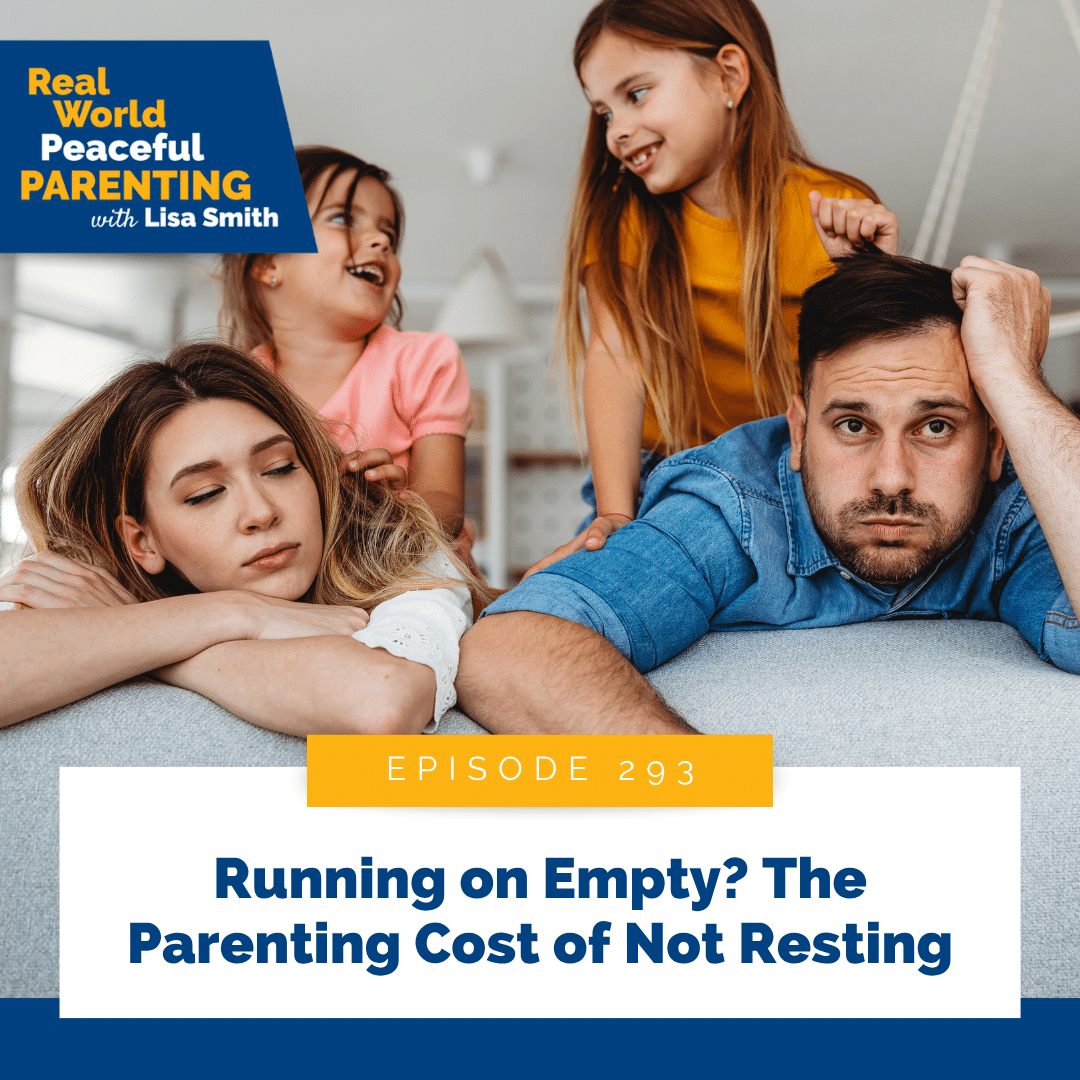
Back-to-school season brings new schedules, new activities, new forms, and approximately 4,732 new things for parents to remember. But before you ask whether your kid is ready, Lisa wants you to ask a different question: Is your tank full enough for what’s coming?
In this episode, Lisa challenges the belief that rest has to be earned after everything else is done. She explains why rest isn’t a reward—it’s fuel—and how your capacity directly affects your ability to stay calm, curious, and connected with your kid. You’ll learn how to identify the beliefs that make resting feel uncomfortable, redefine what “real rest” looks like, and start building small “water stations” into your day before your tank hits empty.
Sign up for my free Peaceful Parenting mini-course! You’ll find everything you need to get started on the path to peaceful parenting just waiting for you right here!
What You’ll Learn from this Episode:
- Why rest is fuel, not a reward, and what your car’s gas tank can teach you about caring for your own nervous system.
- How running on empty shrinks the space between your kid’s behavior and your reaction—and makes peaceful parenting tools harder to access.
- Why slowing down and resting can actually make you more focused and efficient, rather than putting you further behind.
- How guilt, anxiety, nervous energy, and the belief that “I should be doing something” can make rest feel anything but restful.
- The difference between rest and distraction, plus how to discover what genuinely refuels your nervous system.
- How to create simple five-minute “water stations” throughout your day—and model for your kid that taking care of yourself is a normal part of being human.
Listen to the Full Episode:
Featured on the Show:
-
- Click here to sign up for my free Peaceful Parenting mini-course! You’ll find everything you need to continue on the path to peaceful parenting over there just waiting for you.
- Send us an email!
- Message me on Instagram and tell me how you felt after 10 minutes of undivided attention with your child.
- Click here to join The Hive!
- Peace & Quiet: The Crash Course For Peacefully Parenting Your Strong-Willed Kids
Full Episode Transcript:

Welcome to Real World Peaceful Parenting, a podcast for parents that are tired of yelling, threatening, and punishing their kids. Join mom and master certified parent coach, Lisa Smith, as she gives you actionable step-by-step strategies that’ll help you transform your household from chaos to cooperation.
Let’s dive in.
Welcome, welcome, welcome. Welcome to today’s episode. I am so excited to be with you. We’re heading into back to school season, and if you’re anything like the parents I work with every day, you can already feel it. New schedules, new teachers, new activities, new forms, new drop-off times, new things to remember.
And somehow, even when our kids are the ones going back to school, parents end up carrying an enormous amount of the transition. So today, I don’t want to ask you, is your kid ready for school? I want to ask you something different. Is your tank full enough for what’s coming? We’re talking today about rest, but not in the way we usually talk about rest.
I’m not here to tell you today to get more sleep or book a spa day or take a bubble bath, which would be fun, or somehow find an extra six hours in a week that already feels completely full. Today, I want to talk to you about your relationship with rest, because I’m becoming more and more convinced that for many of us parents, the problem isn’t simply that they aren’t resting enough.
The problem is what they believe about rest, what they feel while they’re resting, and what they make rest mean about them. And that matters to Peaceful Parenting, because your capacity matters. You can know every Peaceful Parenting tool I’ve ever taught you. You can understand connection, regulation, limits, validation, all of it.
But when your tank is empty, accessing those tools gets a whole lot harder. So let’s talk about the gas tank. Think about your car. When the gas light comes on, what do you do? You get gas, right? I mean, come on. The light comes on and you get gas. Now think about this. You don’t pull in the gas station feeling guilty.
You don’t stand next to the pump apologizing to the car because you probably could have driven another 40 miles. You don’t say, “You know what? I haven’t accomplished enough today to deserve this gas.” That sounds ridiculous and laughable, right? Now, think about this. Your car doesn’t have to earn its gas.
Gas isn’t a birthday present. It isn’t a bonus the car gets for doing an exceptional job. Gas is simply what allows the car to keep functioning. And most of us don’t even wait until the tank is empty, right? Half a tank, quarter of a tank, we’re going somewhere tomorrow, we top that baby off. I’m gonna stop and get gas.
But so many of us treat our bodies and our nervous systems completely differently. What do we do? Well, we wait until empty. And then sometimes we even wait a bit longer. And what happens then is that we get irritable. We snap. Everything feels loud. Everybody needs too much from us. We have no patience. We start thinking our kids are the problem, our spouse is the problem, our schedule is the problem, our house is the problem, et cetera, et cetera.
And sometimes, yes, those things are difficult. I’m not saying rust magically makes difficult things easy. I am, however, saying the difficult things are much harder to handle when you’re trying to handle them on fumes So let’s be honest, if you skip the gas station long enough, the car doesn’t negotiate with you.
It doesn’t care how much you have to do. If you skip that gas station long enough, the car eventually stops, usually at the worst possible time, and the tow truck or waiting for AAA to bring you some gas costs a whole lot more than the fill-up would have. And you, my friend, you, my real-world peaceful parent, are no different.
Refueling your gas tank before empty isn’t indulgent, it’s maintenance. Now, I want to tell you where I came from with this, because I didn’t always have the relationship with rest that I have now. In fact, I used to never rest. If I’m honest, I thought rest was something that had to be earned. I thought rest came at the end of the day after all the work was done, if there happened to be any time left.
And I want to ask you, do you hear the problem with that? Well, the problem is, is that work is never done. There is always another email, another load of laundry, more dishes to do, another meal to make, another appointment to make, another thing for your kid, another thing for your work, another thing you suddenly remember at 9:42 at night So I had created a system in which rest was technically allowed, but practically impossible.
Because my mantra was that I could rest when everything was done. However, as we both know, everything is never done, therefore, I never rested, and I don’t think I’m alone in that. One of the moms in the hive said something during our rest challenge this week that captures this perfectly. She said, essentially, “I don’t have time to rest.
If I rest, how will anything get done? Because I’m the one who does everything in the house, and if I take 15 minutes to rest, to read, to deep breathe, the dishes will still be sitting there when I’m done.” Now, you as the listener, I want you to notice the belief underneath that. If I rest, things don’t get done.
So in this mindset, for this mom, rest is competing with responsibility. And if that’s the equation in your brain, responsibility is going to win almost every single time because there is always something that needs to be done. But here’s what I eventually came to understand. I wasn’t choosing between being responsible and rest, because rest is part of being responsible.
Because the quality of the person doing all those things changes depending on how much fuel she has in the tank. And here’s something else I hadn’t considered. Rest doesn’t necessarily cost me time. Sometimes it gives me back time. You see, I really started to understand this when I read the book The Practicing Mind: Developing Focus and Discipline in Your Life by Thomas M.
Sterner. It’s a great book, by the way. And one of the things I took away from the book was this idea that slowing down doesn’t necessarily mean you accomplish less. Sometimes slowing down actually helps you work more efficiently because you’re focused and present instead of frantic and scattered. This was a really, really, really big shift for me because I had always assumed that if I stopped for 15 minutes, I had just lost 15 minutes.
But you see, that’s not necessarily true. If I’m exhausted, overwhelmed, scattered, and running on fumes, everything can take longer. I can’t think clearly. I walk into a room and forget why I’m there. I start three things and finish none of them. I stare at the dishes like they’re a personal attack. But if I sit down for 15 minutes and I actually let my nervous system settle, then I put some gas in the tank.
Then when I get up to do those dishes that felt like a 15-minute ordeal previously, now they might only take five minutes. Or I solve the problem I’ve been spinning on all afternoon because I can access my critical thinking brain again. Or I remember the thing I was trying so hard to remember. Or, this is a really important part, the dishes still take 15 minutes, but I’m a different person while I’m doing them.
Yeah? Yeah. Who am I when my kids ask me the 17th question in the afternoon? Who am I at bedtime? Who am I when somebody spills something five minutes after I clean the kitchen? This is where the capacity enters the conversation, and this is why I don’t think rest and productivity are opposites. Sometimes rest is the thing that makes everything that comes after it work better, smoother, and easier.
This is why I don’t want rest sitting off in some separate category called self-care, because rest affects parenting. When your nervous system has fuel, you have more room between what happens and how you respond to it. You can pause. You can get curious. You can tolerate noise and mess and big feelings better.
You can remember that your kid isn’t giving you a hard time, they’re having a hard time. When your tank is empty, space gets smaller, and the same behavior can feel completely different depending on the condition of your tank. Think about it. Your child asks for something. When you’re feeling grounded, you might say, “No, buddy, not tonight,” and hold the limit.
Now let’s look at same kid, same request, same answer, but now you’re depleted, overstimulated, hungry, you’ve been going since 6:00 in the morning, and you’ve had no space all day. Suddenly, the request can feel like an assault. “Why are you asking me again? I already answered you.” The kid didn’t necessarily become harder in those two scenarios.
Your capacity changed. This is not about blaming yourself for yelling or telling yourself that if you would just rest enough, you’d become some perfectly regulated parent. Nope. Absolutely not. It’s about recognizing one of the variables you actually have some influence over. Your gas gauge matters. It really does.
And here’s where this gets really interesting. We tend to assume the reason parents don’t rest is that you don’t have enough time, and certainly sometimes that’s true. But I’m not convinced that’s the whole story, because I’ve been listening to parents inside the hive this week talk about their relationship with rest, and some of them do have moments when they could rest.
The problem is what happens inside their brain when they try. One mom told me, “I do really like to rest, but when I do, it gives me a kind of nervous energy because I think there’s so much to do.” I find this fascinating Because her body may enjoy the rest, but her mind is still running around the house with a clipboard.
Do you do this? Did you do this? What about that? Shouldn’t you get up? Aren’t you forgetting something? Another mom described feeling nervous, scared, and frustrated when she even begins to think about rest. She said she can’t sit still for more than a few minutes without feeling like she has to move on to the next thing or her mind starts overthinking, which then makes her anxious.
Another mom said she’s frustrated that she can’t turn her mind off, sit down and watch TV, and rest. She sees other people in her family put things aside and not worry about them, and she’s so annoyed with herself that rest doesn’t come easy to her during the day. So my question is, do you see what’s happening?
Now rest has become another thing she’s judging herself for not doing correctly. We can actually turn rest into a performance metric. I’m supposed to rest. I’m supposed to enjoy resting. I’m supposed to be good at resting. Why can’t I rest like everybody else? Well, heck, no wonder resting isn’t relaxing.
So if rest feels uncomfortable for you, I don’t want you to turn this into evidence that you’re bad at rest. I want you instead to get curious. What happens in me when I stop? What thoughts show up? What sensations show up? What am I afraid won’t happen if I’m not doing? Because sometimes the first step isn’t learning how to rest longer, it’s learning how to be with yourself for five minutes without immediately obeying the urge to get up and do something.
This is the question I asked the Hive members today, and I wanna ask you the same question. Are you ready? What do you want your relationship with rest to be? That’s the question today. Not why can’t you rest? Not what’s wrong with you? Not even how are you going to make it happen? We’ll get into logistics later.
For a minute, I want you to dream. If you could design your relationship with rest, what would it feel like? One Hive parent gave me an answer I absolutely love. She said she wants rest to feel natural, the way working out feels natural to her. She knows she doesn’t have as good of a day when she doesn’t work out.
Exercise is simply a part of her day. She needs it, her body needs it, so she does it. And she said, essentially, “I wanna get to that point with rest.” She said, “I wanna get to the point where my body needs it, and that’s what we’re doing, no questions asked, and it starts to feel natural.” Notice she’s not saying she wants to become lazy.
She’s not saying she wants to stop being productive. She’s saying she wants to stop having an internal negotiation every time her body needs fuel, and that is the goal. The goal is simply to become a person who rests more, maybe just more today than you did yesterday. The goal is to become a person who no longer has an argument with themselves every time they need rest.
Now, let me share with you, my personal relationship with rest has come a long way. Today the word I use for it is symbiotic. I am a biology major from college, and I like to get a good biology word into the podcast every once in a while. Symbiotic means mutually beneficial. I take care of my body and my nervous system by resting, and in exchange, my body and nervous system take care of me by giving me more capacity.
When I refuel, I’m less likely to live in that hypervigilant, agitated, fight or flight place. I have more access to my thoughts. I have more access to my nervous system, more access to patience, more access to perspective, and more access to the parenting tools I already know. I take care of my body, and it takes care of me, and I am very intentional about the relationship that I wanna have with rest.
This is a huge shift over the years from believing rest is something I get after I’ve done enough Rest is no longer for me the prize at the finish line. Rest is a part of how I get to the finish line. And I want to clear up something, because people often hear rest and immediately think sleep. Sleep matters obviously, but sleep and rest aren’t exactly the same thing.
For the purposes of what I’m talking about today, rest is anything that helps your nervous system put something down for a few minutes. Doesn’t have to be a spa day, doesn’t have to be a seven-day vacation. It doesn’t even have to be 30 minutes. Five minutes counts. Sitting in your car before pickup with your eyes closed can count.
Coffee on the patio with nothing else happening can count. Sitting somewhere quietly without somebody needing something from you can count. So here’s a useful question: When you’re finished, do you feel slightly more fueled? Because distraction and rest aren’t always the same thing. Sometimes we pick up our phones because we have five minutes, and we call it rest, but 20 minutes later, we feel more agitated than when we started.
No judgment from me. Just use this as information. I want you to learn what your fuel is, and I want you to realize with today’s episode that whatever your fuel is, for however long, you don’t have to earn it first. Okay? Now, here’s another way I’ve been thinking about this. Imagine you’re running a marathon.
I’ve run a couple half-marathons, and imagine you’re coming up to a water station and being furious that your body needs water. I mean, seriously, think about that. You’re standing there thinking, “This is so annoying. I can’t believe I have to stop for water. Why can’t my body just keep going?” I mean, even the fastest of runners in the world take water during a marathon at the water stations.
When I say this, you can probably recognize how ridiculous that thought would be. Water station isn’t evidence you’re failing at the marathon. The water station is part of the marathon. You grab the water, maybe some liquid sugar, use the bathroom if you need to. You refuel because you’re asking your body to carry you through the next three miles until the next water station, right?
That’s the relationship I want you to start building with rest. Not resentment that you need the water station, not shame that you couldn’t run the entire marathon without one, because really no one can. Instead, I want you to think, “Oh, good. Here’s the water station. I’m gonna take what I need so I can keep going.”
And I think this analogy really works because let’s be honest, parenting is basically running a marathon. Parenting is not a three-day sprint where you can white-knuckle your way through and collapse afterwards. This is years and years and years of showing up, and you need water stations. That’s just the way it goes.
And the whole concept of rest affects our kids in an important way, because you know I talk about modeling all the time. So please don’t overlook the fact that your kids are watching. Not because we need to turn rest into one more thing you have to perform perfectly for your children. I am not recommending that or suggesting that at all, so please don’t do that.
But kids do learn what they need by watching how you respond to what you need. If they only see you stop when you’re sick, completely depleted, or finally done with everything at 10:00 at night, what do they learn? Well, they might learn that rest is what happens after you’ve proven you’ve worked hard enough.
They might learn that responsible people ignore themselves. Maybe they learn that needing a break is something to apologize for or go, or go out of your way to avoid at all costs But what if? What if they occasionally hear you say, or maybe even regularly hear you say, “I’m going to sit down for five minutes, and then I’ll be with you.”
When they hear that, they get a different blueprint. Bodies need fuel. People have limits. Rest is normal. And perhaps most importantly, taking care of yourself and caring deeply for your family are not opposing ideas. Instead, they support each other. Yeah? Yeah. All right, let’s bring this home. I want you to remember a few things from today.
First, rest is fuel, not a reward. Your car doesn’t have to earn its gas, and neither do you. Second, your capacity affects your parenting. When the tank is low, accessing patience, perspective, curiosity, and regulation becomes harder. Third, if rest feels uncomfortable, that doesn’t mean you’re doing it wrong.
Get curious about your relationship with stopping instead of turning rest into another thing you’re failing at. Fourth, ask yourself what do you want your relationship with rest to be? And don’t imagine that you can’t have it. Just spend a little time dreaming it. And fifth, build water stations. Don’t wait for the finish line to drink.
The water station is part of how you get there. So I have two invitations for you this week. Number one, ask yourself, “What do I want my relationship with rest to be?” Don’t solve it yet, and don’t tell me why it can’t happen, and don’t start listing your schedule and your kids’ jobs and your job and the dishes.
Just answer the question, “How do I feel about rest? What would I like it to mean? What would I like my relationship with my own need for fuel to look like?” And number two, find one five-minute water station. Not when you’re empty, but before. Pick one moment when you would normally push through, and top off instead Five minutes on purpose, and pay attention to what your brain says while you’re doing it, and that’s where the work is.
And I have to tell you, this episode really grew out of the work that we’re doing inside the hive this week. We’re doing a rest challenge, and I’m excited, fascinated, and impressed by the conversations that are coming out of it. Because what we’re discussing is that this isn’t really about finding five minutes to sit down.
It’s about noticing what we believe about rest, what comes up when we stop, what kind of relationship we wanna have with our own capacity, and that’s the kind of work we do inside the hive. We look underneath the behavior, including our own, and we get curious about what’s actually driving it. So wherever you are with rest right now, I want you to keep getting curious.
Don’t judge your relationship with it. Just notice it, and then start deciding what you’d like it to become. And that’s it for today, my real-world peaceful parent. So with that, I challenge you to go find your water station, and until next time, I’m wishing you peaceful parenting.
Thanks for listening to Real World: Peaceful Parenting. If you want more info on how you can transform your parenting, visit thepeacefulparent.com. See you soon
Enjoy the Show?
-
-
- Don’t miss an episode, follow the podcast on Spotify, Apple Podcasts, or RSS.
- Leave me a review in Apple Podcasts.
-