
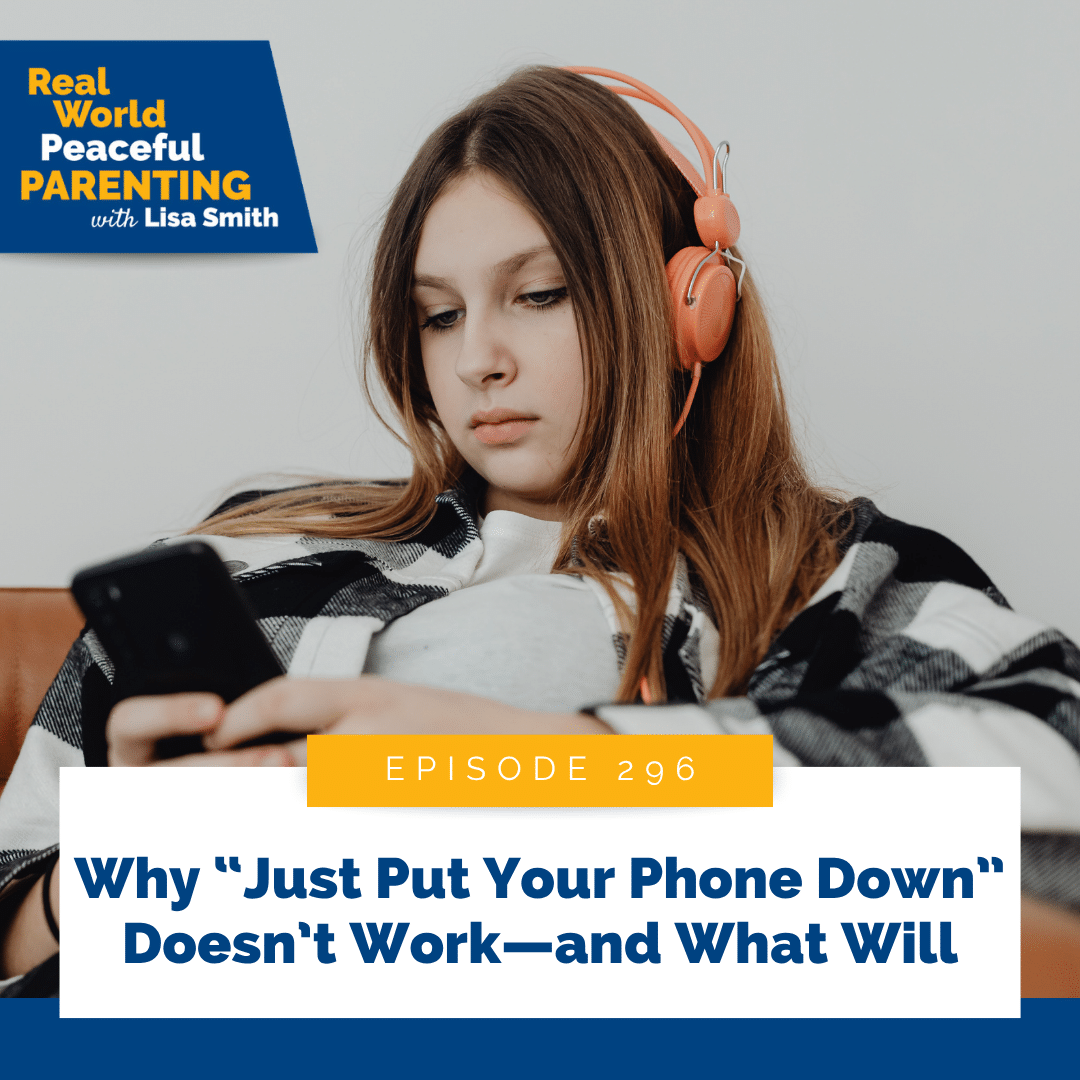
Your kid can’t put their phone down…and if we’re being honest, sometimes neither can we.
In this episode of Real World Peaceful Parenting, Lisa takes a fresh look at kids, smartphones, and screen-time limits. Instead of blaming kids for lacking willpower—or declaring technology the enemy—Lisa explains why developing brains need parents to create thoughtful “governors” around technology.
You’ll learn how phones can crowd out boredom, sleep, face-to-face connection, and opportunities to practice emotional regulation, plus three areas of family life Lisa believes are worth protecting. Most importantly, you’ll learn how to set limits with a strong spine and soft heart—even when your kid absolutely, positively, passionately does NOT agree.
Sign up for my free Peaceful Parenting mini-course! You’ll find everything you need to get started on the path to peaceful parenting just waiting for you right here!
What You’ll Learn from this Episode:
- Why expecting kids to regulate their own phone use through willpower alone may be asking their developing brains to do an incredibly difficult job.
- How to think about technology limits as a “governor” that protects your kid rather than a punishment for doing something wrong.
- Why boredom, waiting, awkwardness, and discomfort are valuable opportunities for kids to develop emotional regulation and real-world social skills.
- The difference between using a phone as one regulation tool and allowing it to become the entire emotional-regulation toolbox.
- Three places to consider protecting from phones—sleep, the family table, and intentional empty space—and why each matters.
- How to hold a healthy phone boundary with a strong spine and soft heart, while also examining the technology habits you’re modeling for your kid.
Listen to the Full Episode:
Featured on the Show:
-
- Click here to sign up for my free Peaceful Parenting mini-course! You’ll find everything you need to continue on the path to peaceful parenting over there just waiting for you.
- Send us an email!
- Message me on Instagram and tell me how you felt after 10 minutes of undivided attention with your child.
- Click here to join The Hive!
- Peace & Quiet: The Crash Course For Peacefully Parenting Your Strong-Willed Kids
Full Episode Transcript:

Welcome to Real World Peaceful Parenting, a podcast for parents that are tired of yelling, threatening, and punishing their kids. Join mom and master certified parent coach, Lisa Smith, as she gives you actionable step-by-step strategies that’ll help you transform your household from chaos to cooperation.
Let’s dive in.
Welcome, welcome, welcome Welcome to today’s episode. I am so excited to be with you. I want you to picture something. You’re sitting at the dinner table. Maybe you’ve made tacos, maybe you’ve ordered pizza, maybe you’re eating something you threw together in 14 minutes because everybody has somewhere to be tonight, and your kid is sitting across from you, and they’re on their phone.
Dun, dun, dun. They’re scrolling, and you keep trying to talk to them. “Hey, buddy. How was your day?” Nothing. Then you say, “Did you hear me?” “Yep.” And their eyes never leave the screen. And eventually you say it. “Can you please put your phone down?” Maybe they do. Maybe they roll their eyes first. Maybe they tell you they’re in the middle of something.
Maybe you have to ask three times. And then, eventually, the phone goes down. And then your phone buzzes. And let’s be honest, what do you do? You probably look at it. Ugh. I know, I know. Today, we’re gonna talk about phones, smartphones, but I wanna talk about them a little differently because something really interesting happened this past week, and I’ve been thinking about it a lot.
Meta, the company that owns Instagram and Facebook, agreed to a proposed settlement with a bipartisan group of attorneys general over allegations about the way its platforms were designed for kids and teenagers. And as part of the proposed settlement, Meta agreed to some pretty extraordinary restrictions for users under 18.
They include a default two-hour daily limit, which means teenagers and kids would not be allowed to be on the app more than two hours a day. They also agreed to no access to the app, each app, between midnight and 6:00 AM in the morning, unless a parent overrides it. They agreed to notifications being blocked overnight and during the school day, and an option for a feed that isn’t personalized by algorithms designed to keep serving you more and more of what captures your attention.
And there were some other protections thrown in as well. Now, I wanna be really clear. The settlement still has to be approved by the court and implemented by Meta, and I have absolutely no idea how effectively Meta is ultimately going to implement this. I don’t know how they’re gonna enforce it. I don’t know how kids will be able to figure out a get-around on some of this.
I don’t know. But honestly, that’s not the part I find interesting. Here’s the part I literally cannot stop thinking about. Look at the limits. Two hours, no middle of the night, no during the school day, and periods of the day when the device simply doesn’t get to interrupt you. We are finally acknowledging That expecting kids to regulate themselves indefinitely around technology that is incredibly good at capturing their attention might not be a reasonable or realistic plan.
And I want us to understand something about that attention. Meta alone reported that it has more than seventy-five thousand employees this summer. Now, I’m not saying that seventy-five thousand people sit at desks all day trying to figure out how to get your kid to keep scrolling. That’s not accurate But what I want you to appreciate for a moment is that these companies, Snapchat, Instagram, Facebook, Discord, YouTube, TikTok, have enormous teams of engineers, product designers, data scientists, researchers, and marketeers working on products that compete for one valuable thing, our attention, our eyeballs, including our kids.
Because these are businesses, and the more time we, meaning you and your kids, spend on these apps, the more opportunities there are to show us ads. The more we engage, the more valuable those platforms become to advertisers. And ultimately, these are publicly traded companies with shareholders, where profits matter.
So when your twelve-year-old has trouble putting Instagram down, or your sixteen-year-old says, “Just one more video,” and forty-five minutes disappear, I want us to stop pretending that that is simply a willpower problem. Your kid’s developing brain is on one side of the equation, and on the other side is an enormously sophisticated industry with extraordinary amounts of money, technology, data, and human talent working to make products people want to keep using, and that matters.
And here’s my question for us parents. Why would we wait for Meta to implement these changes? Why? Think about a golf cart for a minute, or a U-Haul truck, or one of those little rental scooters. A lot of them have something on board called a governor. The machine is physically capable of going faster, but the governor says, “Nope, that’s as fast as we’re going.”
Not because the machine is bad, not because speed is evil, but because somebody decided there should be a limit built into the system. Golf carts should only go so fast. U-Hauls should not be capable of going as fast as a Lamborghini. People on scooters with no helmet and maybe not a lot of experience shouldn’t be allowed to go as fast as a motorcycle.
And I think our kids need governors around technology as well. Not because phones are evil. I’m not anti-phone. I’m not anti-technology. Good Lord, I love my phone. I run parts of my business from my phone. I get to talk to the people I love on my phone. I get directions from my phone. And if you know me personally, you know I am terrible at directions.
I take pictures with my phone. I listen to podcasts on my phone. I order things from it. I look things up. I communicate. I connect. Phones are incredible tools, and they are also incredibly good at capturing our attention Both things can and are equally true. The problem is that we’ve spent years handing kids this incredibly powerful device and then expecting their still-developing brains to know when they’ve had enough.
We expect them to just put it down, stop scrolling, set the phone on the nightstand and roll over and go to sleep. Don’t check it during school. Ignore the notification. Don’t worry about how many likes you got. And when you think about that, I mean, come on. Some of us are 35, 47, and 55-year-olds who can’t do that.
Some of us can’t stand in line at Target for 90 seconds without pulling out our phone. Am I right? And yet we hand one to a 9, 10, 12, 14, 16-year-old, and they get furious when they don’t demonstrate impeccable self-control around it. And I’m here to say I don’t think that’s fair. And that’s why I like the idea of a governor.
The limit doesn’t have to depend entirely on your kid making a good decision while the thing they desperately want is sitting six inches from their hand. Sometimes the system makes the decision, like the golf cart or the scooter. I don’t know if you know this, but schools are starting to do this. Meta isn’t the only place we’re seeing this.
Schools all over the country in the United States, and in some other countries, like Sweden and Spain, are experimenting with the same basic idea. They’re taking the phone out of the equation during the school day. And this is not a tiny fringe experiment anymore. As of this summer, 24 states in the United States have what’s called bell-to-bell phone restrictions, meaning the phone is unavailable to the student from the beginning of the school day until the end.
Think about that. That’s 24 states. Maybe you live in one of them. I mean, that’s essentially half of the United States. In one large national survey of educators, bell-to-bell phone restrictions has become incredibly common and normalized. And here’s where it gets interesting. Teachers have started reporting transformations and breakthroughs.
They’re reporting that kids are starting to talk to each other at lunch and in the hallways, face-to-face, old school. I mean, imagine that for a minute. One teacher is quoted saying essentially the lunchroom got louder because kids were socializing again, and it was music to her heart. I love that, because think about what happens when our phone isn’t available to fill every empty second.
Think about it. We look around. We learn to tolerate a little boredom. We make eye contact with the people around us, right? If you’re a kid, you might say, “Hey, what are you doing after school?” You might sit there awkwardly for a moment. You might join the conversation happening next to you. You might actually begin to figure out what to do with yourself.
You might learn to tolerate being uncomfortable. Those, I want you to realize, for our kids and for us, are not wasted moments. Those are developmental moments Because hear me on this, please. Boredom has a job. Awkwardness has a job. Waiting has a job. Face-to-face interaction has a job. Figuring out how to enter a conversation has a job.
And if every tiny pocket of discomfort gets immediately filled by a screen, where do our kids learn these skills? Where do they get to practice these things? Think about that. And I’ve talked before about not wanting our kids to depend on their phones as their primary tool, or heck, any tool, for emotional regulation.
I wanna make an important distinction here. I am not saying that we should not ever use our phones to regulate. Please. I do it, you probably do it. Sometimes I wanna watch something funny. Sometimes I wanna scroll. Sometimes I wanna listen to a podcast for inspiration, or music to regulate my nervous system.
Sometimes I wanna text somebody I love and experience connection as a calming regulator. Technology can help us feel better. That’s not the problem. The question is, is it the only tool in the toolbox? The question is, is it one tool in the toolbox, or is it the entire toolbox? This is the question I want you to take a deep look at For your kids and yourself.
Can your kid be bored without immediately reaching for the phone or the PS5 or the Xbox? Can they sit in the car for 10 minutes without a phone? Can they wait in the lobby for the dentist without watching TikTok videos? Can they go in to a family gathering that feels awkward and leave their phone in the car?
Can they be disappointed without needing to be soothed with videos or connecting with someone on a phone? Can they be lonely for a minute? Can they have a hard day without disappearing into their bedroom for hours on end to watch video after video after video? Can they tolerate the uncomfortable space between wanting stimulation and finding something else to do?
Because emotional regulation isn’t learning how to never feel uncomfortable. It’s learning I can feel uncomfortable and I can survive it. I don’t have to immediately make the uncomfortable feelings disappear. This is an incredibly important skill. I can’t emphasize enough. If your kid moves out of your home with the skill of being comfortable being uncomfortable, A+, well done, amazing.
Amazing. And here’s the thing I want you to think about. If every time we automatically hand a screen to a kid at any age because they’re bored, cranky, impatient, uncomfortable, waiting, frustrated, or unhappy, we are interrupting the opportunity to practice the needed skills. We are interrupting the opportunity to build the toolbox to tolerate disappointment, boredom, frustration, and discomfort.
Yeah? Yeah. Okay. Here’s the part some of us aren’t going to love. Because if we’re gonna talk about our kids’ relationship with their phones, we have to talk about ours. And a study published just last week looked at smartphone engagement in parents and kids between 10 and 15. The researchers found an association, a modest one, but an association between higher parental smartphone engagement and more emotional and behavioral difficulties in kids.
Now, I wanna emphasize the word association. This study does not prove that being on your phone causes your kid to have emotional or behavioral problems. It doesn’t. But it adds to a growing body of research asking an important question: What is it like for a kid to repeatedly experience their parents’ attention being somewhere else?
Another study published this summer actually asked kids. Some of the words kids used to describe their parents’ phones. You ready? A wall, a barrier, a time thief Oof, those land, don’t they? Because we spend so much time worrying about what the phone is doing to our kids, and sometimes we forget to ask what our phone is doing to our relationship with our kids.
We say, “Put your phone down,” while ours is sitting next to the plate. We say, “You don’t need to answer every notification.” Ding. And then we say, “Oh, hang on, I need to check this one.” We say, “Why can’t you just sit here and talk to us?” while we’re half listening and half reading an email. Kids don’t just learn from what we tell them, they study us.
They watch what gets our attention. They watch what we interrupt a conversation for. They watch whether we can tolerate waiting. They watch whether we bring our phones everywhere and are scrolling while we’re waiting in the dentist office or standing in line at Target. They watch whether we can sit still without reaching for stimulation.
They watch what we do, what we’re modeling for them. When Malcolm was growing up There were some places Dave and I protected from the phones, and I mean protected. We never brought phones to the dinner table, none of us, ever, no matter what. We didn’t sit in the middle of a diner checking texts or answering emails.
When we were riding in the car together, we buried our phones, them in their pocket, me in my purse. The car was face-to-face time. It was family time. And there was one more place we were absolutely, positively dogmatic about no phones, and it was Malcolm’s bedroom overnight. Now, this caused a lot of passionate, heated discussions in our family from time to time, but until he graduated from high school, his phone was not allowed to stay in his bedroom overnight, period.
That protected the entire night. This allowed him to go in his room, shut the door, and sleep without notifications going off, without text messages coming in, without the temptation to check something at midnight or 1:00 in the morning or 3:00 in the morning when he couldn’t sleep. David and I felt incredibly strongly about this.
The phone did not sleep in the bedroom with him. We had a $5 alarm clock from Target. And I don’t tell you this because we did everything perfectly. Oh my goodness, heck no. If you’ve listened to this podcast long enough, you know way better than that. I’ve made plenty of parenting mistakes, but looking back, I am incredibly grateful that we had those practices.
Because we weren’t asking Malcolm to do something we weren’t willing to do ourselves. The rule wasn’t, “Malcolm needs to stay off his phone.” The value was, there are parts of our life together that were going to be protected from our phones. Can you hear the difference? I love that word, protect. I’m not trying to punish you by taking your phone away.
I’m protecting fellowship time at dinner. I’m protecting sleep so growth hormone can be released and your brain can detoxify and you’re not walking around like the mother of a newborn whose sleep is getting interrupted every two hours. I’m not punishing you. I’m protecting conversation and connection between the kid and the parent.
I’m protecting your developing brain from having to make a decision every 30 seconds about whether to check the notification. I’m protecting you by helping you experience boredom. I’m protecting face-to-face interaction. I’m protecting opportunities to learn how to regulate without immediately reaching for a device.
I’m protecting our relationship.” And that’s a completely different energy than, “Get off the dang phone right now.” So here’s what I want you to hear today. You don’t need Meta’s permission. You don’t need to wait for Instagram to implement a two-hour governor. You don’t need your school district to create the perfect policy.
You don’t need to wait until your kid admits, “You know what, Mom? You’re absolutely right. I think I’m spending too much time on my phone, and I’d really appreciate some limits.” I mean, good luck with that. Here’s what I want you to realize. You’re the parent. You can create the governor, and you can do it with a strong spine and a soft heart.
You don’t have to go to the route of, “Phones are terrible. Social media’s ruining your life. You clearly can’t be trusted.” Instead, you can go, “Hey, I’ve been learning more about this, and I realize we’ve been asking your brain to do a job that’s really difficult, so we’re gonna create some phone-free times in our family.”
That’s leadership. Now, I don’t want you to finish listening to this episode by declaring 12 new ph- phone rules tonight. Please don’t do that. Please. And I think you know me better than that. Rather, I want you to get curious and pick one place to start. Here are three that I think are worth considering.
One, protect sleep. This is probably the easiest yes for me. Phones don’t need to sleep with kids. And in fact, Dr. Jean Twenge published a book last year, Ten Rules for Raising Kids in a High-Tech World, and the number one tip she recommends in the entire book is get the phones out of the bedroom at night for our kids.
Now, the reality is, your sixteen-year-old may have seventeen arguments for why theirs absolutely does need to be in their bedroom. It’s their alarm. Their friend might need them. They like listening to music while they go to sleep. They need to check the weather at two fourteen in the morning. Okay, we can solve these problems.
Buy an alarm clock. Find another way to play music. Create a plan for emergencies. The proposed meta settlement itself includes a midnight to six block for minors, and if other platforms adopt similar terms, that window could become even larger. That tells us something. Sleep deserves protection from a device designed to call your attention back to it, and this is a place where technology can actually help us.
You don’t have to stand outside your teen’s bedroom every night wrestling the phone out of their hand. You can use parental controls like a Troomy phone or BrightCanary. Use the tools built into the device. Use monitoring and safety tools if they’re appropriate for your family. Let the technology and the system help you hold the limit.
Implement a governor just like U-Haul has done. Number two, protect the table. Meals, no phones. I mean everybody. Everybody. Under no circumstances. Not, “Kids, put your phone away while Dad answers emails,” or, “Oh, uh, Mom’s saying I have to have my phone here in case my friend texts me or the PTA about something important.”
No, everybody. Maybe you don’t eat together every night. Fine. Maybe breakfast is chaos. Fine. I’m not asking you to become the Cleavers. I’m asking you, is there one regular place where everybody’s attention belongs to the people in front of them? Because connection needs a place to live. Give it a home.
Give it a rhythm. Give it a routine. It matters. And then number three, protect some empty space. Now, this one might be the hardest, but the goal is to not fill every gap. The 10-minute drive, the waiting room, standing in line 15 minutes before practice starts, sitting outside walking the dog. Let some moments be empty.
Not every moment. Again, I’m not interested in creating a monastery. I want our kids, frankly us, to maintain the ability to be alone with our brains sometimes, to notice things, to think, to daydream, to start a conversation, to feel bored and discover that boredom does not require emergency medical treatment.
We can survive it, I promise. We can get comfortable Being uncomfortable. Now, if you decide to change your family’s phone habits after listening to this episode, please hear me. Your kids are not gonna like it. They’re going to complain. They may tell you you’re the only parent in the world doing this.
They’re gonna tell you that everybody else’s mom lets them sleep with their phone. They may even go so far as to tell you their social life is over. They may get angry and tell you they hate you or you’re ruining their life. Hear me on this. That doesn’t mean the limit is wrong. A limit can still be healthy and create disappointment and frustration and anger initially.
Our job is not create a limit our kids enthusiastically approve of. Our job is to decide what’s healthy and appropriate, to communicate it clearly, to set the limit, and hold it while listening to their feelings about it. Strong spine, soft heart. I totally get, son, that you don’t like this. That’s a soft heart.
I get it, you wish you could keep your phone tonight. Soft heart. I know I’ve allowed this to go on for a while, and phones are now gonna live outside of our bedrooms at sleep time. That’s a strong spine. Strong spine, soft heart, both at the same time. That’s peaceful parenting in action. I don’t think the goal is to raise kids who aren’t interested in their phones.
That’s not realistic. We’re all interested in our phones, if we’re honest. And I don’t think the goal is to make technology the enemy. And I really don’t think the goal is to spend the next 10 years fighting about screen time. What I do think is that the goal is to teach our kids something bigger.
Technology gets to be a part of your life. A part. It doesn’t get to consume every part of your life. There should be places it doesn’t go. There should be hours it can’t reach you. There should be conversations it doesn’t interrupt. There should be uncomfortable feelings it doesn’t immediately rescue you from.
There should be people sitting across from you who know that, for this moment, they have your attention. And frankly, if we want that for our kids, we have to be willing to practice it ourselves. So here’s your homework this week. First, identify one part of your family’s life you’re willing to protect from phones.
Dinner, sleep, the car, an hour after school, Sunday morning, whatever makes sense for your family. One. Just one. And then look at your own behavior before you say a word to your kid. Are you asking them to have a relationship with technology that you aren’t modeling yet? There’s no shame. You’re just looking and gathering information.
Because you don’t have to wait for Meta to build the governor. You can decide what deserves protecting in your family. I want that for you, and I want that for your kids. I want you to bring the Governor into your family. I want you to decide what deserves protecting and implement it with a strong spine and a soft heart.
Yeah? Yeah. Okay. Until next time, I’m wishing you peaceful parenting.
Thanks for listening to Real World peaceful parenting. If you want more info on how you can transform your parenting, visit thepeacefulparent.com. See you soon
Enjoy the Show?
-
-
- Don’t miss an episode, follow the podcast on Spotify, Apple Podcasts, or RSS.
- Leave me a review in Apple Podcasts.
-