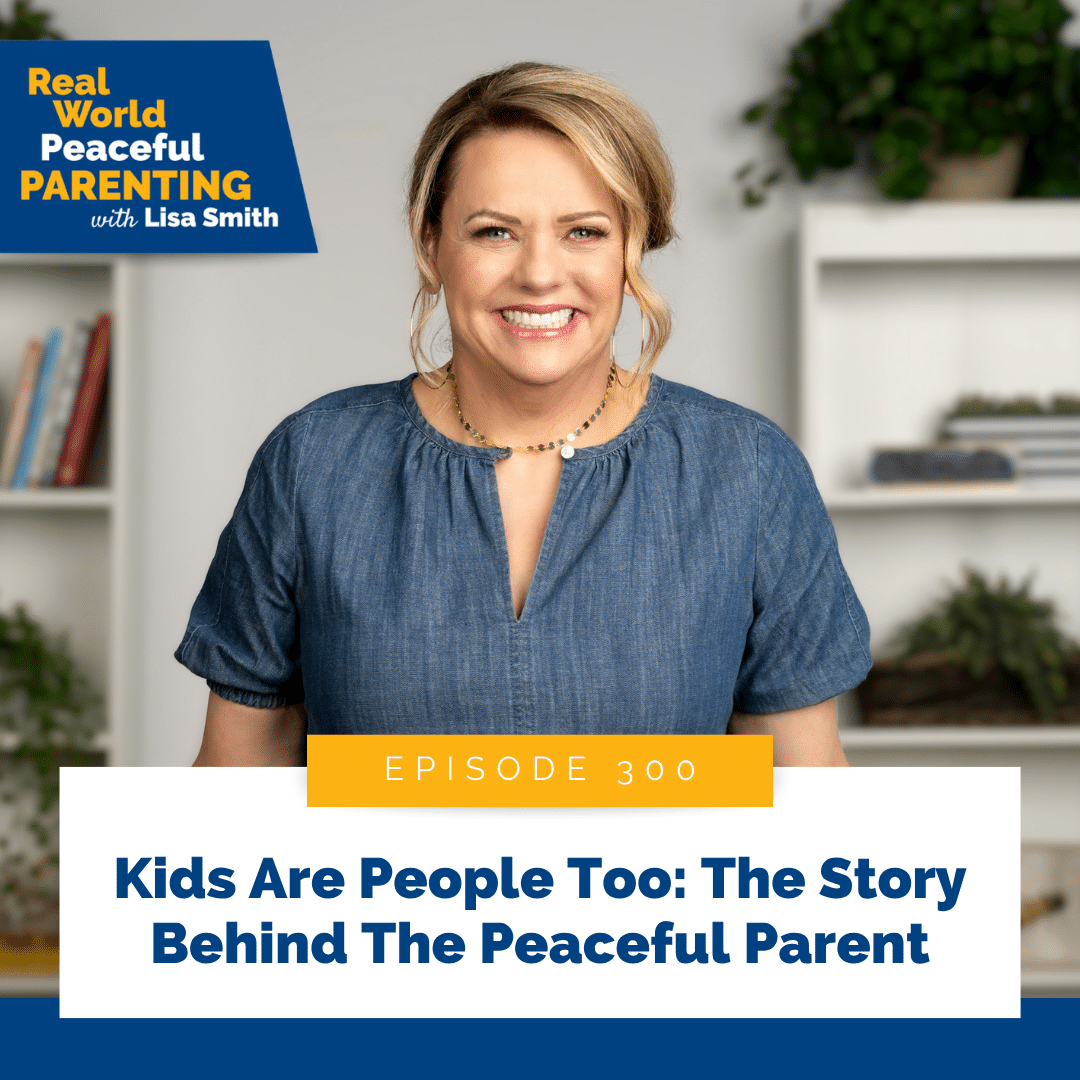
We’re celebrating 300 episodes of Real World Peaceful Parenting with a very special conversation!
This week, I’m handing the microphone to my dear friend of 30 years, Melissa Botello, for a candid, behind-the-scenes interview about my life before peaceful parenting, my journey from corporate executive to parent coach, and the experiences that shaped my mission.
We’re talking about raising my strong-willed son, Malcolm, breaking generational parenting patterns, and the moment he told me he knew I loved him because I went to parent coach training.
I’m also sharing why I believe kids deserve the same respect we give adults, what I wish I’d known as a working mom, and the lessons I’ve learned after 17 years of coaching parents.
It’s a celebration of 300 episodes, the long game of peaceful parenting, and the power of deciding to do things differently. ❤️
Sign up for my free Peaceful Parenting mini-course! You’ll find everything you need to get started on the path to peaceful parenting just waiting for you right here!
What You’ll Learn from this Episode:
- How Lisa went from corporate executive to parent coach, including the challenges of balancing a demanding career with raising a young kid.
- Why parenting her strong-willed son became a turning point and inspired her to find a different approach than the dominant parenting style she experienced growing up.
- The childhood experience that shaped Lisa’s mission to advocate for kids and help parents recognize that kids are people who deserve dignity and respect.
- The unforgettable moment Malcolm recognized her parenting transformation and how his words strengthened her commitment to helping other families.
- Why Lisa favors practical parenting concepts over rigid scripts, and how regulating yourself first creates space to respond instead of react.
- What 17 years of parent coaching has taught Lisa about growth, support, and self-care, including why rest is fuel, not a reward, and why parents don’t have to figure everything out alone.
Listen to the Full Episode:
Featured on the Show:
-
- Click here to sign up for my free Peaceful Parenting mini-course! You’ll find everything you need to continue on the path to peaceful parenting over there just waiting for you.
- Send us an email!
- Message me on Instagram and tell me how you felt after 10 minutes of undivided attention with your child.
- Click here to join The Hive!
- Peace & Quiet: The Crash Course For Peacefully Parenting Your Strong-Willed Kids
Full Episode Transcript:

Welcome to Real World Peaceful Parenting, a podcast for parents that are tired of yelling, threatening, and punishing their kids. Join mom and master certified parent coach, Lisa Smith, as she gives you actionable step-by-step strategies that’ll help you transform your household from chaos to cooperation.
Let’s dive in.
Welcome, welcome, welcome. I am really, really, really excited to be with you here today, and this is a really, really, really special episode of Real World Peaceful Parenting because, my friend, this is episode 300. I absolutely love doing this podcast. I love showing up here every week. I love getting to share what I’m learning, what I’m thinking about, what I’m seeing in my coaching, and what I know can help you create more connection and peace in your family.
So episode 300 feels like something worth celebrating, and a perfect opportunity to do something a little different. So today, drum roll please, I’m turning over the microphone to my dear, dear, dear friend, Melissa Botello. She’s here to interview me. Now, listen to me. Melissa and I have known each other for, this is hard to say out loud, but 30 years.
Melissa knew me long before there was a Real World Peaceful Parenting podcast, long before there was The Peaceful Parent. She’s known me as a friend, a coworker, a wife, a mom, an entrepreneur, and a coach, and through a whole lot of different seasons in my life. Now, Melissa is an incredibly accomplished medical device executive and entrepreneur.
And when I say entrepreneur, y’all, I mean it. She’s a mom herself to an adult son, Dominic, and she’s hosted her own podcast, which I’ve had the pleasure of being a guest on in the past. And now the tables are turning. And here’s the fun part. I have no idea what she’s gonna ask me. I intentionally didn’t get the questions ahead of time because I want this to be a real conversation.
I want Melissa to bring her perspective as somebody who’s known me for more than three decades, follow her curiosity, and ask me the things she genuinely wants to know. I hope this gives you an opportunity to get to know me a little differently. As you guys know, Malcolm’s now 22 and I’ve spent more than 17 years coaching parents.
So I have the gift of being able to look back on my own parenting from a completely different vantage point than I had when I was right in the middle of raising him. There are things now that I understand that I couldn’t possibly have understood then. So whether you’ve been listening to Real World Peaceful Parenting since the beginning or you found me last week, I hope today’s conversation gives you a little more insight into who I am, why I so believe deeply in this work, and maybe gives you a little glimpse into the long game of peaceful parenting while we’re still right in the middle of it So join me in welcoming Melissa.
Melissa, welcome. The mic is yours. I turn it to you. Well, thank you. What a, what a, an amazing opening, and I’m so honored to be part of number 300. Oh my gosh, I can’t believe it. You’ve accomplished so much, and I’m so excited to talk to you today, and hopefully, like you said, give your audience and your connections a little bit of a glimpse into what an amazing person you are outside of peaceful parenting.
I’m excited. All right. So you were very modest about yourself in the beginning, and you basically just talked about 300 episodes, and I mean, we’re gonna go all places here. Um, but w- let’s start, let’s go back a little bit. So people know you as the Peaceful Parent. You’ve been doing this for 17 years. This is 300 episodes.
You mentioned we’ve known each other for 30 years. We met in a corporate world, which is super different from your peaceful parenting and coaching. Oh, and I’ll tell just in case you don’t, you, you not only, uh, launched products in the orthopedic space, but then you went on to mergers and acquisitions where you did deals up to $350 million.
That’s huge, and, you know, n- not a lot of women, not a lot of people can say that. So take us back. Who was Lisa Smith before peaceful parenting? What a question. What a good one. I was so different. I mean, it’s just funny to even think back on, you know, the two faces, if you will. I think a good place to start, as you well know, is that when Dave and I got married, we both walked down that aisle with the intention of not having children.
Mm-hmm. We had made that decision individually and together. We were very happy, content with that decision, and were, you know, really living an amazing life of dual income, no kids. I had the fortunate opportunity to travel all over the world with one of my jobs, and we really enjoyed life. to its fullest. I was able to dedicate an inordinate amount of time to my career, which it required, as we both know.
Mm-hmm, yes. Because we shared offices next door to each other. So it was full throttle travel, 150,000
miles a year easily accomplished, spending time with clients and coworkers, and it was an amazing life. And then I turned about 36 and realized that for the first time Dave and I should probably have a candid conversation and really double check that we didn’t wanna have kids because, you know, we know what the numbers are, fertility drops off.
And through a series of events that I won’t go into, we decided that yeah, we did wanna try to have a child, and within six months we were pregnant. I was shocked. Right? You were, were you? You wanna say anything about that? Well, no, just to your point, and I, and I know you don’t wanna get into the real details, but you know, you go all this time, you’re 36, you’ve got this amazing career.
For people who may be on the fence, maybe this may be an opportunity, you know, without getting into all those personal details, but you know, what were the one or two things that made you rethink it? Um, and then, you know, obviously it’s been gratifying and you’ve got an amazing son and so on, but anything to elaborate there for people who might be not parents yet, but still…
‘Cause so many people are doing this, right? Like, people put their careers- Yeah … out there and they put, you know, child second or last. You know, I think a lot of it came down to I had some relationships with people, yourself included, ’cause Dominic is older than Malcolm, and some other people that we know. I had relationships with people who were parents, and I had close relationships, aunt and uncle-like relationships with their children.
And what I really came to realize is that when I spent time with little kids, I found it so fulfilling, and in l- and it, it gave me an energy that I wasn’t getting anywhere else. You know, seeing the smile and the, and the silly laugh, and the playfulness, and the imagination of little kids, it, it, it caused me to take a look at myself- And then also, I did find the people like yourself who are balancing parenting and career to just be so much more interesting and engaged in both their career and their parenting.
And I thought, “Wow, I want that too.” And, um, on top of it, I don’t have a lot of family on my side. My husband has a lot of family. I don’t have a lot of family, and I did come to the realization that I wanted to be part of a real family, a nuclear family, and I wanted Dave and I to extend our unit to include one more.
And then the last thing I would add is I just think my husband is the bee’s knees. He’s so smart and- He is … so gifted, right? And- Yes … I just wanted his genes To, you know, carry on another generation in the world. Those were really the driving reasons. Mm, I love it, and we’re so glad you did. I mean, this world is better because of Malcolm, for sure.
You know, Melissa, I also wanna say, I mean, when I think about this question, you were a big part of the mentorship. You know, again, Dominic is older than Malcolm, and watching you be a parent, watching you have a career and balance all of it, and also I would say watching… Not to make this episode about you, but-
you know, to the person, having a mentor in the parenting role is never a bad thing either, right? Because what I saw you do is think outside the box and do things differently, and take chances that you might not have taken in your career if you weren’t a mom. And it, it actually showed me that it’s possible.
Mm. Well, thank you. It- it, you know, and you know this as well as I do, and your entire audience, there’s no harder job than parenting, but there’s no better. Like, there’s so much that we get back from it, but it is so hard. And then if you throw in there a corporate, any kind of job, even if you’re not outside of the home, I, I frankly think staying inside and working inside is harder than going outside, but it’s so difficult.
Um, so what you’re doing and what you’re bringing to your audience and the world is, is desperately needed. I mean, just think when we first started having kids 20-something years ago, there were no parenting coaching. Th- people… In corporate America, we didn’t even talk about our children because that, you know, we worked with mostly men, and it was taboo.
So what- Yeah … you’re doing and, and the space that you’ve created for people is, is well, well needed. So we’re, we just got a little bit ahead in talking about corporate, um, and parenting. And so, so you started to tell us how you got started, about, a little bit about having children. So take us back to when you were thinking about making a pivot because I think parents make pivots at home, either going back to work, staying at home.
They leave jobs. Talk about the pivot in the parenting scenario as well as just corporate and, and work in general. Well, I find out that I’m pregnant the exact same weekend. It was Thanksgiving weekend. I can’t r- uh, let’s see. It was Thanksgiving weekend of 2003, and I, I find out… Well, the Friday after Thanksgiving, I get a phone call.
‘Cause let’s be honest, the company we worked at, this is how things rolled back then. Yes. There were no holidays, right? Yes. So Friday morning after Thanksgiving, I get a phone call from this person offering me the position to move to a different division and lead the M&A department business development.
And I mean, this is my dream job. I am so excited. I cannot believe I’m getting this offer. Truth is, I’m probably unqualified for the job, but the guy believes in me, and he’s like, “I know you can step into this role. You’re gonna make it happen. It’s gonna be great.” And I’m like, “Yes.” And then ironically, Saturday morning I realize that I’m pregnant.
Oh. Literally the same weekend. And the job requires a coast-to-coast move across the United States, right? So we’re gonna relocate- Yes … from California to the East Coast to do the job. This is like a Hallmark movie, or this is a movie, right? Like- Yeah … this doesn’t happen in real life. You get the dream job, and then you find out you’re pregnant.
And you’re gonna move- And you’re moving across the country … to a town where you know one family. Mm-hmm. The guy that you’re gonna work for. Yes. Yeah. Exactly. The suspense builds. So I had a ideal pregnancy. I did great during it. Speaking of pivoting, Malcolm’s born, um, and I go back to work almost immediately.
And we’ll, we’ll protect the privacy of the company over those details, but literally almost immediately, as you know. Yes. But the thing is, I didn’t think about a pivot or I didn’t visualize, how is this gonna work? What is it gonna look like? I didn’t set boundaries or goals. I, I basically did it as wrong as you can do it- As a new parent going back to work for the first time.
Yeah. And in some ways it was a disaster on me emotionally. Um- Yes, of course. Yeah. Go back to work right after you have a baby, your hormones, your body’s- Right … not even ready, like- Right … and for you to go into this high stakes corporate job- Right … brand new, new community, oh my gosh. Right. And this is where I think, to your point of all the things that are available today, this is where the parent coaching space and the information age can be helpful, right?
Mm-hmm. This is where you can, you know, go and find people that are just a couple steps ahead of you and say, “How do I do this? What do I need to know? Can I get support through this?” I mean, if I’d had a parent coach at the time, someone that I was meeting with once a week that I could have brainstormed ideas, or if I’d had a community like I run of The Hive, where I could have gone into the live coaching calls and crowdsourced ideas and strategies, “What have you all tried?
What advice do you have for me?” I would have been… It, it would’ve been just so much better for me than it was. I mean, I was performing at work, no doubt. I was doing a great job, and I was performing at home with my child, bonding, raising him, attaching, creating a secure, safe environment, but on the inside of me I was a mess.
Yeah. Gosh, I mean, that, that’s… Without even saying, like, it’s hard to even believe you were functioning. You know, with that level of stress and trying to keep it all together, and something’s gotta give, and it’s usually you. Yes. The person, you know, mom, the, the woman in the corporate job. Yeah. And if I just had a place to pivot or even- Yeah
know about pivoting, a safe place, right? Because I wasn’t gonna go down the hall and talk to my coworkers. I mean, most of them were men, but I work with men too, so it’s not about the man thing. It’s just that in the corporate environment, you’re not gonna go next door to your peer or go to your boss or go to your direct reports and say, “Hey, I’m struggling.
What ideas do you have for me,” right? It doesn’t work like that. No. And if you’re an in-home mom, like you said, if you’re working inside the home, you may not have a community of people to, to- Right … to feel safe to say, “Here’s what’s happening for me. What ideas do you have?” And even if these people have ideas, they may not be productive ideas.
You may just end up complaining together but not really coming up with any solutions. So to your point about the pivot, I think back now, I think about this often, I think about where would I be if I’d a had a resource and a safe community to let my guard down, to be vulnerable, to crowdsource ideas, to get support, and to get expert coaching.
The honest truth is I’d probably still be in that job Because I did absolutely love that job- Yeah … and I was incredibly successful at it, but to your point, something had to give. Yeah, that’s so hard. And, and I think today we do have the resources, right? There’s, uh, like you have your communities, but I think there’s still the stigma with women, like we feel like we have to do it all.
We don’t wanna show our vulnerability. But as soon as someone shows it, then we all just go, “Oh my God, I’m feeling that too.” Like, so what would you say, looking back at that lady, Lisa Smith, some 20 years ago, or to the lady right now who, you know, still is trying to struggle and do it all, like what, what, what do you know now and what would you have done differently?
I mean, you said if you would’ve joined a community you would’ve had that, but how do you take that first step? I think you embrace the saying nothing changes if nothing changes, right? Mm-hmm. And I think that Lisa Smith would’ve said on one hand, “Oh, I don’t have time for this.” But what I know now is finding that support and joining that group or, or just however it, it happens for you, right?
But getting in a safe place to be vulnerable, to ask questions without feeling judgment, and to get support, I just, I know the game changer that it is. Like I really do. Yeah. And I think men, you know, have an equal hard time being honest about- Oh, for sure. Mm-hmm … the level of support they need. You know, I have dads in my membership, and they get on coaching calls, and they need the help and support as much as the moms do, and they, they have even less people to talk to most of the time, right, than- Right.
For sure … than moms. Yeah. For s- dads, you know, we, we joke around our family and I think you too at the, the men need a, a men’s group, right? Because they don’t, they, you know, they don’t have it. I mean, we find it hard. They’re, they’re 10 times- Right … more challenged. So okay, so we’ve heard a lot about the beginnings, and then how, you know, you’re, you’re at that intersection, you’ve taken the new job, you’re, you’re parenting, then let’s fast-forward a little bit to the point where you go, “Okay, I’m, I’m ready to give up the corporate.
I wanna start something on my own.” Like, how did that all… Tell the audience, uh, I know the story obviously, but, you know, ’cause a lot of times we have these big ideas and we just sit on ’em or we don’t act on ’em. Like, what was your thought process in trying to- Make this big change, start a new business, become the entrepreneur.
Like, that’s a lot in itself that so many people dream about doing. Give some behind-the-scenes curtains ideas on how people could do that. Well, I think the exit out of, out of corporate America came out of really, I owe it to Malcolm in the sense of first he was a baby, right? And, and babies are, you can take them anywhere.
You can pack them up. I mean, Dave and I- Yeah … ate at, you know, a five-star restaurant with Malcolm, you know, in the car seat next to us at one point. Yeah. But they get older. They get to be about two or three, and the personality begins to emerge.
And a couple things started happening. Malcolm emerged as a very, as you know, strong-willed kid. Yes. Well, his parents are strong-willed too, right? Oh, really? I don’t think so. His dad is, but his mom, no. Okay. All right. Determined maybe, but not strong-willed I don’t think. But anyway, Malcolm’s personality started to come out, and it…
Parenting him started for me, based on my own history of the house I grew up in and what was modeled for me, right, I growing up was forced into a very compliant model, right? I was, I was raised by dominant people who, you know, um, I, I remember my caregivers, you know, one of the statements was, “When I say jump, the only appropriate answer is, ‘Yes sir, how high?'”
Right? Mm-hmm. Yeah. So that was what was modeled for me. So Malcolm starts pushing back pretty hard at two and three years old. No, no, not listening, running away. And my frustration level started to grow that the tools that I thought I had were not working. Mm-hmm. So I wouldn’t be home from work more than five or 10 minutes, and I would just be frustrated, exasperated, um, maybe angry, being very dominant, and everything felt rushed and compressed.
And, you know, I would get home from work at 5:00, 5:30, 6:00 o’clock, and he would go to bed at 8:00. And so there were two hours to basically, you know, do 24 hours of parenting, and his strong-willedness was not making that a happy time, right? Mm-hmm. And my lack of tools. I’m not gonna blame him. It was the combination- Right
my lack of tools coupled with his strong-willedness made this compressed time really stressful for me. And then that- Yeah … I was just carrying that stress to work and into my, you know, personal life, and into my laying in bed at night and sleeping, trying to go to sleep and being stressed. And I just started thinking about fast-forward what was our relationship gonna be like now- Yeah
if all the parenting that I did with him was, A, compressed, and B, stressful and compressed? Yes. And it scared me. To my- Yeah … I mean, I shook thinking about it. Really? Yeah. And like a seed got planted, and watered, and grew, and I just knew, A, I didn’t want it to be compressed time for me personally. If, if that compressed time could’ve been fun and joyous, I might’ve made a different decision.
Right. So I realized, A, that I didn’t want to only see him a couple hours a day, and B, I didn’t like the parent I was. Mm. I realized it was all about me and not him. So I set about to figure something out, and I, you know, this is about the age of the internet, right? Yep. And social media. It’s about, this is about 2006 or ‘7.
And I just started looking for a solution, and I found peaceful parenting as a concept. Mm-hmm. Not gentle parenting, but peaceful parenting. There’s a difference. And I started digging into that, and then I found an institute, and I originally signed up with no intention of being a, quote, “parent coach.” I signed up to get the information.
To learn, yeah. Yeah. And by week two, I was, I was all in. I mean, it was like I’d stepped into a different world. Yeah. So two things. Number one, thank you for being vulnerable. I mean, it, it’s never easy to talk about w- you know, where we fall a little bit short. And so by you, and I- I’m sure you’ve done this with your clients in the past, and I’ve heard you a little bit on, on podcasts, but, you know, being so vulnerable and being so open to share those dark moments, like, we all need to admit they happen.
They’re real, and, you know, kudos to you for seeking out the support and, you know, finding the peaceful parent. One question real quick, um, before I forget. You said there’s a difference between peaceful parenting and what’s the other parenting? Gentle parenting. Gentle. I don’t know the difference, and maybe others don’t in the audience.
Can you share? Well, there may not in, in, in, in practical terms, other parent coaches, and I agree with them, there’s not a big actual difference between peaceful and gentle parenting, but there is a perception out in the world- Mm … if you will, that gentle parenting means no consequences, right? At all. And we- Yeah, I remember.
There was, like, a big media thing where they let their kids go to the park by themselves and stay there for hours by themselves. That’s more the gentle. Right. And do anything they want, and- Yeah … we only focus on feelings, and there are no consequences. Yeah. So for example, if Johnny hits his brother Joey, and you know- Yeah
the reason that he hits Joey is because he was mad, the perception is the parent says, “Oh, I’m so sorry you were mad,” and leaves it at that. That’s not what I teach. I teach all feelings are welcome, all, but a- not all behaviors are allowed when you’re feeling those feelings. Yes. And there are consequences to behaviors.
Now, what we wanna do is make sure the consequences are not, uh, painful or detrimental or harmful, right? Because then we’re modeling that for the parent or for the kid, and we don’t wanna model that. So we wanna make sure the consequences are age appropriate and that they teach, which is the word discipline is to teach.
Mm-hmm. The word punish is to harm. Yes. So I would say that’s the distinction, because the world works with consequences, right? Yeah. Yeah. You don’t go to work, you don’t get paid. Yeah. You don’t do your job well, you get fired. You speed, you get a ticket, right? So there are consequences in the world, and sometimes gentle parenting gets attached to natural consequences, right?
Which is, I’m also not a fan of. In the sense of if you’re in second grade and you don’t wanna do your homework, right? Then someone might think the natural consequence is, well, I just let you not turn in the homework and then you won’t get into Harvard when you’re 18. A second grader doesn’t have enough prefrontal cortex development to understand that they do need to do their homework, and we’re not gonna be able to go watch TV until we get the homework done.
That’s peaceful parenting Yes, got it. And I love it. You know, serving kids early, you see a lot of parents or, you know, and, and I try not to, I guess, if you will, be judgmental, but when you see things happening and you go, “Okay, if you think you’re gonna change that behavior later on,” you, you’re creating these habits that, you know, have to start early to your point of understanding consequences.
Yeah. I love it. Yeah. All right. Thank you for, for defining the difference there between peaceful and gentle. You said you were raised by dominant people, so you went… You got into this peaceful parenting, and tell us a little bit about when the light bulb went on for you to say, “Wait, not only is this helping me personally, my relationship with Malcolm is better.
I feel better about myself.” What, what sparked the, “I wanna go out and help other people”? And, and again, a lot of people have great ideas, but they don’t execute, so tell us some secrets behind the scenes of how you, how you did it all. Well, there really wasn’t ever an intention in the beginning of building a business.
There was the intention of serving people with this content. Mm. Right? Love it. The mission was so strong, and a couple things happened along the way that fortified the mission. One is, and I think I talk about this in my free class that I teach, but I don’t think I’ve said this on the podcast before. I have this very strong memory.
I was about, I was about 12. I was in seventh grade, and I was in a, a green bikini- Ooh. … in the backyard laying out in the sun with my, with my friend, and I had just been chewed out by one of my caregivers. And after I’d been chewed out, the caregiver, the window was open, and I heard the caregiver on the phone talking to one of their friends complaining about me- Wow
sort of listing all my crimes out loud. And I remember looking at my friend outside in the backyard on the, you know, lawn chair that, you know, roll up. Yes. We were laying outside, probably had baby oil and iodine on our bodies- Uh-huh … laying out in the sun catching rays, and I remember distinctly looking at her and saying this: “Kids are people too, you know?”
Yeah. And, you know, growing up, I didn’t feel like a people. Oh, Lisa. I felt like… I know. I mean, it’s okay. But it, it always felt like I was like a stuffed animal that people could boss around and do what they want and, not to get into that too much, but I feel like part of my mission has always been helping parents- really understand that kids are people too.
Oh, I love it. So, you know, ’cause first, I love that story, and then something that just occurred to me is, you know, I’ve always looked at and admired you and your- the people you serve and the work you do, and it- it’s always appeared to me that, you know, you’re helping parents, obviously, and that’s first and foremost.
But what I just heard and realized, and took me- why it took me this long to realize, but what you’re doing is advocating for kids. Yes. Yes. Yeah, right? Like, it- it’s not about being a- a good parent. Yes, it is, but at the end of the day, you’re- you’re helping people treat children better, how they deserve to be treated, like little people, and that, that is amazing, Lisa.
Yeah. I don’t know why it took me a little while to figure out, you know? When you put that into context of how you experienced your childhood and hearing how you were talked about- Yeah … I love that. Well, and it probably didn’t dawn on you because I know that you’ve always treated Dominic like a person, and so it probably didn’t even, you know, um, resonate with you that people need help with that.
Yeah. And yeah, it does. Yeah. And I remember, like, my mom makes this joke now. Like, one time Dominic was melting down, and I just said, “Come on, we’re gonna go out here,” and I took him out to our garage. We were in our living room outside, um, because I wanted to talk to him, but I didn’t wanna embarrass him in front of people.
Yes. Like, I would- I wouldn’t speak to you or my husband. And so I took him out to the garage, and you know, I tried to say, “Listen, little dude, if you wanna melt down, that’s fine. You’re gonna stay here. We’re not gonna do it in there.” And he chose to come back in. But I guess for a lot of people, and you are firsthand experience, your lived experience, that I guess adults don’t always treat children like little people, you know?
And they are. Yeah. You know? They- Yeah … they deserve to be discussed privately and not shamed and- Right … things that you heard. So- Called names and- Yeah … and, you know, I have a lot of compassion. In, in the same vein, I have a lot of compassion for parents who- Mm-hmm … fall into that cycle because it was modeled for them, or they have a lot of stress on their plate, or no one’s guided them on how to do it differently or how to think differently about their kids.
Or sometimes it’s fear running the show, right? I’m, I’m so afraid this kid is gonna end up living under a bridge with a shopping cart that, that I feel like I have to attack this now. So I have compassion for the parents, and I’m an advocate for the kids and peace in the home. And I work with the parents, and the benefit of that is that the kids, you know, or the outcome is the kids benefit from it.
I don’t work with the kids. I work with the parents because we’re the ones that need the tools and the help and the support and the guidance. And, and I, I understood when Malcolm was little, around two or three, that, that it wasn’t him. It was me. Yeah. And I needed new tools. The tools in my toolbox were old, ineffective, dominant, because that’s what was modeled for me, and- Exactly
were causing both of us harm. And so I went looking for new tools, and that’s what I found. And I just became really passionate about helping people. And then the other part of the story is Malcolm was probably, he was in, uh, I’m gonna say fourth grade ’cause we had just moved here to Arizona. And you know, my business was, I was dabbling in it a little bit and still doing some other things in the corporate world, consulting and whatnot.
And Malcolm and I used to play this game, I know you love me because. Aw. We would play this game at night, you know? And, and they were silly things like, “I know you love me because you took me to the park today. I know you love me because you gave me a hug,” right? That would be my answer to him. And he’d say, “I know you love me because we played Legos today.”
Mm-hmm. And one night we were playing this game, and we’ve gone back and forth a couple times. And again, I remember this like it was yesterday, and I’ll probably get a little choked up telling the story, so I’ll, I’ll just try to swallow the lump in my throat here. So one night he says to me, “Mom, do you know how I know you really love me?”
Mm. And I was like, “Really love you?” You know, I’m thinking in my head, where’s this going? I said, “How, sweetheart?” And he said, “Well, I know that you really love me because you went to parent coach training to learn how to be a better parent.” Aw. And I know you did that for me. That’s what he said He’s been so smart and self-aware since he was, came out of the womb-
that kid. I love that. Yes. Wow. And in that moment, I mean, he’s an only child, so he’s able to say in his brain, right, “You didn’t do it for us or for y- my brother Bobby or…” Like, “I’m m- I’m the kid- Yeah … and you did this.” And I know that he felt the shift in our relationship before parent coaching and after, right?
And it’s not perfect. We still have storms, and we have to repair, and I make mistakes and, but I know he felt the shift, and he associated that shift in this thing of parent coaching, and that lit a spark in me, Melissa, that I have carried to this day. Oh, it’s the, the little, it seems little, but in- it was such a significant thing to say from a little guy, and that he recognized.
And I, I know it today. I see, you know, you from afar, and he’s such a, uh, just an amazing young man, and look what you’ve created and, and he, and most importantly, he’s aware of it. You know, a lot of kids would just not even be aware and, and be able to articulate that. That’s incredible. I love that story. Me too.
What a guy that Malcolm is. All right. So let’s get into, we’ve got a lot of the behind, you know, w- who is Lisa Smith, who was she before peaceful parenting. I love it all. So couple rapid-fire here. What piece of parenting advice that everyone seems to swear by but that you actually think is terrible?
Scripts. Mm. Tell us more. Well, every kid is unique- Yes … and every situation is different, and scripts, um, intimate that, follow this and you will get this result, right? So it’s like a recipe. What I know after all this time is that when things go wrong, and we’re disregulated as the parent, right, and the cortisol is running through our body, and we’re in our middle brain, our emotional center, we don’t have access to our higher brain, and so the scripts go out the window, or we can’t access them.
And so I would rather we focus on getting regulated first and then access the information. And also, you know, scripts are a movie where there’s a director that can say, “Cut. Hey, Melissa- Right … you didn’t quite nail that line correctly with the right emotion, so let’s roll it again.” When you have a script, it assumes the other person is gonna read from the script- But it doesn’t work like that with kids.
So I like to teach concepts and tools that are applied when the person is regulated, the parent, rather than scripts that lead you to believe this is going to go according to plan. I love it. Now, regulating our systems, I’ve been hearing a lot, I read a lot about, you know, regulating your nervous system.
For those who don’t know very much about it, could you just give high level two or three tips? Like, what could one do in the heat of the moment, having a, a conflict with their child, or even, you know, a relationship? What are the two or three things you do quickly to try to regulate before you get, go down that rabbit hole of, uh, escalation?
Yeah. I like that you asked that. I really love the work of Viktor Frankl in Man’s Search for Meaning, in which he talks about stimulus, react Right? That’s dysregulation, right? Mm-hmm. There’s a stimulus. You’re say, “Melissa, put your shoes on,” and then a few seconds later I listen, I realize you haven’t done what I asked or commanded, and then I react to it.
I blow up. I come in the, “What? What are you doing? Put your shoes on now.” Right? That’s, that’s stimulus, react. Right. What’s better is stimulus, pause, so you can respond. And it is in that pause that we have our power and we have our ability to choose our response, right? So it’s slowing everything down, maybe taking a big deep breath with a big giant exhale.
The vagus nerve allows us to, um, regulate ourselves. There’s a lot of science behind that that I won’t go into now, but could be another episode for a podcast. So it’s, it’s really trying to memorize stimulus, pause, and respond. So instead of going to the living room and yelling, “Melissa, what are you doing?
You never listen to me. Get your shoes on,” I might go in and say, “Hey, hey, Melissa, did you hear me ask you to put your shoes on?” Yeah. Right? And the, the kid might say, “What? No, I didn’t.” “Okay. Well, now that I have your attention- Right … can you go put your shoes on? It’s time to go to soccer practice.” Right? Yes.
But I would also say the biggest tip I could give somebody is step one is noticing in your body what does it feel like when I’m dysreg- and what does it feel like when I’m regulated? You know, it’s like checking in with yourself 87 times a day. Like right now, I just checked in and I’m regulated. Yes.
Right? Good. I know, I know the difference, right? And training yourself to notice the difference the minute you get dysregulated, job one, before you do anything else, open your mouth, before you step forward, before you try to correct, before you try to parent and coach, is to try as best you can to get regulated before you go do those activities.
So yeah, I get it. Sometimes just that little pause, the deep breath, can help you. And, and I think a good point you made was, you know, the child may in that, in that scenario you described, you know, the child may not even heard you, so to go into a room and blow up and the kid’s going, “Wait, what? I didn’t even hear you.”
So such good, good pointers. Yeah. I love them. Yeah. All right. So tell us a few things, shifting gears a little bit, what your audience may not know about you that’s very unique and different and makes you special. Oh, boy. I’d love to hear from you. I, I am sassy. Yes. I love that one. You are sassy. But they probably never see that side of, of Lisa.
W- what gets you sassy? Life. Mm-hmm. Um, people. You know, I, I, I think my hobby is people. I love studying people. Yes. I really do. We’ve ha- we’ve had many fun days, uh, with, uh, sipping a glass of wine and people watching and- Yes … I mean, I wa- I remember one of the things we used to do would, we would, you know, you, you see someone and you go, “Huh, they look like they’re a school teacher,” or, “They do this.”
Yes. You know? And- Yes … it’s just so fun. But that’s also part- I have a game I play. I know I’ve told you. We’ve played it before together. But anytime I go to the airport- Yes … I pick people out and I make whole stories up about them. Yes. Their background, why are they at the airport, right? I, I call it the, the airport game.
So that’s… I’m sassy. I would say, um, I love hard. I really, I- Yes, you do … I really love the people I love. Mm-hmm.
I’m competitive You’re very generous I’m competitive to a fault, as you know. Yeah, you… Competitive to a fault. Yes. Uh, and I love sports. You do. You know more about sports than probably 10 men I know all put together. It’s very impressive. I think the next pivot you could, uh, run a sports team, run a franchise.
You and Malcolm could conquer the world in the basketball world. Be like that lady from, uh, the basketball team with the- Yeah, Jeanie Buss … Jeanie, yes. She’s- You’d, you’d take her on a run for her money. She’s an idol of mine, for sure. For sure. Yes. Yes, yes. Y- so, well, idols. Who else, who else do you idol and, and respect, either in the parenting world, just in the world in general?
Mentors of mine would include you. Mm. Um, and- And I feel the same- Oh, thank you … towards you. Um, I’ve learned a lot from you over the years, including last weekend when we were hanging out together. I, I was very observant, and, uh- Oh … yeah, yeah, which, you know, we can talk about- What did you observe? Or we don’t have to go there, this is fine.
Well, I observed how welcoming you are. I observed, um… So Melissa had, uh, a get-together at her house with a variety of people who were helping Melissa and her partner own a small vineyard, of which the wine is phenomenal. And it, and they invited a few of us to come and help harvest the grapes. And just how welcoming you were and how inclusive, um, how you have a nice…
I’ve always admired about you, you have a nice style of being professional and welcoming, which is a gift. Many people are one or the other, right? But you, you, you hit the bullseye on both of them. So that was impressive and a good reminder of how to show up in the world and host things well. Um- Well, thank you.
I think, yeah, another topic for another date, but I, I have found, and I think maybe it goes back to regulation, I’m finding that the more and more people I’m around, like the larger the group, the more I get overwhelmed. And so how I regulate myself is I just sort of quiet down, um, because I am so overwhelmed, but then that doesn’t always make for the most welcoming, um, situation, you know?
But that’s just something I gotta get through, but all good. I, I think you’ve hit the mark on that, of welcoming people in a calm, confident way that makes them feel very comfortable. There was no frenetic rushing around, yelling at people behavior every time you pulled up in the cart. You were encouraging and grateful, and I learned a lot this weekend.
So you’re on the list of people I, I definitely consider on my mentor. On my list would be Brene Brown. Oh, love her. I mean, she- We’ve gotta go see her, Lisa- I know … somehow. We need to find her. I know. She’s on my list of people that I, I study. I study her. Her presentation, her style, her process, the way she speaks, the way she educates.
Um, big fan of hers. Big fan. Uh, Oprah would be at the top of my list In the parenting space, um, I mean, there’s a ton of people, so I’m reticent to name any one person. Yes, I get it. There’s a lot of mentors in that space. Yeah. The, the place where I trained I’m a big fan of. I think their curriculum is outstanding, and the people I know that have graduated out of there I have a ton of respect for.
Um, I didn’t expect this question, so I’m trying to think of who else. You know- Well- … I, I take a lot of, um, inspiration, honestly, from the people I have the privilege of working with and coaching. They inspire me a lot, and I get a lot of energy from the people that I get the opportunity to work with. And oftentimes I’m learning right alongside them or they’re inspiring me in ways that I don’t even think I could ever explain.
Yeah. No, that’s one thing I’ve always admired and respected about you. You’re a lifelong learner, and you’re very open to learning other people’s, uh, tips, tricks, strategies, and, uh, you’re open and not closed to that. So I could see where you … You know, you have such a diverse audience of people you support.
I can imagine it’s just like a kid in a candy store with, you know, things you can learn from everybody. Yes. Well, as- I wanna throw one more person on the mentor list, and it’s a little odd- Yes … but I just thought about it. Someone I admire a lot, which is, um, I would love for this to get back to him. It probably won’t, but I would love for it to.
But someone I… Two people I admire a lot. One is Michael Barbera, who is- Oh, I love him … the host of The Daily. Yeah. I love his interview style. Really do love it. Another person I admire a lot is Stephen, uh, who runs Diary of a CEO podcast. Of a CEO. Yep. Love him. Yep. His interview style, his willingness to be vulnerable in the interview.
He asks the, really good questions that are not ego based, um, but are… Again, I think he’s a lifelong learner. And then I would be remiss if I honestly, and I’m, I’m doing this sincerely, and he will probably never listen to this, but the other person I admire a lot is Malcolm Smith. No. I love him, and he will listen.
David, not- I, I admire him so much. He, his ability to communicate, have hard conversations, put boundaries up with people, stick to his guns. He’s a learner. He’s interested in a lot of things. He expresses his love for people in his circle. I- There’s just, there is… And I know he’s my kid, and we all think our kid’s amazing, but dang, I admire that kid.
Oh, I love to hear that. And you know what? I hope you and David, especially you, take time privately or publicly and acknowledge that- Y- that was, uh, it came… It didn’t just happen. He didn’t just turn out that way by accident, right? Like, that was a lot of you and your parenting and your support, and you’re willing to communicate and be open to talking.
Like, I’ve always admired that about you. So- Oh, thank you … I’m giving you a pat on the back, friend. I’m receiving it. Good job with Malcolm. Thank you. Good. All right, one last thing and then, um, you talk a lot about rest, uh, as fuel, not, uh, yeah, as fuel, not as a reward. How do you recommend people spend more time in rest mode?
Yeah, this is a driving theme of mine within my community. In fact, we’re- Mm … we’re, we’re, um, we just finished up a 10-day rest challenge in the community. Ooh. Yeah. Oh, are you gonna do more? Yes. And we talk about- Okay … rest a lot. The thing about rest that, that I want people, I want you, listener, to h- take away from this is it, it can be five minutes.
It can be, you know, um, pulling up five minutes before a pickup and sitting in the car quietly with the air conditioning on. It can be, um, instead of sitting at soccer practice and gossiping or chatting about Real Housewives with the moms or dads, going to sit in your car and close your eyes while listening to a meditation for 10 minutes.
Yes. Right? Yes. Or taking a walk with the dog and just letting your brain rest. It doesn’t have to be an eight-hour spa day or a weekend away. I mean, those are fantastic. I enjoy those. I enjoy those with you very much. But it can also be in the middle of a girls’ weekend, which I’ve done many times, saying, “Hey, I’m gonna go to my room for two hours and just lay down and be still, still and quiet.
I’ll be back.” Yes. You know? I did it recently at a girls’ trip, and a couple of them, the people I were with were like, “What? You’re doing what?” And I was like, “Yeah, I need some quiet time.” Yes. “And I’m gonna take it because it’s what’s good for me.” And, you know, the thing is, I tell my clients all the time, selfish by definition is taking or doing something for yourself to the harm of others.
Harm, right? Yeah. You haven’t eaten for two weeks, and I take four pieces of pizza and give you one. That’s harm, right? Saying, “Hey, I’m gonna go lay down for an hour and re- relax my brain,” that, th- that’s not selfish. That’s self-care. Yes. We need to… I mean, gosh, we could do a whole nother podcast on this. I, in fact, let me invite you back- Okay
and let’s do a whole session, because I know you’re- I would love that … as passionate about this as I am. I, I watched you last weekend. You have all- Well- … these people and you said, “I need to go rest my brain for a little bit.” Yeah, and I’m glad, uh, you brought that up. And while I still feel a little bit embarrassed about it, and but I’ve gotten to the point in my life, like, I can’t keep doing things that make other people happy, and I need to nourish my own soul if I’m gonna keep going.
And, you know, so I felt bad. I’m checking out. We’ve got 20 people there, and I’m like, “I need to take a little time out,” but we have to. And if I could have figured that out 25 years ago- Yeah … instead of waiting till late in life, that, you know what? I can take a break. Yeah. Like you said, I’m not going to sleep.
I’m gonna go rest, close my eyes. Yes. Yeah. The difference between you and I is, and it isn’t to say that I’m better, I just don’t feel ba- I refuse to feel bad about it because I understand that if I go and rest- for an hour in the middle of a Saturday afternoon on a girls’ trip, that when I come back I have more to give.
Exactly. Right? It’s like a 401. So even while we were at your house, we went back to the hotel, and we re- we took a shower, we shut the curtains, we turned the air down, we got in bed, and we rested for an hour. And when I came back, I just, I felt so rejuvenated, right? Whereas if I’d have pushed- Yes … through and stayed- Yes
my energy and my contribution and my presence would have dwindled as the night went on. Absolutely. Well, and I have good friends like you who are accepting of it, and hopefully your girls’ trip was, too. People go, “Okay, everyone’s different. We gotta, you know, respect their, um, their needs as well.” Yeah. So you said you, you grew up with dominant caretakers, and you started parenting that way because that’s all you knew.
So you’re helping people break generational cycles of some bad behaviors when it comes to children and parenting. Yeah. So you should be proud of it. You’ve got five stars on all of the, uh, reviews. You’ve had over 220 reviews at five stars, so I would encourage everyone, leave a review. Let us know how you liked this, if you want more of it, and, uh, this will help Lisa reach more people who need this.
So thank you for allowing me to be part of this 300. I wish we had some champagne to be like, pop it- Yes … and, uh, celebrate 300, and I look forward to- Yes … 300 more with you. Well, thank you, Melissa. You are an amazing human. I’m honored to call you my friend. Yeah, friend doesn’t even describe our relationship.
I know. You know? We’re more like family. Right. We are like family. We’re like Gayle and Oprah, and I don’t know which one of us is Oprah and which is Gayle, but we’re Gayle and Oprah. Right? So it- I love it. We should dress up some Halloween as Gayle and Oprah. We should. Get their attention and be like, “Hey.”
Yeah. Yeah, yeah. But it’s been an honor. I thank you for the questions. They were, they were awesome. I know the listener is gonna enjoy. And, um, yeah, I think there’s more to come, so I- I think so … wanna invite you back to talk about a couple topics. We’ll get that on the books. But listener, I hope you enjoyed this, and honestly, if you’d like more of this, slide into my DMs, thepeacefulparent on Instagram, send me an email, leave a review.
If this really lit your fire and you want more of this, I’m happy to do it, so let us know. Give us some feedback, if you will. And until next time, I’m wishing you peaceful parenting.
Thanks for listening to Real World peaceful parenting. If you want more info on how you can transform your parenting, visit thepeacefulparent.com. See you soon.
Enjoy the Show?
-
-
- Don’t miss an episode, follow the podcast on Spotify, Apple Podcasts, or RSS.
- Leave me a review in Apple Podcasts.
-