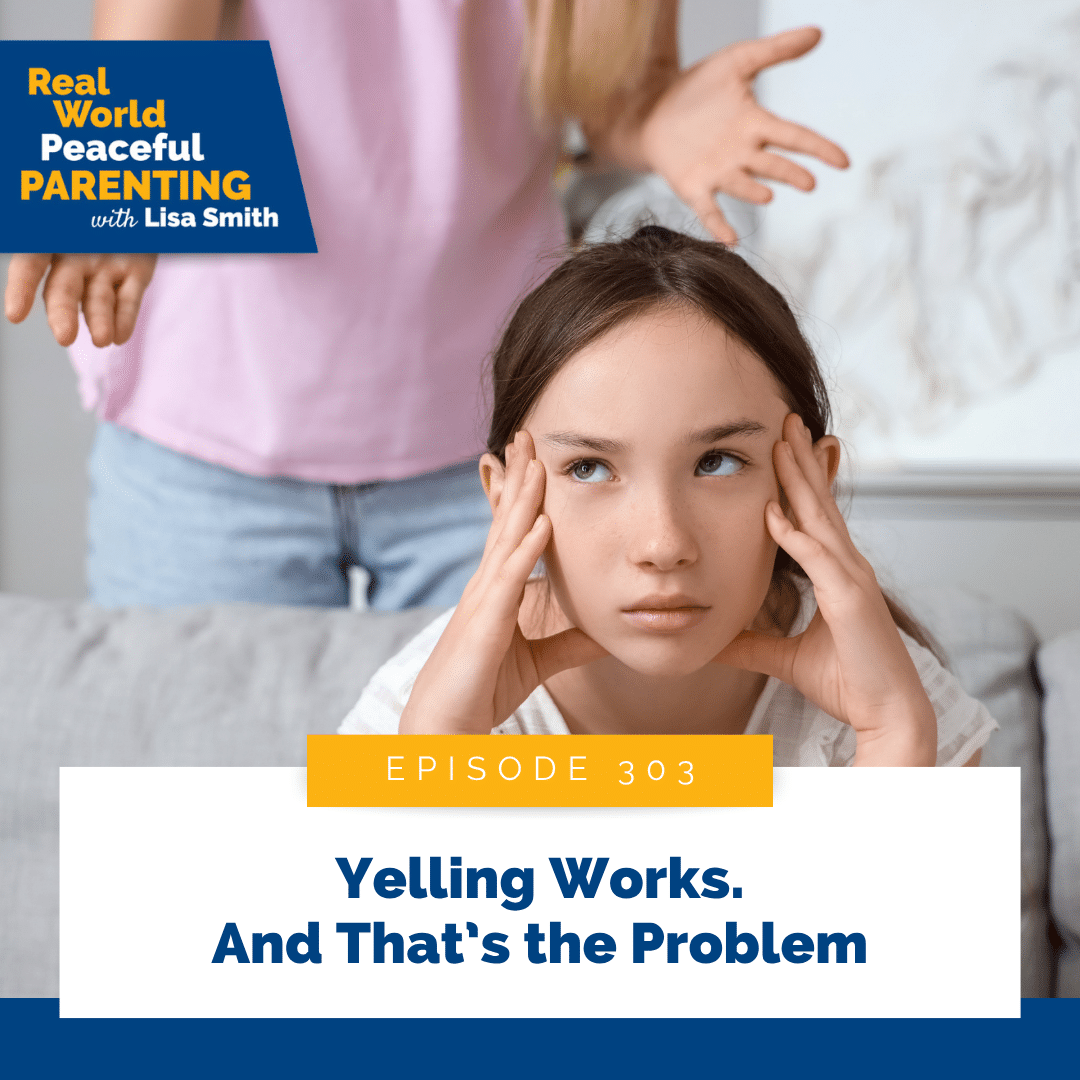
You’ve asked nicely. You’ve repeated yourself three times. You’ve tried staying calm. And then you finally yell… and suddenly your kid listens.
So yelling works, right?
Well, not so fast.
In this episode of Real World Peaceful Parenting, I’m challenging one of the biggest beliefs that keeps parents stuck in the yelling cycle: that our kids have to feel bad in order to learn their lesson.
I’ll share why immediate compliance isn’t the same as real learning, how yelling can accidentally become your kid’s starting gun, and why measuring your parenting success by how upset your kid looks is keeping you focused on the wrong thing.
I’m also opening up about my own experience using anger to parent Malcolm, the patterns I had to unlearn, and the three shifts that helped me move from trying to control behavior to actually teaching the skills my kid needed.
Because your kid doesn’t have to feel worse to learn to do better. And you don’t have to be frightening to be a strong, confident leader.
Sign up for my free Peaceful Parenting mini-course! You’ll find everything you need to get started on the path to peaceful parenting just waiting for you right here!
What You’ll Learn from this Episode:
- Why yelling can feel like it’s working when it actually reinforces the wrong pattern, teaching your kid to wait until you’re furious before responding.
- The difference between immediate compliance and long-term learning, and why stopping a behavior doesn’t necessarily teach your kid what to do differently next time.
- Why your kid doesn’t need to suffer to learn a lesson, and how tears, silence, or a forced apology aren’t reliable measures of genuine remorse or accountability.
- How your own anger can accidentally become your parenting strategy, and what Lisa learned from recognizing and changing this pattern in her relationship with Malcolm.
- How to hold firm boundaries and require accountability without shame, fear, or punishment, using the calm leadership sequence of regulating, co-regulating, holding the limit, and teaching.
- Three practical shifts to break the yelling-and-punishment cycle: redefine what “working” means, stop measuring success by your kid’s suffering, and recognize when your anger is trying to take charge.
Listen to the Full Episode:
Featured on the Show:
-
- Click here to sign up for my free Peaceful Parenting mini-course! You’ll find everything you need to continue on the path to peaceful parenting over there just waiting for you.
- Send us an email!
- Message me on Instagram and tell me how you felt after 10 minutes of undivided attention with your child.
- Click here to join The Hive!
- Peace & Quiet: The Crash Course For Peacefully Parenting Your Strong-Willed Kids
Full Episode Transcript:

Let’s dive in.
Welcome, welcome, welcome Welcome to today’s episode. I’m excited to be with you here today. I’m fighting a little bit of a cold, so hopefully my voice will hang in there throughout the whole episode. So if I sound different today with an even deeper voice, that’s why. I hope you’re doing well and staying flu and cold-free this winter season.
Now, as we dig in to today’s episode, I want you to picture something. Let’s say you’ve asked your kid to get off the phone once, twice, three times. You’re trying to make some dinner, somebody needs a ride, there are dishes everywhere, and your kid is still scrolling. You ask again. Nothing. Then finally, your voice gets loud, like really, really loud, and suddenly the phone goes down.
Or maybe your younger kid is chasing their sibling, and you’ve been trying to separate them for the last 10 minutes, and so you shout, “Stop!” And they stop. And you think, “See? This is what works. This is what works. I’ve tried being calm. I’ve tried asking nicely, and nobody listens until I yell.” Have you ever had that thought?
I know I certainly used to all the time, and today I want to challenge it, because there’s a difference between something that stops the behavior and something that teaches your kid what to do better next time. A lot of things can stop a behavior in the moment, a lot. Yelling certainly can. Threatening can.
Spanking can sometimes produce immediate obedience, too. Not a fan of that at all, but it can produce immediate obedience. That’s part of why these approaches persist. But today I’m asking you to look beyond the next 30 seconds and ask yourself, what did your kid actually learn, and what are they going to do when you’re not standing there?
In our last episode, we talked about the difference between teaching and making a kid pay, and today we’re gonna go a layer deeper, because I want you to consider a belief that might be living in your brain without even knowing it’s there, and it might be this: “My kid needs to feel bad in order to learn.”
Well, my friend, your kid does not have to feel worse to learn to do better, and let’s talk about why. I want to be very fair to every exhausted parent listening. I understand why yelling feels effective. I get it. When your kid finally moves after you raise your voice, that’s an immediate result. You got loud for action, and you got action, and in a busy household and a busy life, that can feel like a win, but I want you to think about what’s happening.
If your kid has learned, “I don’t really need to respond until my parent sounds furious,” you’ve accidentally made yelling the starting gun. Your calm voice becomes background noise, and your urgent voice becomes the signal to begin, and now you have a loop. You ask calmly, nothing happens. You repeat yourself, nothing happens.
You get louder. And your kid responds, and your brain says, “Great, we found the thing that works.” And the next time you’re under pressure, your brain reaches for the same thing, the yelling, and maybe even a little faster. Now, notice that I said your brain, because this isn’t just about your kid’s behavior.
It’s about what gets reinforced in us as parents. We get immediate relief when the situation stops. The house gets quieter. The phone gets put away. The shoes are on. And our nervous systems love relief, so we start confusing relief with effective parenting. Now, does every kid respond to yelling the same way?
Of course not. Some comply. Some shut down. Some fight back and get louder themselves. And for some kids, the behavior actually intensifies. The truth is there’s no universal response to yelling. But even when yelling does get a kid to comply, compliance tells you what happened in the moment. It does not tell you what grew inside that kid.
Did they learn to manage disappointment? Did they learn to tell the truth? Did they learn to resolve conflict? Did they learn how to pause before acting? Maybe those lessons happened somewhere along the way, but yelling alone doesn’t create them or guarantee them. So I want us to change the question.
Instead of did it work, I want us to ask, what did it work for? Did it get the phone put away? Sure. But did it develop the judgment and self-regulation I want my kid to carry into adulthood? That’s a much bigger and much more important question. Here’s the belief I really want to get underneath. I hear variations of it all the time, and it’s, “Lisa, if the consequence doesn’t hurt, how will he learn?
If she’s not upset, she obviously doesn’t care. If he’s laughing five minutes later, I must have gone too easy on him.” I want you to hear that again. We start measuring the success of our parenting by how bad our kids feel. We look for tears, silence, a long face, some visible sign that the punishment landed.
And if we don’t see it, we think we need to turn up the volume. But being miserable is not, not, not, not the same thing as learning. Crying isn’t proof of empathy. Silence isn’t proof of respect. A kid saying, “I’m sorry,” while terrified isn’t proof that they understand the impact of what happened. Maybe the kid is sorry.
Maybe they’re embarrassed. Maybe they’re genuinely remorseful. Those feelings can be meaningful. I’m not saying we should rescue our kids from every uncomfortable emotion. Absolutely not. If a teenager breaks a friend’s trust and feels awful about it, that feeling might be an important part of owning the mistake.
In making the repair. The difference is between allowing a feeling and deliberately creating pain to force a lesson. We do not need to manufacture suffering. We do not need to make our kids feel small or ashamed to make the behavior matter. Think of an adult you deeply respect, maybe a boss or a mentor, and you make a mistake at work, a big one.
Who helps you learn more? The person who humiliates you in front of everyone and says, “I hope that hurt enough that you’ll never do it again,” or the person who says, “This mattered. Let’s own what happened, fix what we can, and figure out how to prevent it from happening next time.” Both might leave you uncomfortable.
Both require accountability, but only one makes your pain the point. And let me add one more important thing. A kid who doesn’t show remorse in the way you expect isn’t necessarily indifferent. Some k- some kids laugh when they’re anxious. Some get defensive. Some go quiet Some need time before they can talk honestly.
We’re looking for responsibility over time, not a performance of regret on demand. I want to share something from a coaching conversation that’s stayed with me for a while now. I’ve changed the names and relationships and several details to protect the family’s privacy. This situation involves a strong-willed kid with big emotions.
One day, something didn’t go the kid’s way, and a meltdown followed. The adult responsible for the kid became furious, and instead of helping the kid settle down, the adult grabbed the kid roughly by the arm and pulled them out of the situation. The behavior needed attention, absolutely, but now there were two people overwhelmed by big feelings, the kid and the adult.
Picture the moment. The kid is upset and acting out. The adult is angry and wants the behavior to stop immediately. And maybe the rough response does stop the behavior in the moment, but what did the kid actually learn? Did they learn what to do when frustration takes over? Did they learn how to calm down or ask for help or handle disappointment?
Or did they learn to be afraid of the adult’s anger? This was the problem we were looking at in coaching. This wasn’t about a grown-up who didn’t care. It was about a grown-up who was worried about the behavior and wanted to raise a responsible kid, but was using anger to drive the response, and that’s a very different thing from teaching.
In this coaching conversation, I said something I want to say to you today. It’s okay to be angry. Anger is a feeling. You don’t have to pretend to be delighted when your kid does something dangerous or disrespectful, but anger doesn’t have to be the thing that parents your kid. That was the shift we were talking about.
Can the adult pause long enough to choose what needs to happen rather than use force of the anger to make something happen? Can we protect people, hold a limit, and still come back to the question of what are we trying to teach? Now, that coaching conversation didn’t end with the magical report that every hard moment disappeared.
That’s not real life. But it named a pattern that matters, and naming the pattern gives a parent a chance to interrupt it. And there’s a reason I talk so directly to you about this. I recognize that pattern because I used to live in it. When Malcolm was very young, in those first several years of parenting, I often used my anger to parent him.
I wish I could tell you that I naturally knew how to stay steady and teach, but the truth is, I didn’t. I had no idea what it looked like. He would do something or not do something that made me furious, and I would feel almost entitled to use the anger. I remember that feeling of, “You made me this upset, and now you’re gonna get it.”
It’s hard to admit, but I like to be transparent with you. I wasn’t thinking those exact words every single time, but that was the energy underneath my reaction. I believed, at that time, because the behavior was wrong, that the intensity of my response was justified. I thought my anger proved how serious I was, and sometimes I got the immediate result I wanted.
The behavior stopped. But here’s what I had to come to terms with. My anger was not a parenting strategy. It was information about what was happening inside me. And when I used my anger as the engine for punishment, I wasn’t showing or teaching Malcolm how to manage big emotions. I was showing him what it looked like when the biggest person in the room let their anger take the wheel.
That was uncomfortable for me to recognize, very uncomfortable, because I loved my kid fiercely, still do, and I was trying so hard to do a good job as a parent. My intentions were there. I wanted to be a good parent, and at the same time, I was repeating the very pattern I’d been raised in. This was the old way of parenting that had been modeled for me over and over and over again.
When a kid misbehaved, the parent got angry, and that anger became the punishment. And I was doing the same thing with Malcolm back then. The pattern didn’t just need to change. I needed to be the one to break it. I had to learn how to feel angry without using anger as a weapon. I had to learn that I could hold a limit without raising the emotional temperature.
I could be serious without being scary. I could correct a behavior without making him pay for having upset me. You feel me? Light bulb going on, maybe, just a bit? And listen, this did not happen overnight. Breaking the cycle did not happen overnight. I had to practice it a lot. I got it wrong. I repaired. I practiced again.
And that’s why I have so much compassion- For parents who tell me, “Lisa, I don’t want to yell, but in the moment, it just happens.” I get it. I get it. But I also want you to know that the pattern can change, and it starts with you. So let me be clear, I’m not asking you, nor are you required to never feel anger again.
I mean, that’s impossible. What I am asking you to do is become responsible for what you do with your anger, and that, my real-world peaceful parent, is the work. That’s the work. Now, let’s look at this from your kid’s point of view. Imagine a little kid who grabs a toy from their sibling and then gets threatened with a harsh punishment, and they give it back.
They give the toy back. Great. But what have they learned? But have they learned to wait? Have they learned how to ask? Have they learned how to tolerate hearing no? No, the toy is returned, but the skill of waiting and asking and tolerating no was not worked on. All that was offered was the threat of a harsh punishment.
Imagine your 12-year-old has a sharp, disrespectful tone, and you shout louder than they do over them to stop being disrespectful You may have stopped the words, but have they learned how to disagree with someone respectfully while they’re frustrated? Have they learned to slow down before speaking?
Probably not. They’ve learned that the loudest voice in the room wins. Or imagine your 16-year-old breaks an agreement about where they’re going, and you respond with a threat that terrifies them, and they promise never to do it again. Maybe they’re sincere because they’re scared. They don’t want the threat to be enforced.
But do they understand how to weigh risk, how to handle peer pressure, how to reach out when they need help, how to take responsibility when they’ve made a choice? Probably not. What they’re focused on is not having the threat come to life. And here’s what makes this so important. We’re not gonna be standing next to them forever.
We can’t yell from across town when they’re at a party. We can’t threaten them into integrity when they’re making decisions at work as an adult. We can’t follow them into every friendship, romantic relationship, classroom, or job. This is why I care so much about the long game. I don’t want to raise a kid who’s only cooperative when an authority figure is furious, and I don’t want you to either.
I want for you to raise a kid who’s learning to hear their own inner voice, who understands what matters, to think through an impulse, to take responsibility even when nobody’s watching. I also want to be precise about spanking. Physical punishment is not just another form of speaking firmly. Research has associated spanking with an increased risk of negative emotional and behavioral outcomes, and professional pediatric guidance recommends against it.
The fact that some kids stop what they’re doing when they’re hit is not a defense of hitting. It tells us that physical force can interrupt behavior, but it does not establish that in a healthy way that teaches. We can make this distinction without declaring that every parent who’s ever spanked or yelled at their kid has ruined their kid.
That’s not true, and it doesn’t help What helps is recognizing the cost, taking responsibility, and choosing another way forward. And remember this, just because your kid stops a behavior doesn’t mean they’ve learned how to handle the situation differently next time. Let me say that again. Just because your kid stops a behavior doesn’t mean that they’ve learned how to handle the situation differently next time.
So what can we do with all this? I want to give you three shifts you can practice. Not five, not 15, but three. First, change your definition of working. When your kid complies, especially after you’ve yelled, pause and ask yourself, “What happened here?” You may have gotten the task done. That’s real, but don’t automatically give the method full credit for teaching the deeper skill.
Ask, “What would I want my kid to be able to do next time differently without my anger?” That’s the target. Second, take suffering off the scoreboard. Stop using how upset your kid looks as the measure of whether the lesson landed. Maybe they cry, maybe they don’t. Maybe they apologize quickly, maybe they need time.
Instead, watch for something more meaningful. Can they name what happened? Can they hear the impact? Can they take responsibility? Can they make repair? Can they try a different response the next time? Those signs are imperfect, but they’re far more useful than, “Did I make them feel bad enough?” And third, interpret the moment when your anger wants to become the discipline.
You might notice your shoulders tightening, your face getting hot, or the thought, “That’s it. Now they’re gonna pay.” That’s your cue not to give in, not to ignore the behavior, but to pause. If safety is at stake, intervene immediately as calmly as you can. Protect everyone and hold the limit. But then when you’re able to think clearly, decide what teaching and repair are needed.
This is your calm leadership sequence in real life. Regulate, co-regulate with your kid, hold the limit, and then teach the lesson. Now, sometimes we can move through these steps quickly. Sometimes teaching happens hours later. But the point is your anger isn’t in charge and doesn’t get to make the whole plan.
So here’s one place I want us to be especially careful. You might hear all of this and think, “So I shouldn’t give consequences?” That is not at all what I’m saying. Limits and accountability still matters enormously. We’re gonna spend time going deep into consequences on the next episode, because it’s a subject parents deserve real clarity about.
But for today, I just want you to stop treating pain as the evidence that you’ve done your job. And I want to leave you with a picture of an adult, and I want to leave you today with a picture of the adult your kid is becoming. One day they’re going to disappoint somebody. They’re gonna get something wrong.
They might forget a commitment. They might be severely late for something. They might say something hurtful, overspend, lose their temper, or make a choice they wish they could take back, because they’re human just like us. And in that moment, what do you want them to have inside themselves? A panicked fear that someone bigger is gonna make them suffer, or the ability to pause, recognize what happened, care about the impact, own the mistake, and figure out their next move.
That ability doesn’t appear because we’ve made mistakes painful. It grows through modeling, connection, limits, honest conversations, opportunities to repair, and practice. Lots and lots of practice. Your kid doesn’t have to feel worse to learn to do better, and you don’t have to be frightening to be a strong leader.
In fact, some of the best leaders I know are quiet and calm and direct. I bet you know some too. Here’s your homework. The next time you get quick compliance after your voice gets loud, don’t just ask whether the behavior stopped. Ask yourself, “What did my kid actually learn in this moment?” Yeah? Yeah. And one more thing, when you feel that surge of anger, see if you can catch it before it starts running the show and doing the parenting for you.
I want that for you, and I want that for your kids. Until next time, I’m wishing you peaceful parenting.
Thanks for listening to Real World Peaceful Parenting. If you want more info on how you can transform your parenting, visit thepeacefulparent.com. See you soon.
Enjoy the Show?
-
-
- Don’t miss an episode, follow the podcast on Spotify, Apple Podcasts, or RSS.
- Leave me a review in Apple Podcasts.
-