
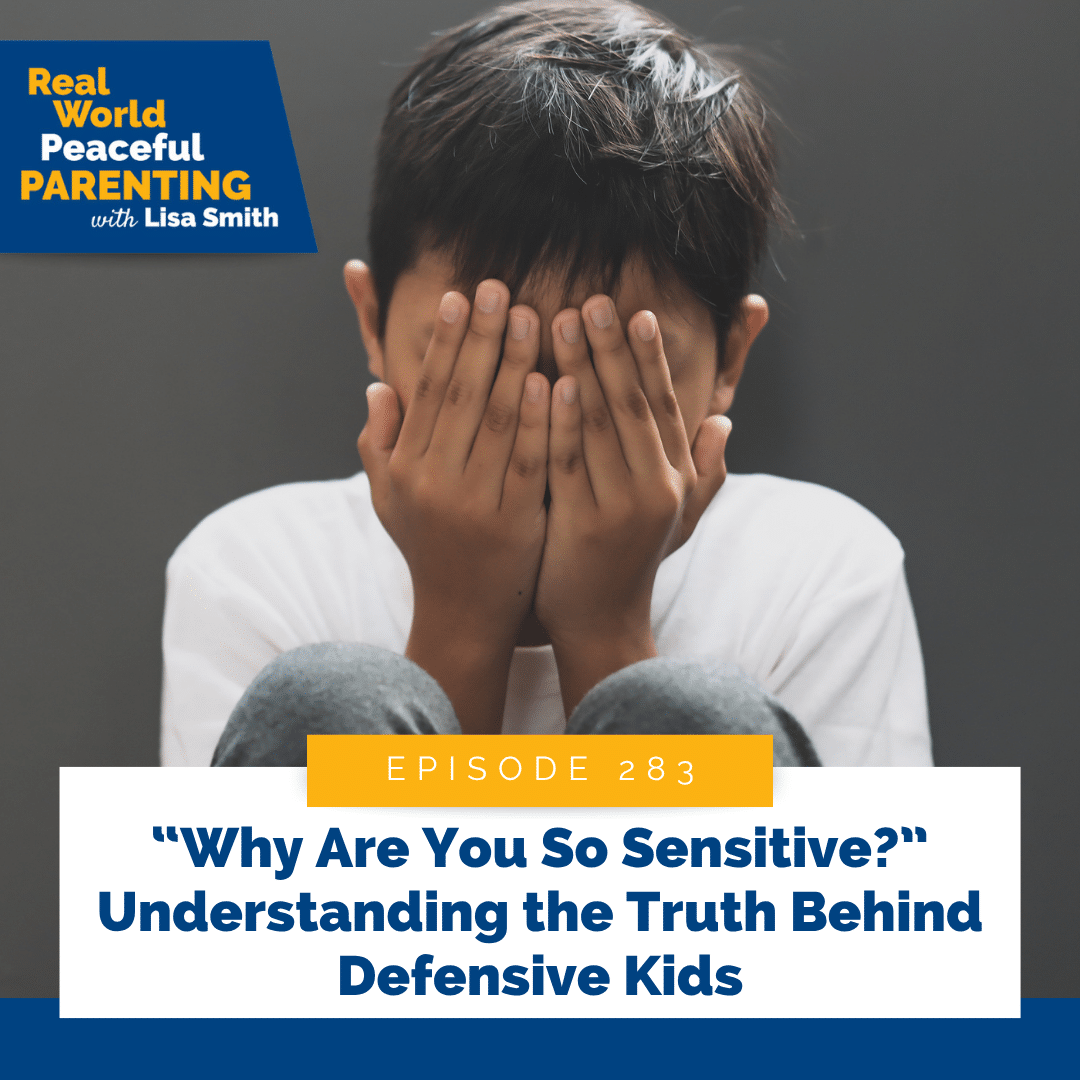
In this deeply powerful episode of Real World Peaceful Parenting, Lisa Smith unpacks one of the most misunderstood behaviors in strong-willed kids: defensiveness. If your kid explodes, argues, shuts down, or spirals the moment they’re corrected, this episode will completely shift how you see what’s happening underneath the behavior.
Lisa explains why so much of what looks like defiance is actually shame management and how many kids secretly carry the belief that mistakes make them “bad” or “too much.” She also explores how our own childhood experiences shape the way we respond to our kids’ mistakes and why belonging and connection must stay secure — even while holding limits and accountability. This episode is emotional, eye-opening, and packed with the kind of perspective shift that changes families from the inside out.
Sign up for my free Peaceful Parenting mini-course! You’ll find everything you need to get started on the path to peaceful parenting just waiting for you right here!
What You’ll Learn from this Episode:
- Why many strong-willed kids react defensively to even gentle correction
- The hidden shame and fear that often lives underneath “defiant” behavior
- How correction can accidentally feel emotionally unsafe to kids
- The difference between unconditional worth and unconditional acceptance of behavior
- How your own childhood blueprint may still be shaping your parenting reactions today
- A powerful new way to approach correction that preserves connection while still holding boundaries
Listen to the Full Episode:
Featured on the Show:
-
- Click here to sign up for my free Peaceful Parenting mini-course! You’ll find everything you need to continue on the path to peaceful parenting over there just waiting for you.
- Send us an email!
- Message me on Instagram and tell me how you felt after 10 minutes of undivided attention with your child.
- Click here to join The Hive!
- Peace & Quiet: The Crash Course For Peacefully Parenting Your Strong-Willed Kids
Full Episode Transcript:

Welcome to Real World Peaceful Parenting, a podcast for parents that are tired of yelling, threatening, and punishing their kids. Join mom and master certified parent coach, Lisa Smith, as she gives you actionable step-by-step strategies that’ll help you transform your household from chaos to cooperation.
Let’s dive in.
Welcome, welcome, welcome Welcome to today’s episode. I am honored today to be with you, and today’s episode might be one of the most important things that I’ve ever said on this podcast, and I know that’s a strong statement, but I really believe it. I wanna start with a moment, a very ordinary moment, that I’m guessing has happened in your house more times than you can count.
You correct your kid, maybe it’s calmly, maybe it’s reasonably, maybe you’re even through it before you’ve said it, and what comes back at you is completely out of proportion to what just happened. They argue, they explode, they shut down, they get so defensive so fast that you’re standing there genuinely baffled because you barely said anything.
It was a small thing, a normal thing, and somehow it’s turned into a full-scale emotional emergency. Been there? Yeah, me too. And the story most parents tell themselves in that moment is some version of, “Why are you so sensitive? Why does my kid make everything such a big deal? Why can’t they just hear a correction without completely losing it?”
Well, today I wanna offer you a different story, a truer story, one that is going to change how you see that moment, and I’ll be honest with you, it might change how you see yourself, too. So if you’re ready, let’s dive in. Okay. As you know, I work with parents of strong-willed kids, and the words I hear most often that the parents use to describe their kid is some version of this list: defiant, explosive, reactive, defensive, and often impossible to correct.
And those descriptions are not wrong. That behavior is real. The explosions are real. The walls go up the second you try to redirect or correct. Those are real. But here’s what I wanna offer you today. What if, what if, what if the behavior isn’t the thing? What if what you’re watching, the defiance, the explosiveness, the chronic defensiveness, is actually a response to something happening underneath, something the child never had words for, or in many cases, has never even consciously thought?
And here’s what I know from over 18 years of working with these kids and their families, a lot, a lot of what looks like defiance is actually shame management. Not manipulation, not control-seeking, not disrespect, but protection. Your kid has learned through experience, through repetition, through hundreds of small moments that they may not even remember, that correction is dangerous to them.
Not physically dangerous. I’m not saying you’re being physically dangerous in any way, so don’t hear that But because of how they’re hardwired, the current correction style feels emotionally dangerous. That when they get something wrong, something between them and you shifts. The tone shifts, the energy in the room changes.
And even if it’s subtle, even if you think you’re handling it well, and you, you may well be, it’s their nervous system that has been keeping score. So now even a gentle correction can feel like a threat to them. They aren’t necessarily reacting to that moment. They’re reacting to what the moment means emotionally, and they are doing the only thing they know how to do with that feeling.
They’re immediately defending against it. They aren’t being difficult, they’re being defensive. And I wanna go a little deeper here because I think this is the piece that most parents have never named clearly. Underneath the armor, underneath the explosiveness and the arguing and the walls, many strong-willed kids are carrying a belief.
They’ve never said it out loud. They probably couldn’t even articulate it if you asked, depending on their age, but it’s there running quietly in the background of everything they do, and it sounds something like this I disappoint everyone. I never get it right. I’m too much. If I mess up, it’s because I’m the problem.
And when a child or a kid or a human actually is carrying that belief, consciously or not, every correction becomes a confirmation. Every redirect feels like more evidence. Every, “That’s not how we do it,” lands not as information, but as verdict. Now, here’s what makes this especially important for parents of strong-willed kids specifically.
Strong-willed kids do not respond to shame the same way non-strong-willed kids do. Compliant kids often collapse inward. They become perfectionists, people pleasers, overthinkers, worriers. They work very hard to be what everyone needs them to be, so the threat never comes. Strong-willed kids go outward.
Their armor looks like attitude. It looks like arguing, aggression, chronic defensiveness, refusing correction, emotional explosions. It looks like a kid who can’t handle being told no, who makes everything a fight. But both responses are actually asking the same question, “Am I still safe with you when I’m struggling?
Do I still belong when I get it wrong?” The behavior isn’t the problem. The belief underneath the behavior is the problem, and here’s the distinction I think is the most important thing I’m gonna say today. A kid who feels secure in their worth can tolerate correction. A kid who is drowning in shame experiences correction as confirmation that they are fundamentally bad, and that is an enormous difference, and it changes everything about how we respond.
Before I go any further, I wanna address something directly because You might be thinking right now, “Lisa, this sounds like you’re telling me to just accept everything my kid does. No correction, no consequences, no accountability. Just validate them until they feel good about themselves and hope for the best.”
Okay, I hear you that that might be where your brain went, but I 1000% promise you that is not what I’m saying, not even close. And I wanna be really clear about this because I think it’s one of those places where peaceful parenting gets misunderstood. Unconditional worth is not the same as unconditional acceptance of behavior.
Here’s the difference. Unconditional acceptance of behavior says, “Everything you do is okay.” Unconditional worth says, “You are okay even when what you did is not.” And those are radically different things, and your kid needs to feel the difference between those two. And what I’m talking about today in this episode is holding two things at the same time, the limit and the love, the correction and the connection.
What you did was not okay, and you are okay. And here’s what’s beneath the research and my years of working with families consistently shows. Children handle accountability better when belonging feels secure, not because limits disappear, but because when a child knows their place in the family is not at stake, they don’t have to spend their energy defending it.
They can actually hear the correction. They can actually take in the lesson. They can actually grow from the mistake because they’re not fighting for their survival at the same time. Belonging is not a reward for good behavior. It is the ground everything else grows from. Does that make sense? Okay, I wanna take us somewhere in this next section that I don’t take lightly, and I wanna do it with a lot of care because I think this is the part of the episode that has the most potential to land deeply and the most potential to sting if I don’t handle it gently.
So I want you to take a breath with me before we go here, and I wanna ask you something, and I want you to sit with it with honesty, without judgment. When you were growing up, when you made a mistake, when you disappointed someone, when you failed at something or got something wrong, what happened? Did the emotional temperature in the room change?
Did affection become a little harder to find or maybe taken away completely? Did someone go quiet in a way that felt like rejection and punishment? Did you get the same sense, even if nothing was said directly, that you were more lovable when you were easy, more acceptable when you were impressive, more worthy of connection when you were compliant or convenient?
For many of us, and I mean many because I hear this over and over and over from the parents I work with, the answer is yes I was a member of this as well. We grew up in environments where belonging felt conditional, where love was present and warm when we were performing well, and love was cooler or quieter or harder to access when we weren’t performing well.
I mean, nobody said, “I love you less when you fail,” but the emotional experience communicated it anyway. And here’s where this becomes so important for the conversation we’re having today. We parent from our blueprint until we don’t. Not because we’re bad parents, not because we haven’t read the books or listened to the podcasts or tried to do it differently, but because the nervous system learns what it lives.
And what it lived for many of us, again, myself included, was that love had an edge of conditionality to it. So even without realizing it, in our own parenting, oftentimes our tone shifts when our kids disappoint us. We withdraw a little when we’re frustrated. We get cool or quiet or sharp in a way that communicates, “Your mistake has changed something between us.”
And again, it’s not because we mean to, but because that is the blueprint we were handed. Many of us were only emotionally safe when we were good girls or good boys or convenient or good or quiet or compliant. And again, we’re parenting from that blueprint. And I wanna say, if that just landed something tender for you, it’s okay.
That is actually exactly right because this is where change starts. Not in guilt, not in shame, but in seeing it. You cannot change a pattern that you cannot see. And once we see it, we can’t unsee it, yeah? Now, today I wanna share a story with you about Dan. Dan joined the Hive at the end of his rope with his 10-year-old son, Tyler.
On our first call, he jumped in and asked for coaching, and he described Tyler as the most defensive kid he had ever met. Any correction, no matter how calm, no matter how reasonable, would turn into a war. Tyler would argue, deny, deflect, and eventually explode. And Dan, who genuinely tried to stay calm, would eventually lose it, too, and then they’d both be in it.
Dan told me, “Lisa, I don’t even try to correct him anymore because it’s just not worth the fight.” And he was so upset when he said this, and I totally understood where he was coming from. I said, “Dan, I hear that, and I want you to sit with something. What do you think it means to Tyler when you stop trying?”
He was quiet. For a long moment, and then he said, “I bet he thinks it means I’ve given up on him.” And there it was. Tyler’s explosiveness had trained Dan, created the pattern, and had trained Dan to back off. And Tyler, who desperately needed to know that he was safe even when he got it wrong, was interpreting the silence as confirmation of his worst belief about himself, that he wasn’t worth it and that Dan had given up on him.
So as we worked together, Dan was able to understand what was underneath Tyler’s armor That Tyler wasn’t fighting him, Tyler was fighting the shame, the belief that every mistake was proof of something permanent about who he was. So Dan started doing something very small. Before any correction, before jumping straight into the correction, which he admitted he had been doing in the past, he started saying, “Hey, I need to talk to you about something, Tyler, and I want you to know before I say it, nothing about this conversation changes how I feel about you.
I love you, and I think you’re amazing.” Now, the first time Dan said it, Tyler looked at him like he had three heads. The second time Dan ran through it, Tyler got a little quieter, and the third time he did it, something shifted. Tyler was strong-willed. He pushed back for sure, because that was the pattern, but the armor was softer because Dan had started answering the question Tyler had never been able to ask out loud, “Am I safe with you and loved by you even when I get it wrong?”
And Dan started communicating that answer up front as yes, and Tyler was finally able to start believing it. And today, Tyler’s able to be corrected, to get feedback without shame and without armor. Occasionally, he still pushes back, but it’s in a whole different tone and approach. I want that for you, and I want that for your kids.
And I wanna close today’s episode with something I really need you to hear. The goal is not raising a kid who never makes mistakes. The goal is raising a kid who knows that mistakes do not threaten connection, a kid who can fail without collapsing into shame, a kid who can be corrected without feeling rejected, a kid who doesn’t need perfection to feel worthy of love.
These are the goals, and they’re not soft goals. This is not permissive parenting. This is the most important thing you can give your kids, an unshakable knowledge that they belong to you no matter what, that your love is not a performance review, that they do not have to earn their place in this family every single day.
And here’s the thing I want you to hold as we close. This work is not just for your kid. It’s for you, too, because somewhere along the way, many of us learned to believe the same thing our kids believe, that mistakes threaten belonging, that failure threatens love, that we have to earn our place in the rooms we’re in, and we’re still carrying that.
Yeah? Yeah. I’ve worked hard on this over the years, and I believe that I’m worthy… Because I breathe, and I want that for you, and I want that for your kids. Now, I don’t normally do this, but I want to let you know that next week in episode 284, I’m going to get very practical with you because I know that understanding is only half of it.
You have a strong-willed kid who needs correction, and we still have to hold limits and consequences. That’s our job as parents. We’re not here to become permissive. So next week in episode 284, I’m going to show you exactly how to do that without triggering shame, without withdrawing belonging, and without losing the connection you’re working so hard to build.
But this week, before we get practical, I want to give you one thing to sit with. This week, when your child reacts in a way that feels out of proportion, when the armor goes up and the walls come down, I want you to get curious instead of reactive. Just for a moment, ask yourself quietly, “What might they be protecting themselves from right now?
What is the belief underneath this behavior?” You don’t have to fix it in that moment. Just see it, because when we can begin to see the shame underneath the defiance, it changes how we respond as the parent. And I want to invite you to come find me this week on Instagram at The Peaceful Parent and send me a message.
Tell me what landed for you in today’s episode, because I have a feeling this one is going to bring up a lot, and I want to be there for that with you, for you. And if you want to do this work in a community of parents who get it, with live coaching and real support from me for your real family, then this is your invitation to come join us inside the Hive at thehivecoaching.com.
I would love to work with you there. I want this for you, and I want this for your family. And until next time, I’m wishing you peaceful parenting. Thanks for listening to Real World Peaceful Parenting. If you want more info on how you can transform your parenting, visit thepeacefulparent.com. See you soon.
Enjoy the Show?
-
-
- Don’t miss an episode, follow the podcast on Spotify, Apple Podcasts, or RSS.
- Leave me a review in Apple Podcasts.
-