
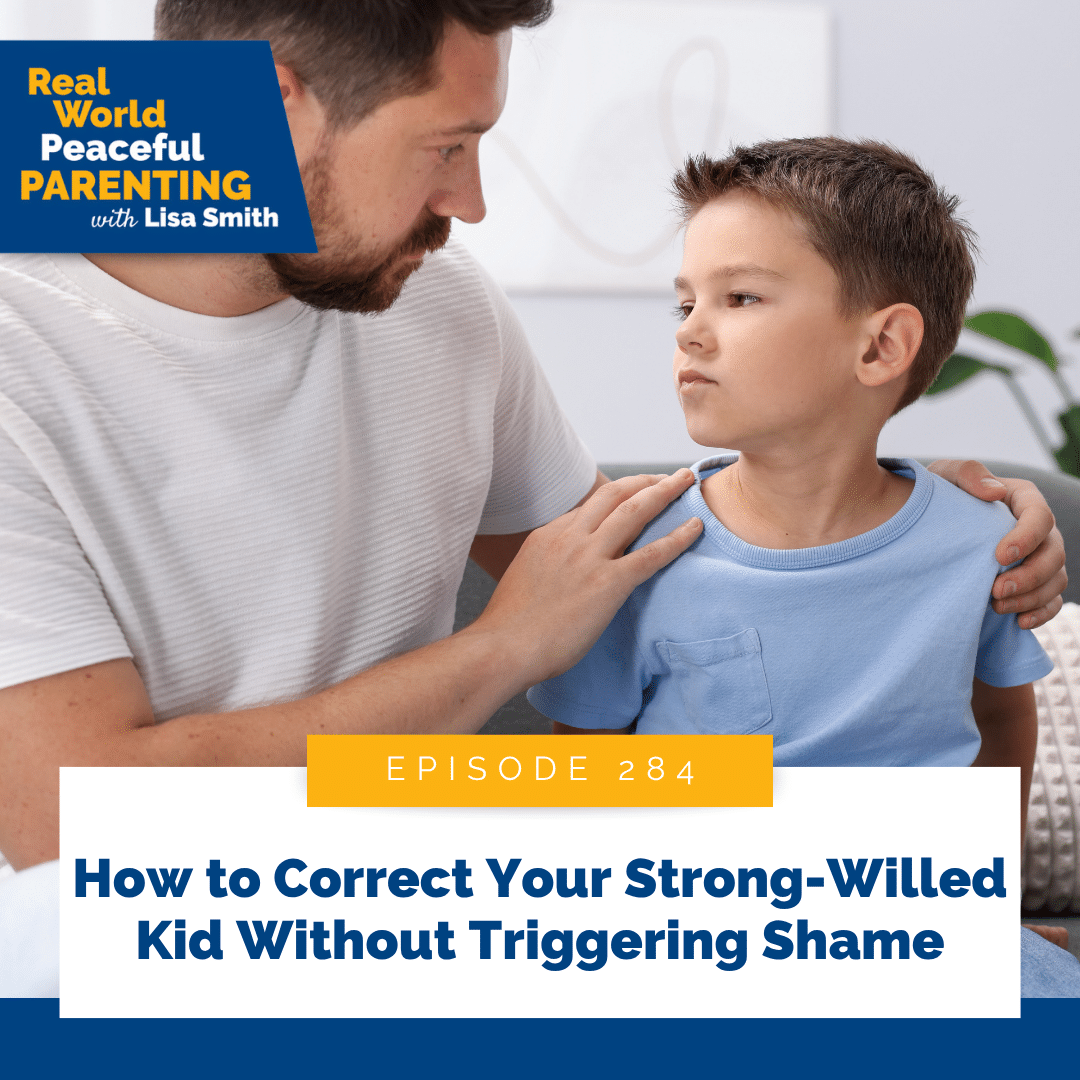
In this powerful follow-up episode of Real World Peaceful Parenting, Lisa Smith gets practical about one of the biggest parenting challenges: how to correct your strong-willed kid without triggering shame, defensiveness, or emotional explosions.
After last week’s conversation about how so much “defiant” behavior is actually shame management, Lisa walks parents through exactly how to hold limits, consequences, and accountability while still protecting connection and belonging. She explains why many common correction patterns accidentally fuel shame, how to separate behavior from your kid’s worth, and why regulated, short, connection-based correction is far more effective than long lectures and emotional withdrawal.
If you’ve ever wondered how to hold boundaries without becoming permissive — or how to correct your kid without damaging your relationship — this episode is a game changer.
Sign up for my free Peaceful Parenting mini-course! You’ll find everything you need to get started on the path to peaceful parenting just waiting for you right here!
What You’ll Learn from this Episode:
- Why shame-filled correction makes strong-willed kids more defensive and reactive
- The difference between correcting behavior and attacking your kid’s identity
- How your tone, body language, and emotional state impact correction moments
- Why shorter corrections are often far more effective than long lectures
- What a “belonging anchor” is and how it helps kids feel safe during correction
- Why repair and reconnection after hard moments are essential for long-term trust and emotional security
Listen to the Full Episode:
Featured on the Show:
-
- Click here to sign up for my free Peaceful Parenting mini-course! You’ll find everything you need to continue on the path to peaceful parenting over there just waiting for you.
- Send us an email!
- Message me on Instagram and tell me how you felt after 10 minutes of undivided attention with your child.
- Click here to join The Hive!
- Peace & Quiet: The Crash Course For Peacefully Parenting Your Strong-Willed Kids
Full Episode Transcript:

Welcome to Real World Peaceful Parenting, a podcast for parents that are tired of yelling, threatening, and punishing their kids. Join mom and master certified parent coach, Lisa Smith, as she gives you actionable step-by-step strategies that’ll help you transform your household from chaos to cooperation.
Let’s dive in
Welcome, welcome, welcome Welcome to today’s episode. I am really fired up to be with you today because this is the episode I know you’ve been waiting for. Last week, I told you something that I hope landed in a really deep place for you in the best of ways. I told you a lot of what looks like defiance is actually shame management, that most likely your strong-willed kid isn’t being difficult, they’re being defensive, that underneath the armor is a kid asking one question over and over and over again, “Am I still safe and loved by you even when I get it wrong?”
And I know some of you heard that and felt something shift. I got a lot of messages in my Instagram account. Maybe you got a little teary. Maybe you thought about your own childhood. Maybe you looked at your kid differently for the rest of the week. I hope that landed for you. But then Monday morning came, and the homework wasn’t done, and you went to address it, and your kid’s attitude showed up, and the limit needed to be held, and you thought, “Okay, Lisa, that’s beautiful, but my kids still need to do their homework, and they need to stop hitting their sister, and they need to get off gaming when I ask, and they need to get in the car.
So what do I actually do with all this?” Well, that’s what today’s episode is all about. Today, we get practical because unconditional worth without real-world application is just a nice idea, and if you know me at all, you know I’m not in the business of nice ideas. I’m here to actually help you and change the world one family at a time.
So if you’re ready, I’m ready. Let’s dive in. Before I give you the tools, and I promise I will give them to you today, I need to address something head-on because if I don’t, everything I’m about to say is gonna get filtered through a lens that will make it harder to use. A lot of times when parents hear unconditional worth, when they hear your child’s belonging is never up for debate, the fear that shows up almost immediately is this, “Okay, Lisa, does that mean no consequences?
Does that mean no limits? Does that mean I just validate everything and let them burn the house down while I talk about feelings?” I hear this a lot, and I want to answer it as clearly as I possibly can. No, that is not what it means. No, absolutely not, not one bit. Unconditional worth and firm limits are not opposites.
They are not in tension with each other. In fact, and this is the thing I really want you to hear, limits delivered without shame are actually more effective than limits delivered with it, and here’s why. When a kid is defending against shame, their nervous system is in protection mode, and they can’t hear the lesson because all they’re focused on is fighting for their emotional survival.
Your correction bounces off their armor of defensiveness and nothing gets in. And then you’re left wondering why nothing you say ever seems to land. Makes sense, right? You can see it But when a kid feels safe, a kid whose belonging is, does not feel like it’s at stake in that moment of correction, that kid can actually receive what you’re saying.
They can actually take in the feedback. They can sit with the consequence, even if they don’t like it, without it becoming a war. The goal is not to make correction feel good. The goal is to make correction feel safe, and those are two different things. And once you understand the difference, everything changes on how you deliver the limits.
Make sense? Okay. I wanna do something next that I think is gonna be really valuable and maybe a little uncomfortable. I wanna help you recognize the patterns you might be running without even realizing it because here’s the thing, most shame-loaded correction doesn’t look like cruelty. It doesn’t look like abuse.
It doesn’t look like anything most parents would even recognize as harmful. Shame-loaded correction might look like a tone that carries a little more disappointment than necessary. It might look like bringing up the last three times your kid made the same mistake in the middle of correcting this one.
It might look like a lecture that goes on and on and on, well beyond what’s needed, but you keep going because you need them to understand. It might look like a comparison, “Your sister never does this. When I was your age, I would have never spoken to my mother that way.” It might look like correcting your child in front of fill in the blank, their siblings, their friends, their grandparents, a coach, when it could have waited for a private moment.
It might look like emotional withdrawal after a mistake, going quiet, going cool, the relationship feeling different for the rest of the day because of something that happened that morning. It might look like connecting their behavior to their character, “You’re so irresponsible. You’re so selfish. Why are you always like this?”
And I totally get it. None of these come from a bad place. Most parents do them because it was what was modeled for you when you were a kid or because you’re dysregulated, and you don’t have access to anything better in the moment or because you genuinely believe your kid needs to feel the weight of what they did in order to learn from it.
But if you have a strong-willed, defensive kid, here’s what each of those patterns communicates underneath the words. “Your mistake, kid, has changed how I, the parent, see you.” And this is the message that builds the armor. This is the message that turns correction into confirmation for your kid. This is the message that makes a strong-willed kid fight harder.
shut down deeper or explode louder every single time you try to guide them. Does this make sense? Can you see it? Okay, here’s where I wanna get into the actual tools, and I wanna walk through these slowly because I think the specifics matter. The first and most important shift is for you to separate the behavior from your kid’s worth every single time without exception.
Not, “You are irresponsible,” instead, I want you to say, “That choice wasn’t responsible.” Not, “Why are you like this?” but, “This behavior needs to change.” Not, “I can’t believe you did this,” instead, you’re gonna go to, “That’s not okay, and I know you can do better.” The behavior gets corrected, the child doesn’t get indicted.
Okay? So we’re gonna separate the behavior from the kid’s worth. The second shift is this: You cannot deliver a shame-free correction from inside a dysregulated nervous system. This is where your own emotional leadership matters more than anything else. If you come into correction hot, if you’re frustrated, depleted, embarrassed, or triggered, the shame will leak through even if you say all the right words.
Your tone will carry it Your body language will carry it. Your kid’s nervous system will pick it up before you’ve even finished the first sentence. I promise you. Been there, done that. Now, let me be clear, this is not about being perfect. This is about being regulated enough, and if you’re not there yet, if the moment got away from you, and you’re already in it, the most powerful thing you can do is pause.
Even 30 seconds, even three deep breaths, even walking out of the room and coming right back. Because a regulated parent changes the entire emotional atmosphere of a correction. And my third tool for you is to keep it short. Keep it short. The longer the lecture, the more shame accumulates. I know it doesn’t feel that way.
It feels more like the more you explain, the more they’ll understand. The light bulb will go on. The more you justify, the more they’ll get it. But what’s actually happening is that every additional sentence adds weight, and at some point, your kid stops hearing the content and just starts feeling the experience of being talked at, of being wrong, of disappointing you again.
Say what needs to be said, say it once, and then stop. And then the fourth shift, return to connection after correction. Don’t let the correction be the last thing that happens between you two. After the limit is held, and after the consequence is delivered, and after the short and sweet conversation is done, come back, not to rehash, not to add in one more thing, but to just emphasize the connection in the relationship.
One hand on the shoulder, sitting next to them quietly. A simple I love you when things have settled. Correction is a moment. Connection is the container it lives in. Let me say that again. Correction is a moment. Connection is the container it lives in. I wanna give you one specific tool that I use with families inside the hive all the time, and I call it the belonging anchor.
A belonging anchor is a simple, direct statement you make before or after a correction, and honestly, sometimes both, that expli- explicitly separates the behavior from the relationship. It removes the threat of shame before the conversation even begins, and it sounds like this, “I need to talk to you about something, and I want you to know before I say anything, nothing about this conversation changes how I feel about you.”
So that’s one example. Another belonging anchor might be, “I’m upset about what happened. I love you no matter what.” No but in between. You can throw in an and, “I’m upset about what happened, and I love you no matter what.” Here’s another belonging anchor you can choose: You made a mistake. That doesn’t make you a mistake.
You can also choose what you did wasn’t okay, but you are more than okay. Now, I wanna be really clear about what this is and what it isn’t. This is not a softening technique. This is not a way of letting your kid off the hook. You still hold the limit. The consequence still happens. The behavior gets addressed.
You are the peaceful leader within the home with the fully developed brain. The behavior still gets addressed. What changes is the emotional safety of the container that it’s delivered in, and this Real World Peaceful Parent is especially powerful for your strong-willed kid, the one who goes outward, who argues and fights and explodes at the first sign of correction.
The belonging anchor takes the fight out of the room before it starts because the thing that they were preparing to defend against, the threat to their belonging, has been explicitly removed by you. They don’t have to fight for their place. You just told them that it’s not at risk, that they belong and are loved no matter what.
And as I stated earlier, when your kid doesn’t have to fight for their survival, they can actually hear you. This is science, by the way, proven. Try it this week, even once, even if it feels awkward, even if your kid looks at you like you’ve grown a second head because I promise you, their n- nervous system heard it, even if their face didn’t show it.
I promise There is one more thing I wanna talk about before we get to today’s example or story, and it might be the most underused tool in your home, and it’s repair. After the hard moment, after the correction, after the consequence, after the meltdown, the conversation that got heated, connection needs to be explicitly restored, not assumed, not hoped for, explicitly, deliberately restored.
And I wanna say this again because I think it’s important. You cannot assume that because the moment is over, your kid feels okay. Strong-willed kids, in particular, carry the emotional residue of the harder moments longer than we realize. They might look fine outwardly. They might have moved on behaviorally, but somewhere in their nervous system, the question is still lingering: Are we okay?
Do I still belong? And do you love me even though I messed up? And repair is how you answer that for them. It doesn’t have to be a long conversation. It doesn’t have to revisit what happened. It can be as simple as sitting down next to them a little while later, asking if they want a snack, putting a hand on their back, saying, “I love you,” quietly when you pass them in the hallway.
What you’re communicating in that moment is this. Even after the worst moments, I come back to you. You’re not too much for me. You do not lose me when you struggle. And over time, over dozens and then hundreds of repair, your kid starts to build something they’ve never had before, and it’s a felt sense that the relationship between you and them is resilient, that hard moments don’t break it, the correction doesn’t mean rejection, and this is the foundation that changes everything.
Repair is not weakness. Repair is the proof of everything you’ve been telling them, that you love them no matter what. I wanna share a story with you from one of our Hive families. Today’s story is about a mom named Nicole who joined the Hive frustrated and honestly a little hopeless about her 11-year-old daughter, Ava.
Ava was the kid who could not handle correction. She could not handle any feedback, any redirection, any consequence, no matter how calmly it was delivered. Every conversation would turn into an explosion or a shutdown or days of emotional distance between Nicole and Ava. Nicole is probably like many.
Nicole had read the books. She’d tried staying calm. She thought she did a pretty good job staying calm. She tried being consistent. She tried natural consequences. Nothing worked, and she was starting to wonder if something was fundamentally wrong with Ava or with her. As we started working together, one thing became very clear.
Nicole was doing something that she never thought is harmful, and frankly, it was how she was parented. Every time she corrected Ava, she did it thoroughly, thoroughly. She explained the problem. She explained why it was a problem. She connected it to the previous times the same thing had happened. Her goal was to make sure that Ava completely understood the full weight of the issue.
Now, Nicole was doing this from love, and I totally understand it. She genuinely wanted Ava to learn, but what Ava was experiencing every single time was an indictment. Correction felt like a trial or a case being built against her. So the first thing we worked on was the belonging anchor. Nicole started leading every correction with a simple statement, “I love you, and this doesn’t change that, and we need to talk about something.”
The first time Nicole said it to Ava, Ava looked at her with genuine suspicion, like she was waiting for the catch, and there was no catch. The second thing we worked on was length. Nicole started saying what needed to be said once and stopping, even when she wasn’t sure it landed, even when every instinct told her to add one more thing, to provide more evidence, to connect it to previous episodes.
She really committed to this And she stopped adding the one more thing. She started saying what needed to be said once, and that was it. And the third thing, the one that Nicole later told me was the most surprising, was the repair. After hard moments, she started coming back, not to lecture again and talk about what happened, just to be near Ava, to sit with her, snuggle with her, let her body communicate what words sometimes couldn’t.
“I’m here, and we’re okay.” About six weeks in, something happened that Nicole told me and all the Hive members about with tears in her eyes. Ava came to her one day on her own without being asked after making a mistake at school. She sat down next to Nicole and said, “Mom, something happened today, and I need to tell you about it.”
Ava had never done that before, not once. In fact, she went out of her way to avoid telling Nicole about things or hiding things from her. Ava was able to come to Nicole and say, “Something happened today, and I wanna tell you about it Because she started to trust that the truth wouldn’t cost her her relationship with her mom.
And this, my friend, is what becomes possible when correction feels safe. I want that for you, and I want that for your kids because that changes your relationship with your kid and makes the world a better place. In closing, I want to bring last week’s episode and this episode home together. Last week, I told you that your kid’s defiance is often protection against shame, that underneath the armor is a kid asking whether they are still safe with you when they struggle, when they make a mistake, when they mess up, when they lose it.
This week, I tried to give you the tools to answer that question with your actions, not just your words. Use the belonging anchor so your kid knows before the correction even starts that their place in the family is secure and that they’re loved no matter what. Use shame-free language so the behavior gets addressed without the child getting indicted.
Use short, regulated correction so the lesson has a chance to land. And then return to connection so correction is never the last thing that happens between the two of you. And when needed, repair so your kid learns over time that hard moments don’t break the relationship. They never did, and they never will.
These two things together, understanding the why and having the how, is what changes the relationship between you and your kids. Not overnight, not perfectly, but steadily, one correction moment at a time. This week, your homework is simple. Pick one correction moment and try two things. Lead with a belonging anchor and return to connection after, just once after the correction, and notice what’s different.
Just notice. And I want to invite you to come over on Instagram to The Space Peaceful Space Parent and send me a message. Tell me what you tried. Tell me what shifted because these messages genuinely make my week, and I want to hear from you. I want to know that this is landing for you. And if you want to take this work deeper, get more hands-on support with live coaching from me, a community of parents who get it, and real support for your real family, then this is your invitation to come join us inside the hive at thehivecoaching.com.
I would love to work with you there. I’m so excited to see how this changes the connection with your kids as they begin to drop their armor and feel totally safe in the moment of correction. Again, I want this for you, and I want this for your kids. And until next time, I’m wishing you peaceful parenting.
Thanks for listening to Real World Peaceful Parenting. If you want more info on how you can transform your parenting, visit thepeacefulparent.com. See you soon.
Enjoy the Show?
-
-
- Don’t miss an episode, follow the podcast on Spotify, Apple Podcasts, or RSS.
- Leave me a review in Apple Podcasts.
-